
One of the biggest marketing myths is:
“The more people we target, the more customers we’ll get.”
It sounds logical.
If your message appeals to everyone, surely you’ll attract more buyers.
But in reality, the opposite is often true.
The brands that grow the fastest are usually the ones that understand exactly who they’re talking to and who they’re not.
That’s why successful companies invest heavily in customer segmentation strategy instead of broadcasting the same message to everyone.
Because modern consumers expect relevance.
And relevance only happens when brands understand their audience.
In 2026, generic marketing is becoming less effective, while personalized and targeted communication is becoming a competitive advantage.
The Problem With Marketing to Everyone
Imagine a business trying to sell:
- students,
- working professionals,
- business owners,
- parents,
- retirees,
using the exact same message.
What happens?
The message becomes so broad that nobody feels it’s meant for them.
This is one of the most common branding mistakes.
When brands try to speak to everyone, they often connect with no one.
Why Customers Respond to Relevance
Consumers are exposed to thousands of marketing messages every day.
Their brains quickly filter information by asking:
- Is this relevant to me?
- Does this solve my problem?
- Does this fit my situation?
If the answer is no, they move on.
This is why target audience marketing matters.
People pay attention when they feel understood.
What Is Customer Segmentation?
Customer segmentation strategy is the process of dividing a larger audience into smaller groups based on shared characteristics.
These characteristics may include:
- demographics,
- interests,
- behaviors,
- buying habits,
- goals,
- challenges,
- location.
Instead of treating everyone the same, businesses communicate differently with each segment.
This creates more relevant marketing.
Why Segmentation Works Better Than Mass Marketing
Let’s compare two approaches.
Mass Marketing
Message:
“Our product is great for everyone.”
Segmented Marketing
Message:
“This solution helps small business owners generate more leads without increasing ad spend.”
Which message feels more relevant?
The second one.
Because specificity creates connection.
And connection drives action.
The Psychology Behind Audience Segmentation
People naturally pay attention to things that feel personally relevant.
This is why audience segmentation works so effectively.
When customers see messaging that reflects:
- their challenges,
- their goals,
- their lifestyle,
- their needs,
they feel understood.
That emotional recognition increases engagement and trust.
One Product Can Serve Multiple Audiences
Many businesses assume segmentation only matters when selling multiple products.
Not true.
A single product can appeal to different groups for different reasons.
For example, a project management software might attract:
Small Business Owners
Interested in:
- efficiency,
- productivity,
- team management.
Freelancers
Interested in:
- organization,
- client tracking,
- workflow management.
Enterprise Teams
Interested in:
- collaboration,
- reporting,
- scalability.
The product remains the same.
The messaging changes.
Why Smart Brands Change the Message, Not the Product
One of the biggest lessons in modern marketing:
You don’t always need different products.
You often need different communication.
A strong brand communication strategy adapts messaging to different audience segments while maintaining a consistent brand identity.
The brand stays recognizable.
The message becomes more relevant.
The Role of Brand Positioning
Segmentation and positioning work together.
Brand positioning strategy answers:
“What do we want to be known for?”
Segmentation answers:
“Who are we communicating that to?”
Without segmentation, positioning becomes weaker because the message lacks focus.
Common Ways Businesses Segment Customers
There are several effective segmentation approaches.
1. Demographic Segmentation
Based on:
- age,
- gender,
- income,
- occupation,
- education.
Example:
Luxury brands often target higher-income audiences differently than mass-market brands.
2. Geographic Segmentation
Based on location.
Examples:
- cities,
- regions,
- countries,
- climate zones.
This is especially important for regional campaigns and local businesses.
3. Behavioral Segmentation
Based on customer actions.
Examples:
- purchase history,
- browsing behavior,
- loyalty levels,
- product usage.
Behavior often reveals intent more accurately than demographics.
4. Psychographic Segmentation
Based on:
- values,
- lifestyle,
- attitudes,
- interests.
This approach helps brands create stronger emotional connections.
Market Segmentation Examples in Action
Let’s look at some practical market segmentation examples.
Fitness Brand
Beginners want:
- simple workouts,
- motivation,
- guidance.
Advanced athletes want:
- performance optimization,
- advanced techniques,
- competitive insights.
The same brand communicates differently to each audience.
E-Commerce Brand
First-time visitors need:
- trust-building,
- product education.
Repeat customers need:
- loyalty rewards,
- exclusive offers.
Again, the audience changes.
The communication changes.
Why Personalized Marketing Performs Better
Consumers increasingly expect personalized experiences.
A strong personalized marketing strategy can improve:
- engagement,
- click-through rates,
- conversions,
- customer satisfaction.
Why?
Because people respond better when content feels tailored to their situation.
The Cost of Ignoring Segmentation
Businesses that ignore segmentation often experience:
- lower engagement,
- weaker conversions,
- higher acquisition costs,
- inconsistent messaging.
Their marketing becomes less efficient because every message is trying to serve too many audiences simultaneously.
Customer Targeting Creates Better Marketing ROI
One major benefit of customer targeting is efficiency.
Instead of spending resources communicating with everyone, businesses focus on the people most likely to respond.
This often leads to:
- higher conversion rates,
- better campaign performance,
- stronger customer relationships.
Segmentation Helps Build Stronger Brands
Many people think segmentation is only about sales.
It’s also about branding.
When customers consistently receive relevant messaging, they develop clearer perceptions of the brand.
This strengthens:
- trust,
- preference,
- recall,
- loyalty.
Strong brands understand their audience deeply.
The Future of Marketing Is Relevance
In the past, broad marketing could work because audiences had fewer choices.
Today, consumers expect brands to understand them.
As AI and data tools improve, relevance will become even more important.
The businesses that thrive will be those that deliver the right message to the right audience at the right time.
Questions Every Business Should Ask
Before launching your next campaign, ask:
- Who is this message for?
- What problem does this audience have?
- What outcome do they want?
- How is this audience different from our other customers?
These questions lead to stronger marketing decisions.
Final Takeaway
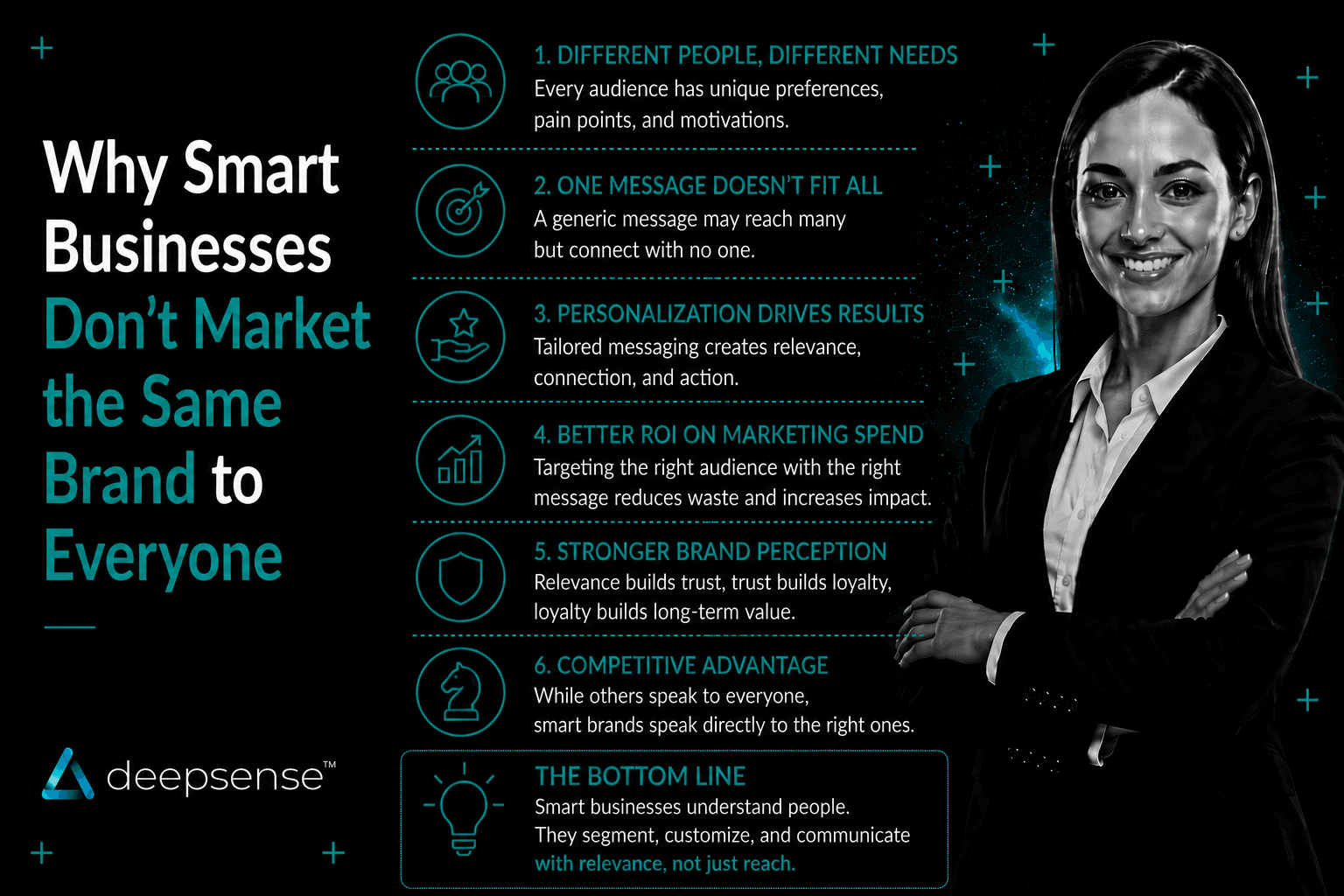
Smart businesses don’t market the same brand to everyone because customers aren’t all the same.
Different audiences have different:
goals
challenges
motivations
buying behaviors
expectations
That’s why an effective customer segmentation strategy is one of the most valuable tools in modern marketing.
The strongest brands don’t try to appeal to everyone.
They focus on understanding specific audiences and communicating in ways that feel personally relevant.
Because in today’s crowded marketplace, relevance beats reach.
And the brands that understand their audience best are often the brands that grow the fastest.
FAQs
1. What is a customer segmentation strategy?
A customer segmentation strategy is the process of dividing a broader audience into smaller groups based on demographics, behavior, interests, needs, or other characteristics to create more targeted marketing.
2. Why is audience segmentation important in marketing?
Audience segmentation helps businesses deliver more relevant messages, improve engagement, increase conversions, and strengthen customer relationships.
3. What is the difference between segmentation and targeting?
Segmentation divides audiences into groups, while targeting involves selecting which segments to focus marketing efforts on.
4. How does personalized marketing improve results?
Personalized marketing increases relevance, making customers more likely to engage, trust the brand, and take action.
5. What are some examples of market segmentation?
Common examples include demographic segmentation (age or income), geographic segmentation (location), behavioral segmentation (purchase habits), and psychographic segmentation (values and interests).
6. How does customer targeting support brand positioning?
Customer targeting ensures that a brand’s positioning is communicated effectively to the audiences most likely to value and respond to it