
Have you ever wondered:
Why does Netflix always seem to know what you’ll binge next?
Why does Amazon show products you were just thinking about?
Why does Instagram somehow keep you scrolling for hours?
That’s not luck.
It’s machine learning.
Modern digital platforms are no longer just apps or websites.
They are intelligent behavioral prediction systems designed to:
- understand your habits,
- predict your interests,
- personalize your experience,
- and maximize your attention.
This is the real power of machine learning in Netflix Amazon Instagram ecosystems.
And in 2026, these systems have become more advanced than ever.
First: What Is Machine Learning?
Before diving into platforms, let’s simplify how machine learning works.
Machine learning is a branch of AI where systems:
- analyze massive amounts of data,
- identify patterns,
- learn from behavior,
- improve predictions over time.
Instead of being manually programmed for every decision,
the system “learns” based on:
- clicks,
- watch history,
- purchases,
- likes,
- scrolling behavior,
- time spent,
- interactions.
In simple words:
machine learning studies what people do…
so platforms can predict what they’ll do next.
Why Digital Platforms Depend on Machine Learning
The internet today runs on attention.
And attention is extremely competitive.
Platforms want users to:
- stay longer,
- engage more,
- consume more content,
- make more purchases,
- return frequently.
Machine learning helps optimize all of this.
That’s why:
Netflix, Amazon, Instagram, YouTube, TikTok, Spotify
all heavily depend on AI-driven behavior prediction systems.
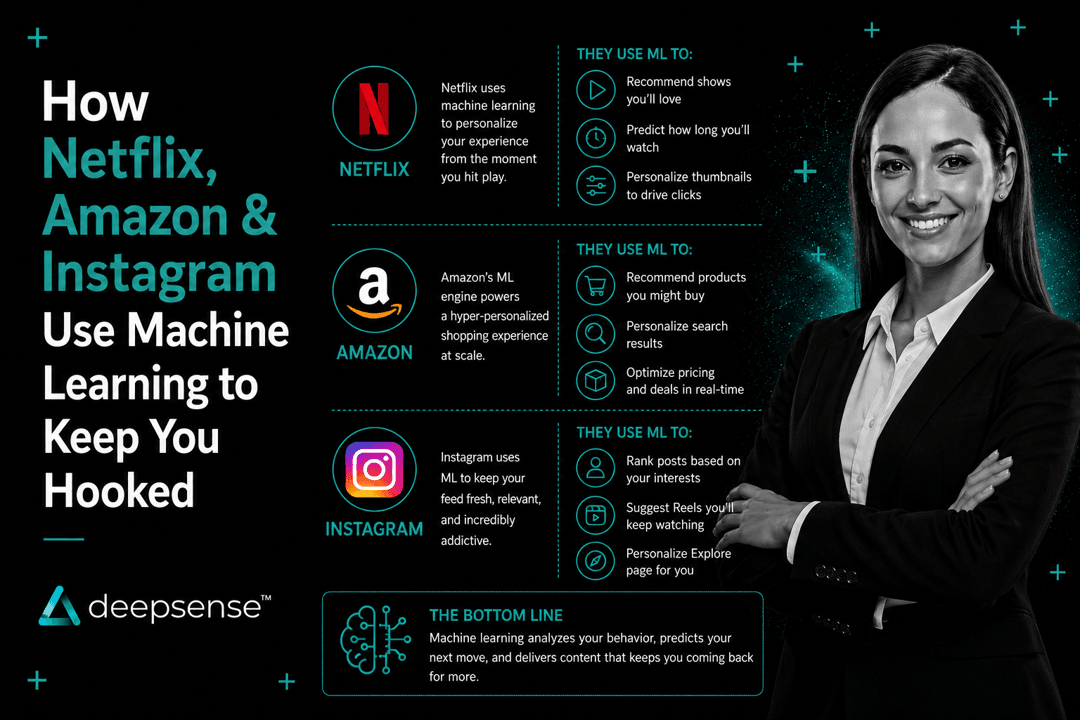
How Netflix Uses Machine Learning to Keep You Watching
Netflix is one of the most famous examples of AI-driven personalization.
Its goal is simple:
reduce the chance of you leaving the platform.
And machine learning powers nearly every part of that process.
1. Netflix Recommendation System
The Netflix recommendation system analyzes:
- what you watch,
- when you pause,
- when you stop,
- what genres you prefer,
- binge patterns,
- viewing time,
- completion rate.
Then it predicts:
what content you’re most likely to watch next.
This creates personalized:
- homepages,
- movie rows,
- recommendations,
- thumbnails.
Even two people in the same house may see completely different Netflix interfaces.
2. Personalized Thumbnails
This is fascinating.
Netflix doesn’t just recommend content.
It changes thumbnails based on what you respond to.
Example:
- If you watch romantic content → softer emotional posters
- If you watch action → intense dramatic visuals
Machine learning identifies which images increase clicks.
That’s behavioral optimization at scale.
3. Predicting User Retention
Netflix also uses machine learning to identify:
- what keeps users subscribed,
- when engagement drops,
- what content increases binge sessions.
The platform constantly adjusts recommendations to maximize retention.
How Amazon Uses Machine Learning to Influence Purchases
Amazon is not just an e-commerce platform.
It is a massive AI-driven personalization engine.
The platform studies:
- browsing behavior,
- purchase history,
- cart activity,
- wishlists,
- search patterns,
- product comparisons.
This powers the famous Amazon personalization algorithm.
1. Product Recommendations
Amazon constantly predicts:
“What is this user most likely to buy next?”
That’s why you see:
- “Recommended for you”
- “Customers also bought”
- “Inspired by your browsing history”
These recommendations are powered by AI models analyzing billions of interactions.
2. Dynamic Pricing & Shopping Behavior
Machine learning also helps Amazon understand:
- purchase urgency,
- buying habits,
- seasonal demand,
- conversion probability.
This influences:
- pricing strategies,
- promotions,
- inventory recommendations.
The platform optimizes shopping experience continuously.
3. Personalized Homepage Experience
Every Amazon homepage is different.
Machine learning decides:
- which categories appear,
- which products surface first,
- which offers are highlighted.
The goal:
increase purchase probability.
How Instagram Uses Machine Learning to Control Attention
Instagram may be one of the most aggressive examples of machine learning in daily life.
Because Instagram’s entire business model depends on:
keeping users engaged as long as possible.
That’s why understanding how Instagram algorithm works is important.
1. Feed Ranking System
Instagram’s algorithm studies:
- what you like,
- what you share,
- what you save,
- who you interact with,
- how long you watch content,
- what you skip quickly.
Then it predicts:
what content will keep you engaged longer.
This determines:
- what appears on your feed,
- what appears first,
- which creators you see more often.
2. Reels Recommendation Engine
Reels are heavily powered by AI recommendation systems.
Instagram tracks:
- watch time,
- replays,
- pauses,
- shares,
- engagement speed.
Then the algorithm amplifies content likely to:
- hold attention,
- trigger emotion,
- encourage endless scrolling.
This is core to machine learning in social media.
3. Explore Page Personalization
No two Explore pages are identical.
Instagram builds a behavioral profile for every user.
The AI predicts:
- what topics interest you,
- what aesthetics attract you,
- what content increases session time.
This creates addictive personalization loops.
The Core Goal Behind All These Platforms
Whether it’s:
- Netflix,
- Amazon,
- Instagram,
the ultimate goal is the same:
maximize user engagement.
Machine learning helps platforms answer:
- What keeps users interested?
- What increases retention?
- What triggers emotional response?
- What increases spending or watch time?
This is the intersection of:
consumer behavior and AI
Why These Algorithms Feel So Addictive
Machine learning works because human behavior is often predictable.
These platforms study:
- curiosity,
- emotional triggers,
- habit patterns,
- dopamine responses,
- reward systems.
Then algorithms optimize content delivery around those behaviors.
That’s why:
- one reel becomes twenty,
- one episode becomes a season,
- one product search becomes multiple purchases.
The Positive Side of Machine Learning
It’s important to understand:
machine learning is not inherently bad.
It improves:
- personalization,
- convenience,
- discovery,
- recommendations,
- user experience.
Without AI systems:
- Netflix suggestions would feel random,
- Amazon shopping would feel chaotic,
- Instagram feeds would feel irrelevant.
Machine learning makes digital experiences more tailored.
The Concern: Attention Economy & Behavioral Manipulation
However, there’s also growing concern.
Because platforms optimize not only for usefulness
but for:
- retention,
- addiction,
- engagement maximization.
This raises important discussions around:
- screen time,
- algorithm influence,
- digital dependency,
- mental health,
- content manipulation.
The more accurately AI predicts human behavior,
the more powerful these systems become.
The Future of Machine Learning in Digital Platforms
In 2026 and beyond, machine learning systems are becoming:
- more predictive,
- more personalized,
- more conversational,
- more emotionally responsive.
Future algorithms may understand:
- mood,
- intent,
- behavioral shifts,
- purchase readiness,
- emotional states,
more deeply than ever before.
This is the evolving future of:
machine learning in digital platforms
What Businesses Can Learn From This
Brands should study these platforms carefully.
Because the biggest lesson is not:
“Use AI.”
The lesson is:
understand behavior deeply.
The companies winning today succeed because they:
- analyze audience patterns,
- personalize experiences,
- reduce friction,
- predict intent,
- optimize engagement.
That’s modern digital growth.
Final Takeaway
Netflix, Amazon, and Instagram are no longer just content or commerce platforms.
They are AI-driven behavioral ecosystems powered by machine learning.
Their algorithms continuously learn:
- what you want,
- what you might want,
- and what keeps you engaged longest.
That’s why machine learning in Netflix Amazon Instagram feels so powerful.
Because the real product these platforms optimize is not only content or shopping.
It’s attention itself.
And in the digital age, attention has become one of the most valuable currencies in the world.
FAQs
1. How does machine learning work in Netflix, Amazon, and Instagram?
Machine learning analyzes user behavior, patterns, interactions, and preferences to personalize recommendations and improve engagement.
2. What is the Netflix recommendation system?
Netflix uses machine learning algorithms to suggest movies and shows based on watch history, viewing behavior, genres, and engagement patterns.
3. How does Instagram’s algorithm use AI?
Instagram’s AI studies likes, saves, shares, watch time, and interactions to personalize feeds, reels, and Explore page recommendations.
4. What is Amazon’s personalization algorithm?
Amazon uses AI and machine learning to recommend products, personalize shopping experiences, and predict purchasing behavior.
5. Why are AI recommendation algorithms so addictive?
They optimize content delivery around human behavior, emotional triggers, curiosity, and engagement patterns to maximize attention and retention.