
A few years ago, most SEO content followed a familiar formula.
Marketers would:
- find a keyword,
- write a blog around it,
- optimize headings,
- build backlinks,
- wait for rankings.
For a long time, that approach worked.
But search behavior is changing rapidly.
Today, people don’t search like they did in 2018.
They no longer type only short phrases like:
- “SEO tips”
- “digital marketing agency”
- “best CRM software”
Instead, they ask complete questions:
- “Why is my website getting traffic but no sales?”
- “How can a small business improve local SEO?”
- “What’s the best marketing strategy for a startup in 2026?”
At the same time, AI-powered search engines and answer engines are changing how information is discovered.
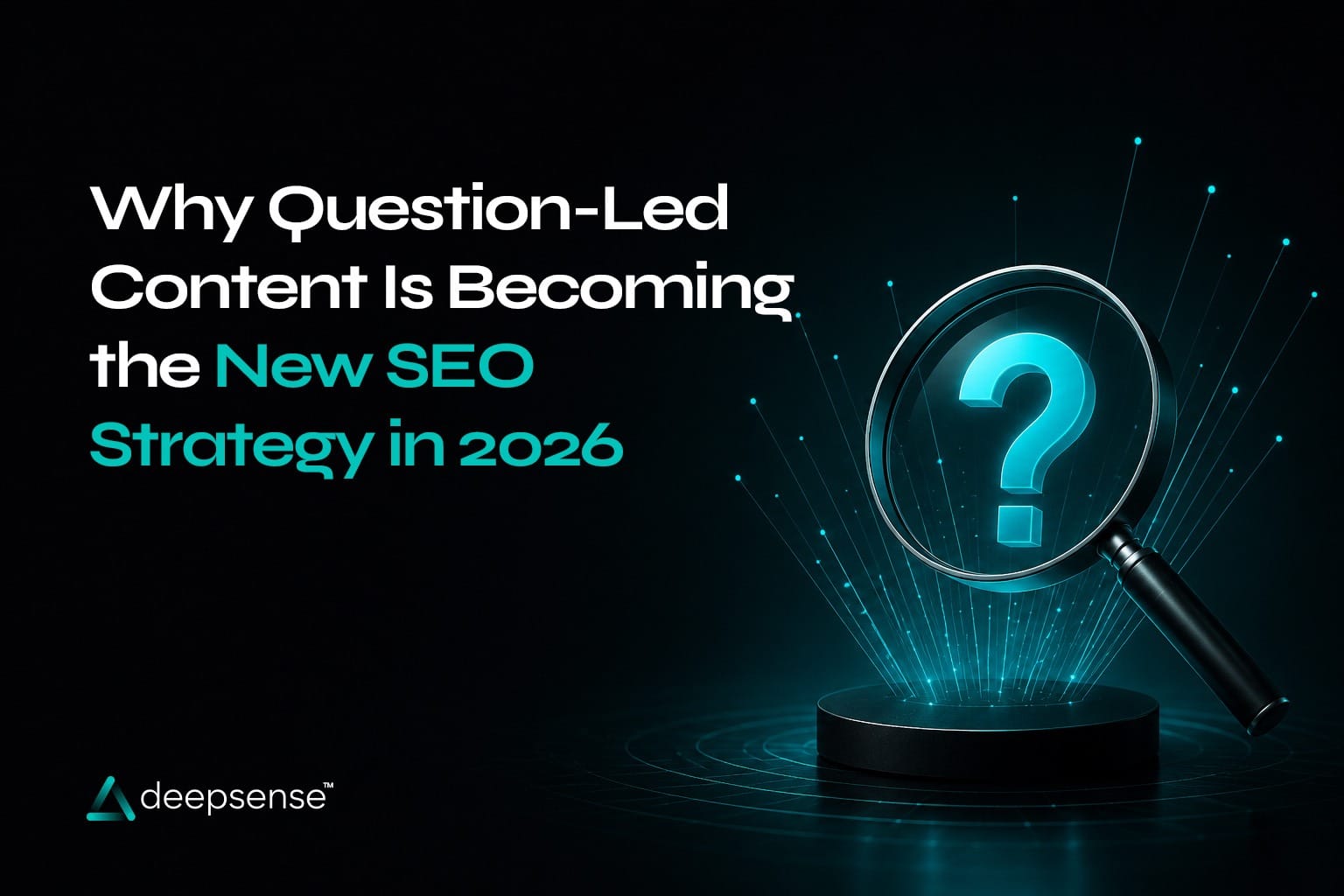
As a result, question-led content is emerging as one of the most effective content formats for SEO, GEO, AEO, and AI search visibility in 2026.
The brands that answer questions effectively are increasingly becoming the brands that get found.
The Evolution of Search Behavior
Traditional SEO was largely keyword-driven.
Users entered fragmented searches because search engines required it.
For example:
Old Search Style
“best SEO agency”
“email marketing software”
“social media strategy”
Today, users are much more conversational.
Modern Search Style
“How do I choose the best SEO agency for my business?”
“Which email marketing platform is best for startups?”
“Why isn’t my social media strategy generating leads?”
This shift is driven by:
- voice search,
- AI assistants,
- mobile usage,
- conversational interfaces.
And it has fundamentally changed content creation.
What Is Question-Led Content?
Question-led content is content structured around real questions people ask.
Instead of starting with a keyword, the content starts with a user question.
For example:
Traditional Topic:
SEO Trends 2026
Question-Led Topic:
What SEO Strategies Still Work in 2026?
Traditional Topic:
Marketing Funnel Guide
Question-Led Topic:
Why Are My Leads Dropping Out of the Funnel?
The difference may seem small.
But from a search perspective, it’s significant.
Why Search Engines Love Questions
Search engines have one primary goal:
Provide the best answer.
Modern algorithms increasingly focus on understanding:
- intent,
- context,
- meaning,
- user needs.
Questions naturally reveal intent.
For example:
A search like:
“SEO”
contains multiple possible intentions.
But:
“Why did my SEO traffic drop suddenly?”
provides clear intent.
This makes it easier for search engines and AI systems to match content with user needs.
The Rise of Answer-First Content
One of the biggest content shifts in recent years is the move toward answer-first content.
Instead of forcing users to scroll through lengthy introductions, successful content immediately addresses the question.
For example:
Question:
Why is my website traffic increasing but sales aren’t?
Answer:
Because traffic quality, user experience, offer positioning, and conversion pathways may not be aligned.
The detailed explanation follows afterward.
This structure improves:
- user experience,
- search visibility,
- AI extraction,
- answer engine performance.
How AI Search Is Changing Content Discovery
Search is no longer limited to traditional search engines.
Users increasingly interact with:
- AI assistants,
- conversational search platforms,
- answer engines,
- generative search experiences.
These systems don’t simply rank pages.
They extract answers.
This is where AI search optimization becomes important.
Content that clearly answers questions is more likely to be:
- cited,
- summarized,
- referenced,
- surfaced in AI-generated responses.
Why Question-Based Content Matches User Intent Better
One of the biggest advantages of a question-based content strategy is alignment with intent.
Every search contains a purpose.
Users may want to:
- learn,
- compare,
- solve,
- evaluate,
- purchase.
Questions reveal those intentions more clearly than keywords alone.
For example:
Informational Intent
“What is schema markup?”
Commercial Intent
“Which SEO tool is best for small businesses?”
Problem-Solving Intent
“Why isn’t my website ranking on Google?”
Each requires a different content approach.
User Intent Is Becoming More Important Than Keywords
For years, SEO focused heavily on keyword placement.
While keywords still matter, user intent SEO is becoming increasingly important.
Search engines now prioritize:
- relevance,
- usefulness,
- completeness,
- contextual understanding.
A page that perfectly answers a question often performs better than a page that simply repeats keywords.
Why Question-Led Content Works for GEO and AEO
As search evolves, businesses need to optimize for more than traditional SEO.
SEO (Search Engine Optimization)
Ranking on search engines.
AEO (Answer Engine Optimization)
Appearing as direct answers.
GEO (Generative Engine Optimization)
Being cited by AI systems.
Question-led content naturally supports all three.
Why?
Because it mirrors how users interact with modern search platforms.
Examples of High-Performing Question-Led Content
Instead of:
Generic Topic
Email Marketing Guide
Try:
Question-Led Topic
How Often Should You Send Marketing Emails in 2026?
Instead of:
Generic Topic
Branding Strategy
Try:
Question-Led Topic
Why Do Customers Choose One Brand Over Another?
Instead of:
Generic Topic
SEO Tips
Try:
Question-Led Topic
Why Is My Website Not Ranking Even After Publishing Content?
The second versions often generate stronger engagement because they align with real user curiosity.
Why Question Headlines Get More Clicks
Questions naturally trigger curiosity.
When readers see a question that reflects their problem, they feel compelled to explore the answer.
For example:
“SEO Strategy Guide”
versus
“Why Isn’t Your SEO Strategy Working?”
The second headline creates emotional relevance.
And relevance drives clicks.
How AI Tools Are Reinforcing This Trend
AI-powered search tools are trained on human conversations.
They are designed to understand:
- natural language,
- questions,
- context,
- follow-up queries.
As a result, content written in a conversational format often aligns better with AI systems.
This makes conversational search SEO increasingly valuable.
The Best Sources for Question-Led Content Ideas
Businesses don’t need to guess what people are asking.
Great questions already exist.
Look at:
Google Autocomplete
Common search suggestions.
People Also Ask
Popular related questions.
Customer Support Tickets
Real-world customer concerns.
Sales Calls
Objections and recurring questions.
Social Media Comments
Audience curiosity and frustrations.
AI Conversations
Questions users frequently ask AI assistants.
These sources reveal valuable content opportunities.
How to Structure Question-Led Content
A simple framework:
Step 1: Start With a Question
Use a real audience query.
Step 2: Answer Immediately
Provide a concise answer early.
Step 3: Expand the Explanation
Add examples, context, and insights.
Step 4: Address Related Questions
Cover connected topics and follow-up concerns.
This structure improves both user experience and search visibility.
Why Businesses Should Adopt This Strategy Now
The shift toward AI-powered search is accelerating.
Businesses that continue producing generic keyword-focused content may struggle to remain visible.
Meanwhile, brands that create:
- answer-focused content,
- intent-driven content,
- conversational content,
are better positioned for the future.
The Future of SEO Content Strategy in 2026
The future isn’t keyword-first.
It’s question-first.
People search with questions.
AI systems process questions.
Answer engines prioritize questions.
This makes SEO content strategy 2026 fundamentally different from the strategies that worked a decade ago.
Content success increasingly depends on understanding what people want to know not just which keywords they use.
Final Takeaway
The rise of question-led content reflects a simple reality:
Search is becoming more human.
Users ask questions.
AI systems answer questions.
Search engines reward useful answers.
That’s why a strong question-based content strategy is becoming essential for modern SEO.
The most successful content in 2026 won’t simply target keywords.
It will:
answer real questions
satisfy user intent
support AI search optimization
improve conversational search SEO
increase visibility across SEO, GEO, and AEO platforms
Because the future of search isn’t about ranking pages.
It’s about becoming the best answer.
FAQs
1. What is question-led content?
Question-led content is content structured around real user questions rather than focusing solely on keywords. It aims to provide direct and relevant answers.
2. Why is question-led content important for SEO in 2026?
Question-led content aligns with modern search behavior, AI search systems, answer engines, and user intent, improving visibility and engagement.
3. How does question-based content improve user intent SEO?
Questions reveal the user’s purpose more clearly, helping search engines match content with relevant search intent and improving rankings.
4. What is answer-first content?
Answer-first content provides a direct answer to a question at the beginning of an article before expanding into detailed explanations and examples.
5. How does AI search optimization relate to question-led content?
AI systems often extract and summarize answers from content. Clear question-and-answer structures improve the chances of being referenced in AI-generated results.
6. How can businesses find topics for question-led content?
Businesses can use customer FAQs, Google autocomplete, People Also Ask results, sales conversations, support queries, social media discussions, and AI search trends to discover valuable content ideas.