
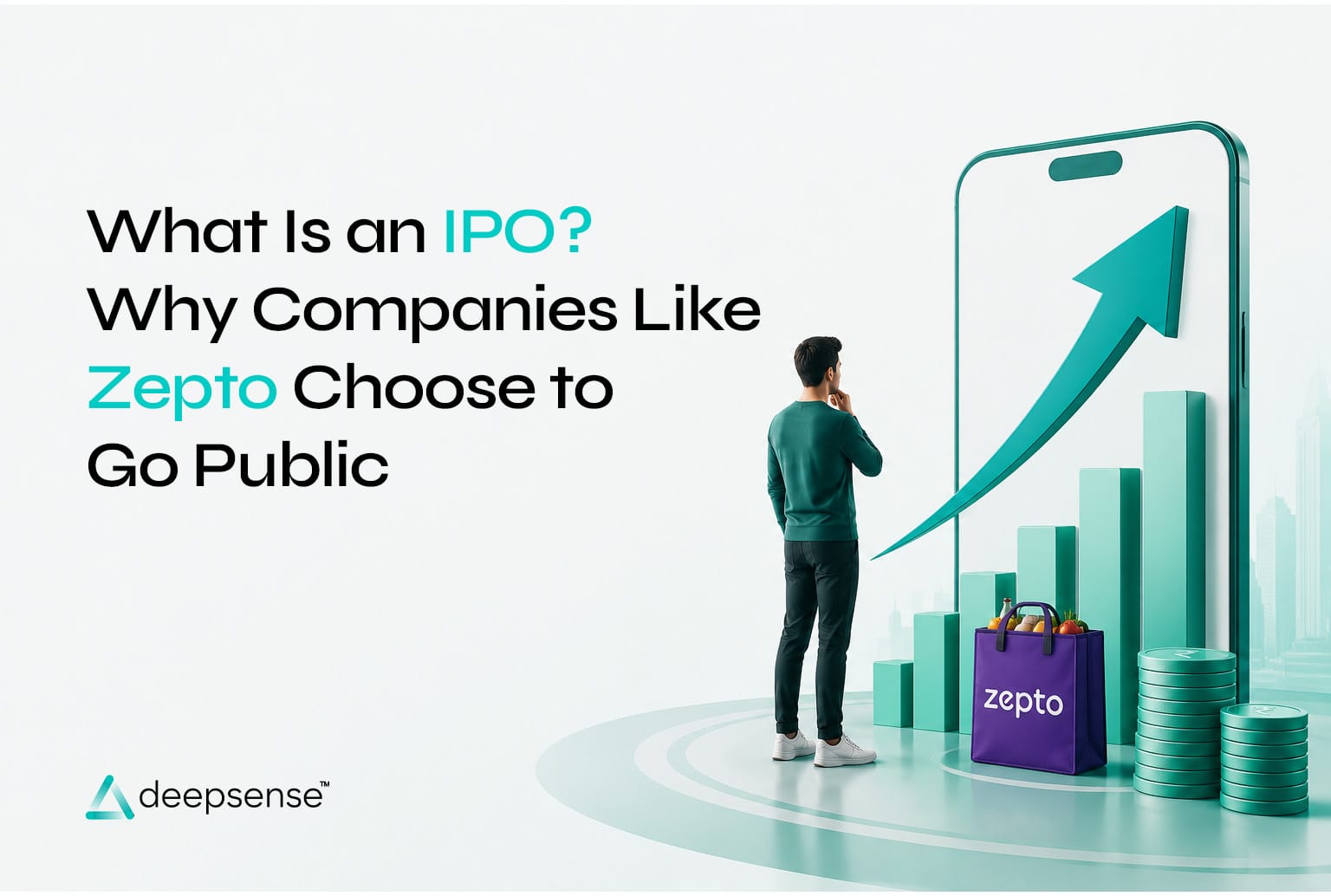
What happens when a privately owned startup decides to let the public buy a piece of the company?
That’s essentially what an IPO does.
An IPO, or Initial Public Offering, is the process through which a private company offers its shares to the public for the first time and becomes listed on a stock exchange.
For startups such as Zepto, an IPO isn’t simply about raising money. It can be a major step in the company’s growth journey bringing access to public capital, greater visibility, increased accountability, and new opportunities for expansion.
But what exactly happens during an IPO? Why would a fast-growing startup choose to go public? And what does a company’s IPO mean for its customers, investors, founders, and employees?
Let’s break it down.
What is an IPO?
An IPO stands for Initial Public Offering.
It is the process of offering shares of a privately held company to public investors for the first time.
Before an IPO, ownership is generally concentrated among:
- Founders
- Early employees
- Venture capital investors
- Private equity investors
- Other private shareholders
After an IPO, shares can be bought and sold by investors through a public stock exchange.
In simple terms:
Private company → IPO → Publicly listed company
This is why an IPO is often considered one of the biggest milestones in a company’s lifecycle.
Why do companies go public?
So, why companies go public when they can continue raising money from private investors?
The biggest reason is access to capital.
A public listing can help a company raise substantial funds to invest in:
- Business expansion
- Technology
- New markets
- Infrastructure
- Acquisitions
- Hiring
- Debt repayment
For a rapidly growing company, access to public capital can provide additional financial flexibility.
But money isn’t the only reason.
What are the benefits of an IPO?
The benefits of an IPO can extend beyond fundraising.
1. Access to larger pools of capital
Public markets can provide access to a much broader investor base.
2. Increased brand visibility
Being publicly listed can increase awareness among customers, investors, partners, and potential employees.
3. Greater credibility
Public companies operate under significant disclosure and regulatory requirements, which can increase transparency.
4. Liquidity for existing shareholders
An IPO can eventually provide founders, employees, and early investors with a mechanism to sell shares, subject to applicable restrictions.
5. Currency for acquisitions
Publicly traded shares can potentially be used as part of future acquisitions or strategic transactions.
So, an IPO can become both a funding event and a strategic milestone.
Why would a startup like Zepto consider an IPO?
The Zepto IPO story is particularly interesting because quick commerce is a capital-intensive and highly competitive industry.
A company operating in this space may need significant investment in:
- Dark stores
- Technology
- Logistics
- Supply chain
- Customer acquisition
- Geographic expansion
An IPO can potentially provide access to a larger pool of capital to support these ambitions.
But there’s another important reason.
A public listing can mark the transition from a venture-backed startup to a company accountable to public shareholders.
What is a startup IPO?
A startup IPO is essentially the same process as any other IPO, but it involves a company that has grown from a relatively young, often venture-backed business into a candidate for public markets.
Startups typically spend years raising private funding before considering an IPO.
The journey can look something like:
Idea → Seed Funding → Venture Capital → Growth → Scale → IPO
However, not every startup follows this exact path.
Some remain private for decades, while others pursue public markets much earlier.
How does the IPO process work?
So, how does the IPO process actually happen?
Although the exact process varies by country and company, it generally involves several stages.
Step 1: The company decides to go public
Management and existing investors evaluate whether the company is ready for public markets.
Step 2: Investment banks are appointed
The company typically works with investment banks that help structure and manage the offering.
Step 3: Financial and legal due diligence
The company undergoes extensive scrutiny of its finances, operations, risks, governance, and legal matters.
Step 4: Regulatory filings
The company submits the required documents to the relevant market regulator.
Step 5: Investor marketing
Management communicates the company’s business model, financial performance, opportunities, and risks to potential investors.
Step 6: Pricing
The company and its advisors determine the price at which shares will be offered.
Step 7: Shares are offered
Investors can participate in the offering according to the applicable process.
Step 8: Stock exchange listing
The company’s shares begin trading publicly.
That’s when the company officially enters the public market.
What is the difference between a public company and a private company?
The difference between a public company vs private company goes beyond whether its shares can be bought by ordinary investors.
| Private Company | Public Company |
|---|---|
| Shares aren’t generally traded on a public exchange | Shares trade on a public exchange |
| Ownership is concentrated among private investors | Ownership can be distributed among public investors |
| Less public disclosure | Greater disclosure requirements |
| Private fundraising | Can access public capital markets |
| Valuation often determined through private funding rounds | Market value changes based on public trading |
Going public therefore changes how a company is financed, governed, reported, and evaluated.
Does an IPO mean the company becomes completely owned by the public?
No.
An IPO doesn’t necessarily mean founders or existing investors give up all ownership.
A company can sell a portion of its shares to public investors while existing shareholders continue to own shares.
The exact structure depends on the offering.
This distinction is important because an IPO is not the same as selling the entire company.
How does an IPO affect startup funding?
Before going public, startups often rely heavily on private capital.
This can come from:
- Angel investors
- Venture capital firms
- Private equity
- Strategic investors
- Debt financing
An IPO introduces another potential source of capital: public investors.
That can significantly change the company’s funding landscape.
However, becoming public also brings greater scrutiny.
Investors expect companies to communicate their financial performance and business risks transparently.
Why is profitability important when a startup goes public?
Does a company need to be profitable before an IPO?
Not necessarily.
A company can potentially go public while still investing heavily for future growth, depending on market conditions, regulations, and investor appetite.
However, public investors generally pay close attention to:
- Revenue growth
- Profitability
- Cash flow
- Customer acquisition costs
- Operating expenses
- Market size
- Competitive position
For companies operating in highly competitive industries, investors may also examine whether growth can eventually translate into sustainable economics.
What does an IPO mean for a company’s founders?
For founders, an IPO can represent years of work reaching a major milestone.
It can provide:
- Increased visibility
- Greater access to capital
- Potential liquidity
- A stronger corporate profile
But it also introduces new responsibilities.
Founders and management must operate under greater public scrutiny and meet ongoing reporting and governance requirements.
The company is no longer accountable only to private investors.
Public shareholders now have a stake in its future.
What does an IPO mean for employees?
For employees who hold equity or stock options, an IPO can potentially create a path toward liquidity.
But the value of those shares isn’t guaranteed.
The eventual value depends on factors such as:
- IPO pricing
- Market performance
- Company performance
- Lock-up restrictions
- Future share-price movements
So an IPO can create opportunities, but it doesn’t automatically make every employee wealthy.
Is an IPO always good for a company?
Not necessarily.
Going public has significant advantages, but it also comes with challenges.
A company may face:
- Higher compliance costs
- Greater regulatory requirements
- Public scrutiny
- Pressure to meet investor expectations
- Greater transparency
- Share-price volatility
Private companies can sometimes make long-term decisions with less public-market pressure.
So the question isn’t simply:
“Can this company go public?”
It’s:
“Is the company ready to operate as a public company?”
Why is Zepto’s business strategy interesting from an IPO perspective?
Zepto’s growth has been built around the quick-commerce model, where speed, convenience, technology, logistics, and customer density play major roles.
An IPO could potentially provide a new source of capital for continuing that growth.
But investors would likely look beyond the speed of delivery.
They would want to understand questions such as:
- Can quick commerce become sustainably profitable?
- How efficiently are dark stores operating?
- What are customer acquisition costs?
- How frequently do customers order?
- How strong are margins?
- Can the company maintain growth as competition increases?
This is where Zepto business strategy becomes particularly relevant to understanding its potential public-market story.
What is the connection between IPOs and startup valuation?
Before an IPO, a startup’s valuation is generally determined through private funding rounds and negotiations with investors.
After listing, the market continuously determines the company’s value through its share price and number of outstanding shares.
That means valuation can change every trading day.
For a startup, this represents a major shift.
Private valuation → Public market valuation
The market, rather than a small group of private investors, now has a much larger role in determining what the company is worth.
Does going public guarantee business growth?
No.
An IPO provides access to capital, but capital alone doesn’t create a successful business.
A company still needs:
- Strong products
- Customer demand
- Efficient operations
- Sustainable economics
- Effective leadership
- Long-term strategy
In other words:
An IPO can fund growth but it cannot manufacture growth.
Why should marketers understand IPOs?
Because an IPO can affect how a brand communicates.
Once a company becomes publicly listed, marketing isn’t operating in isolation.
Brand growth, customer acquisition, revenue, profitability, and market perception can all become part of a larger business narrative.
For marketers, understanding the connection between:
Marketing → Customers → Revenue → Growth → Investor perception
can provide a much broader view of business strategy.
Final Takeaway
So, what is an IPO?
It’s the process through which a private company offers shares to public investors for the first time and becomes publicly listed.
For a company such as Zepto, an IPO can represent much more than a fundraising event. It can mark a major transition in the company’s growth journey from a privately funded startup to a business operating under public-market expectations.
The bigger lesson is this:
Going public isn’t the destination. It’s another stage of growth.
The real challenge begins after the listing when a company has to prove that its growth strategy, business model, and economics can create long-term value.
FAQs
What is an IPO in simple words?
An IPO, or Initial Public Offering, is when a private company offers its shares to the public for the first time and gets listed on a stock exchange.
Why do companies go public?
Companies go public primarily to raise capital, provide potential liquidity to existing shareholders, increase visibility, and gain access to public markets.
What is a startup IPO?
A startup IPO is when a privately held startup reaches the stage where it offers shares to public investors and becomes a publicly listed company.
How does the IPO process work?
The process generally involves selecting advisors, conducting due diligence, preparing regulatory filings, marketing the offering to investors, pricing the shares, and eventually listing them on a stock exchange.
What is the difference between a private and public company?
A private company’s shares aren’t generally traded on a public stock exchange, while a public company’s shares can be bought and sold by public investors. Public companies also face substantially greater disclosure and reporting requirements.
Does an IPO guarantee a company’s success?
No. An IPO can provide capital and visibility, but long-term success still depends on the company’s business model, growth, profitability, customer demand, and ability to execute its strategy.