
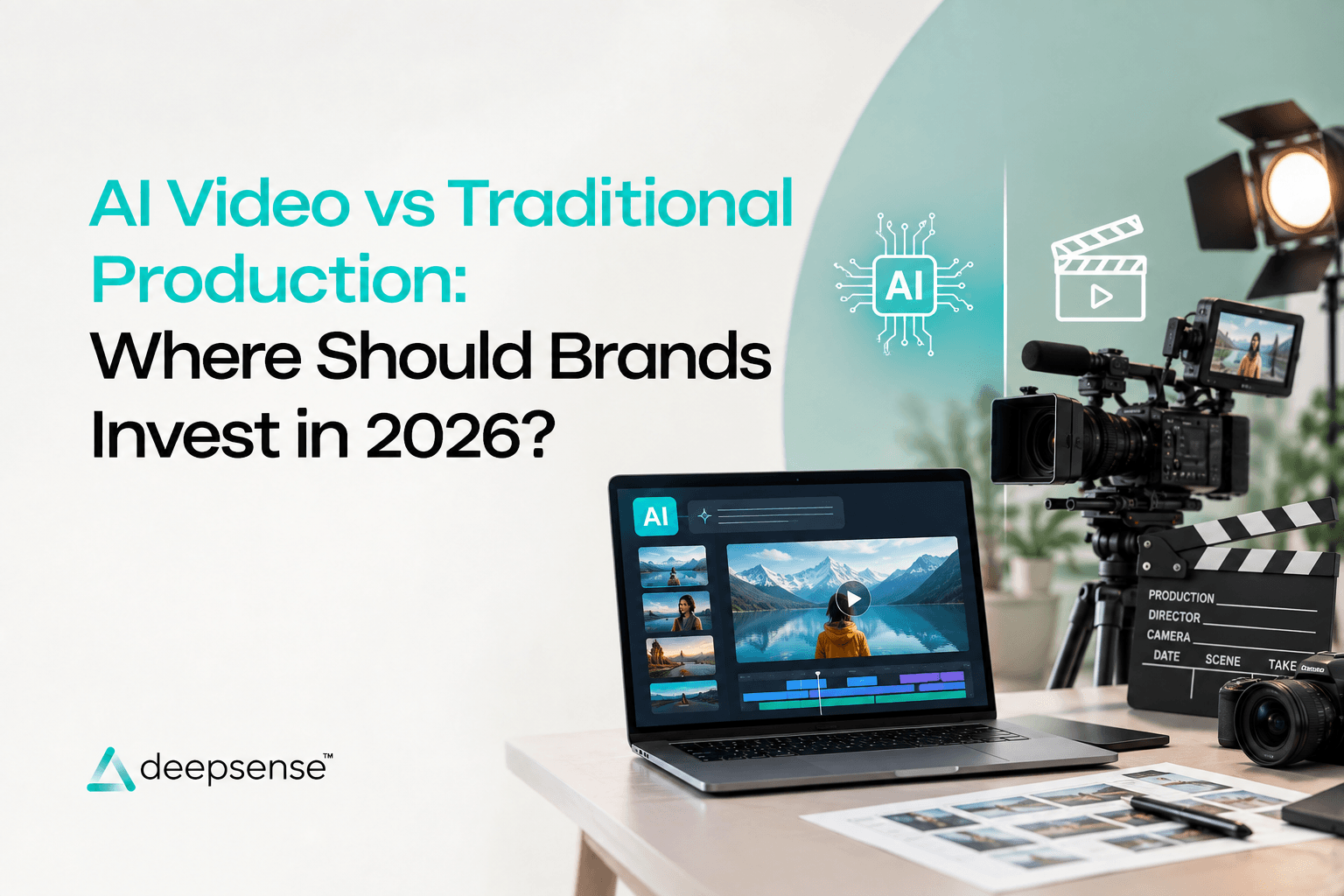
Should brands replace traditional video production with AI or is AI video better used as a production partner?
That’s the question marketers are increasingly asking in 2026.
AI can now help brands generate scripts, visuals, voiceovers, animations, product videos, social clips, and even complete video concepts in a fraction of the time traditional production can require.
But that doesn’t mean traditional production has become irrelevant.
A professionally filmed brand film can still deliver something AI-generated content may struggle to replicate: real people, real environments, physical products, authentic performances, and a distinctive visual identity.
So, when it comes to AI video vs traditional video production, where should brands actually invest?
The answer depends on what the video needs to achieve.
Why are brands reconsidering video production in 2026?
Video has become one of the most important formats in digital marketing.
Brands need video for:
- Instagram Reels
- YouTube Shorts
- Product pages
- Paid advertising
- Brand campaigns
- Explainer videos
- Internal communications
- E-commerce
- Events
The challenge is volume.
A brand may need dozens of videos every month not just one polished campaign film.
This is where AI video production becomes interesting.
Instead of treating every video as a major production, brands can use AI to create, adapt, and test content at scale.
But should everything be AI-generated?
Not necessarily.
What is AI video production?
AI video production uses artificial intelligence to assist with or generate different parts of the video creation process.
Depending on the tool and workflow, AI can help with:
- Scriptwriting
- Storyboarding
- Image generation
- Video generation
- Voiceovers
- Subtitles
- Animations
- Background creation
- Video editing
- Content repurposing
- Translation and localization
This can significantly reduce the time required for certain types of content.
For example:
One long-form video
↓
AI-assisted editing
↓
Short clips
↓
Reels
↓
YouTube Shorts
↓
LinkedIn videos
↓
Multiple pieces of social content
The real value isn’t necessarily “AI makes videos.”
It’s AI helps brands produce more useful video content from the same creative resources.
What is traditional video production?
Traditional video production involves a more conventional production process.
Typically:
Concept → Script → Pre-production → Shoot → Editing → Post-production
Depending on the project, this may involve:
- Directors
- Cinematographers
- Actors
- Models
- Production crews
- Locations
- Lighting
- Cameras
- Props
- Editors
- Motion designers
- Sound professionals
This process can require more time and resources, but it also gives brands greater control over real-world visuals and performances.
Is AI video cheaper than traditional production?
Often, AI can reduce production costs for certain types of content.
But comparing the two purely on price can be misleading.
A simple AI-generated social video and a professionally produced television commercial are solving completely different problems.
For example:
AI video:
Quick product concept for social media.
Traditional production:
Large-scale brand film featuring real people, locations, products, and cinematic storytelling.
The better question isn’t:
“Which one is cheaper?”
It’s:
“Which production method delivers the required outcome most efficiently?”
Where does AI video have an advantage?
AI-generated videos can be particularly useful when brands need:
Speed
Create multiple variations quickly.
Scale
Produce large volumes of content.
Experimentation
Test different concepts before investing heavily in production.
Personalization
Create different versions for different audiences or markets.
Localization
Adapt content into different languages and formats.
Rapid social content
Respond quickly to trends, campaigns, and content opportunities.
This makes AI particularly useful for high-frequency marketing environments.
Where does traditional production have an advantage?
Traditional production remains valuable when authenticity and physical reality are central to the message.
For example:
Product demonstrations
Showing the actual product can build trust.
Customer testimonials
Real customers provide authenticity.
Brand films
Human performances and real environments can create emotional depth.
Events
Real footage captures moments that synthetic content cannot simply reproduce.
Luxury branding
Premium brands may require highly controlled visual production.
Complex physical environments
Some locations, products, and experiences are better captured in the real world.
Can AI replace actors and creators?
AI can generate synthetic characters and voices, but that doesn’t mean every brand should replace real people.
People can bring:
- Personality
- Authenticity
- Emotion
- Improvisation
- Cultural nuance
- Personal experience
For campaigns built around human connection, real people can remain extremely valuable.
The question isn’t:
“Can AI create a person?”
It’s:
“Does the audience need to believe this person is real?”
For many campaigns, the answer is yes.
What about AI video tools?
The AI video ecosystem has expanded rapidly.
Brands can now use different AI video tools for:
- Text-to-video generation
- Image-to-video animation
- AI avatars
- Voice generation
- Editing
- Background removal
- Video enhancement
- Dubbing
- Subtitles
- Content repurposing
But tools should be selected based on the workflow not because they are trending.
A brand doesn’t need ten AI video platforms.
It needs the right combination of tools for its production process.
Can AI and traditional production work together?
Yes.
In fact, this may be the most practical approach for many brands.
Think of a hybrid workflow:
Traditional production
↓
Shoot real product footage
↓
AI-assisted production
↓
Generate variations
↓
Create different formats
↓
Add subtitles and translations
↓
Produce social clips
↓
Human creative review
This combines real-world authenticity with AI’s speed and scalability.
What does a hybrid video production model look like?
Imagine a fashion brand launching a new collection.
Traditional production creates:
- Campaign photos
- Hero video
- Model footage
- Product shots
- Brand film
AI-assisted production creates:
- Multiple Reel variations
- Short-form edits
- Different aspect ratios
- Background variations
- Localized versions
- Social hooks
- Product storytelling variations
Instead of choosing AI or traditional production, the brand uses both where they make sense.
Should brands use AI for every social media video?
Probably not.
Not every piece of content needs the same production investment.
A useful framework is:
| Content Type | Potential Approach |
|---|---|
| Major brand film | Traditional / Hybrid |
| Product launch | Traditional / Hybrid |
| Customer testimonial | Traditional |
| Daily social content | AI-assisted |
| Educational Reel | AI-assisted / Hybrid |
| Trend-based content | AI-assisted |
| Product demo | Traditional / Hybrid |
| Internal communication | AI-assisted |
| Content variations | AI-assisted |
| High-value campaign | Traditional / Hybrid |
The right choice depends on the objective, audience, budget, and brand identity.
Can AI video improve marketing performance?
Potentially but production speed alone doesn’t guarantee results.
A beautifully generated video can still fail if:
- The message is unclear.
- The hook is weak.
- The audience isn’t defined.
- The content doesn’t solve a problem.
- The brand positioning is unclear.
- The CTA doesn’t make sense.
AI can accelerate production.
It cannot automatically fix a weak marketing strategy.
That’s why AI video marketing should begin with the same fundamentals as any other marketing activity:
Audience → Message → Creative → Distribution → Measurement
What happens when brands overuse AI-generated videos?
There is a potential downside.
If every brand starts producing similar AI-generated visuals, audiences may experience creative fatigue.
The problem becomes:
“Everyone can create content.”
But if everyone can create content, content itself becomes less differentiated.
That’s why creative direction becomes even more important.
AI can help you produce faster.
Your brand still needs to answer:
“Why should someone remember this?”
Does AI make creativity less important?
It may actually make creative thinking more important.
When production becomes easier, execution stops being the biggest competitive advantage.
The differentiator becomes:
- The idea
- The story
- The positioning
- The insight
- The hook
- The visual language
- The brand perspective
AI can generate ten concepts.
A creative team still needs to know which concept is worth developing.
How should brands decide where to invest?
Start by categorizing your video requirements.
Invest more in traditional production when:
- The campaign is strategically important.
- Real people are central to the story.
- The physical product needs to be demonstrated.
- Authenticity is critical.
- The video has a long shelf life.
- Production quality directly affects brand perception.
Invest more in AI-assisted production when:
- You need high content volume.
- You need fast turnaround.
- You need multiple variations.
- You’re testing creative concepts.
- You need localization.
- The content has a short lifespan.
- You are producing routine social content.
This approach turns video investment into a strategic decision rather than a technology decision.
What will the future of video production look like?
The future is unlikely to be simply:
AI replaces production.
It’s more likely to become:
AI + Humans + Traditional Production
AI can handle more repetitive production tasks.
Creative teams can focus more on:
- Strategy
- Storytelling
- Creative direction
- Brand identity
- Audience insights
- Quality control
Traditional production remains important where physical authenticity matters.
The production process becomes more flexible.
What should brands invest in during 2026?
Instead of investing exclusively in an AI tool or a traditional production setup, brands should consider building a flexible video production system.
That could include:
1. A strong creative strategy
Know what your brand wants to communicate.
2. A reliable production capability
Create high-quality foundational assets.
3. AI-assisted workflows
Use AI where it genuinely saves time.
4. Content repurposing
Turn one production into multiple content formats.
5. Human quality control
Review visuals, claims, tone, accuracy, and brand consistency.
6. Performance measurement
Track whether videos are actually achieving business objectives.
The goal isn’t to produce more videos.
It’s to produce more effective videos.
Final Takeaway
So, AI video vs traditional video production which should brands choose?
There isn’t one universal answer.
Traditional production remains valuable for authenticity, high-impact storytelling, real-world products, people, and major campaigns.
AI video production offers speed, scale, experimentation, personalization, and efficient content creation.
For many brands, the smartest approach is not choosing one over the other.
It’s knowing when to use each.
The future of brand video production isn’t necessarily about replacing cameras with AI.
It’s about combining technology, creativity, and human judgment to create better content faster.
Because the real competitive advantage in 2026 won’t be simply having access to AI video.
It will be knowing what deserves to be made with AI and what deserves to be made in the real world.
FAQs
What is the difference between AI video and traditional video production?
AI video production uses artificial intelligence to generate or assist with elements such as visuals, scripts, voiceovers, animation, and editing. Traditional video production relies primarily on physical filming, actors, cameras, locations, and conventional post-production.
Is AI video cheaper than traditional video production?
AI can reduce costs for certain types of video content, particularly high-volume or short-form content. However, the cost difference depends on the complexity, quality requirements, tools, and production objectives of each project.
Can AI replace traditional video production?
AI can replace or automate parts of some production workflows, but traditional production remains valuable for real people, physical products, authentic locations, major brand films, and campaigns where human performance and real-world visuals are important.
Should brands use AI-generated videos for marketing?
Brands can use AI-generated videos when they fit the campaign objective, brand identity, audience expectations, and quality requirements. AI is particularly useful for rapid content creation, experimentation, personalization, and producing multiple variations.
What are the benefits of AI video production?
AI video production can help brands create content faster, generate multiple creative variations, experiment with concepts, repurpose existing content, localize videos, and scale short-form content production.
What type of video should brands produce traditionally?
High-impact brand films, customer testimonials, authentic product demonstrations, major campaign assets, event coverage, and productions where real people or physical environments are central may benefit from traditional production.
Is hybrid video production the future?
A hybrid model can allow brands to combine the authenticity and creative control of traditional production with the speed and scalability of AI. This can be particularly useful for brands producing both high-value campaigns and large volumes of digital content.
Would you like the next version to sound more analytical and data-led, or more conversational and brand-focused?