
When most companies launch a new service, they usually do one of two things:
- Add it under the existing brand.
- Slightly modify the current offering.
But in 2025–26, Swiggy made a different move.
Instead of simply expanding the Swiggy brand, it introduced Toing a separate brand with its own identity, positioning, and audience appeal.
This immediately raised an interesting marketing question:
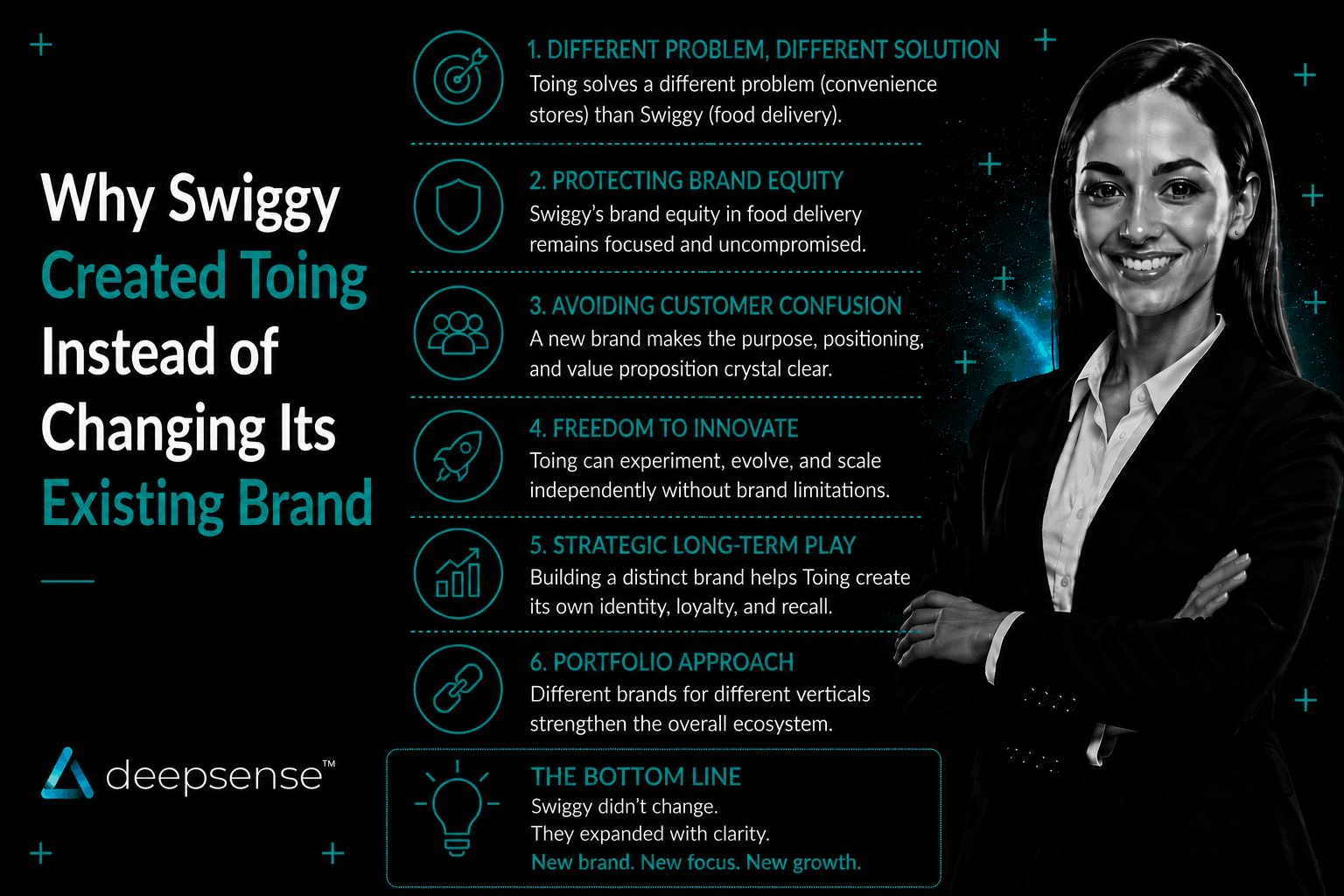
Why did Swiggy create Toing instead of simply changing or extending the existing Swiggy brand?
After all, Swiggy already has massive brand recognition across India.
Why spend time and money building another brand?
The answer lies in one of the most important concepts in modern marketing:
Brand positioning.
And understanding the Swiggy Toing strategy reveals valuable lessons about customer perception, segmentation, and long-term growth.
What Is Toing?
Toing was introduced by Swiggy as a separate consumer-facing brand designed to serve a different use case and audience experience.
Instead of positioning it as just another feature inside the Swiggy ecosystem, the company gave it:
- a distinct name,
- a unique personality,
- separate branding,
- independent positioning.
This wasn’t just a design decision.
It was a strategic branding decision.
The Common Assumption: Why Not Just Use the Swiggy Brand?
At first glance, it seems logical to leverage the existing Swiggy brand.
After all, Swiggy already enjoys:
- strong awareness,
- customer trust,
- nationwide reach,
- established distribution.
Most businesses would think:
“Why build another brand when customers already know us?”
But strong brands can also create limitations.
And that’s where the real strategy begins.
The Problem With Expanding One Brand Forever
Every brand occupies a certain position in the customer’s mind.
When people hear “Swiggy,” they immediately associate it with:
- food delivery,
- convenience,
- ordering meals,
- quick commerce services.
This positioning is powerful.
But it can also become restrictive.
When a company wants to serve a completely different customer need, forcing everything under one brand can create confusion.
This is where brand extension strategy becomes complicated.
Brand Positioning Is About Mental Ownership
A brand isn’t just a logo.
It’s a shortcut in the customer’s mind.
For example:
People associate certain brands with:
- luxury,
- affordability,
- speed,
- innovation,
- convenience.
The stronger the association, the easier the brand becomes to remember.
This is why marketers often use brand positioning examples to explain customer perception.
If Swiggy tried to stretch its positioning too far, it risked weakening its existing identity.
Why Swiggy Chose a Separate Brand
Creating Toing allowed Swiggy to build a fresh identity without affecting the core Swiggy perception.
Instead of forcing a new proposition into an existing mental category, it created a new category association.
This offers several advantages.
1. Different Audience, Different Positioning
One of the biggest reasons behind the Swiggy Toing strategy is likely audience distinction.
Not every customer interacts with brands in the same way.
Different segments have different:
- motivations,
- behaviors,
- expectations,
- content preferences.
A separate brand makes it easier to communicate directly with a specific audience without diluting the parent brand.
This is a classic customer segmentation strategy.
2. Freedom to Build a New Brand Personality
Established brands often carry expectations.
Customers already know what they stand for.
Creating a new brand allows companies to experiment with:
- tone of voice,
- communication style,
- design language,
- community building,
- customer experience.
Toing can develop its own personality without being constrained by Swiggy’s existing brand framework.
3. Avoiding Brand Confusion
One of the biggest risks in branding is confusion.
When customers struggle to understand:
- what a brand does,
- who it’s for,
- why it exists,
marketing becomes harder.
Separate branding creates clearer communication.
Customers immediately understand that they are interacting with something distinct.
4. Stronger Category Ownership
A single brand cannot always dominate multiple categories effectively.
Sometimes creating a new brand helps establish stronger ownership within a specific market segment.
This approach is common in multi-brand marketing strategies.
Instead of stretching one brand across every opportunity, companies create focused brands for focused audiences.
Understanding Multi-Brand Marketing
Many successful companies operate multiple brands simultaneously.
The goal is not redundancy.
The goal is precision.
A multi-brand marketing strategy allows businesses to:
- target different audiences,
- address different needs,
- create differentiated experiences,
- reduce positioning conflicts.
The parent company benefits from broader market coverage without weakening existing brand equity.
Why Startups Can Learn From This Strategy
The Toing launch offers important lessons for founders and marketers.
Many startups try to serve everyone under a single brand.
This often creates:
- unclear messaging,
- weak positioning,
- audience confusion.
A strong startup branding strategy begins with clarity.
The question isn’t:
“How many people can we attract?”
The question is:
“Who are we specifically building for?”
Customer Segmentation Is the Real Story
The most valuable takeaway from the Swiggy marketing strategy here is segmentation.
Great brands understand that different audiences require different approaches.
A message that works for one customer group may fail completely with another.
Segmentation allows brands to create:
- more relevant communication,
- stronger emotional connection,
- clearer value propositions.
Toing demonstrates the power of creating a brand designed for a specific audience rather than trying to fit everyone into one identity.
The Difference Between Features and Brands
Many companies think:
“We launched a new feature.”
But customers don’t think in features.
They think in perceptions.
Sometimes a new product, service, or experience deserves more than a feature label.
It deserves its own brand.
That distinction often determines how customers perceive and adopt it.
The Risk of Overextending a Brand
History is filled with examples of brands that expanded too broadly.
When brands try to stand for everything, they eventually stand for nothing.
Overextension can weaken:
- recognition,
- differentiation,
- customer understanding.
Creating a separate brand often protects the strength of the parent brand while allowing innovation.
Why This Matters in 2026
Today’s consumers interact with hundreds of brands daily.
Attention is limited.
Customer expectations are higher.
This means positioning matters more than ever.
The strongest brands are not always the biggest.
They’re the clearest.
And clarity often requires strategic separation rather than endless expansion.
What Marketers Can Learn From the Swiggy Toing Strategy
The biggest lesson isn’t about food delivery.
It’s about branding.
Before launching a new offering, ask:
- Does this serve the same audience?
- Does it solve the same problem?
- Does it fit the current brand perception?
- Will it strengthen or dilute our positioning?
Sometimes the best growth strategy is not extending the brand.
It’s creating a new one.
Final Takeaway
The Swiggy Toing strategy highlights an important branding principle:
Strong brands are built through focus, not expansion.
Instead of forcing every new idea into the existing Swiggy identity, the company chose to create a separate brand with its own positioning and audience appeal.
This approach provides:
clearer positioning
better customer segmentation
stronger category ownership
reduced brand confusion
greater flexibility for growth
In a world where customer attention is limited, clarity wins.
And sometimes the smartest branding decision isn’t changing the existing brand.
It’s creating a new one that customers can understand instantly.
FAQs
1. Why did Swiggy create Toing instead of using its existing brand?
Swiggy likely created Toing to target a specific audience, establish distinct positioning, and avoid diluting the core Swiggy brand identity.
2. What is the Swiggy Toing strategy?
The Swiggy Toing strategy involves creating a separate brand rather than extending the existing Swiggy brand, allowing for clearer positioning and audience segmentation.
3. What is a brand extension strategy?
A brand extension strategy involves using an existing brand name to launch new products or services. However, excessive extensions can sometimes create customer confusion.
4. How does customer segmentation influence branding?
Customer segmentation helps brands create tailored messaging, experiences, and positioning for different audience groups, improving relevance and engagement.
5. What is multi-brand marketing?
Multi-brand marketing is a strategy where a company operates multiple brands to target different customer segments, categories, or market opportunities.
6. What can startups learn from the Toing launch?
Startups can learn the importance of clear positioning, audience focus, and avoiding brand dilution when expanding into new markets or customer segments.