
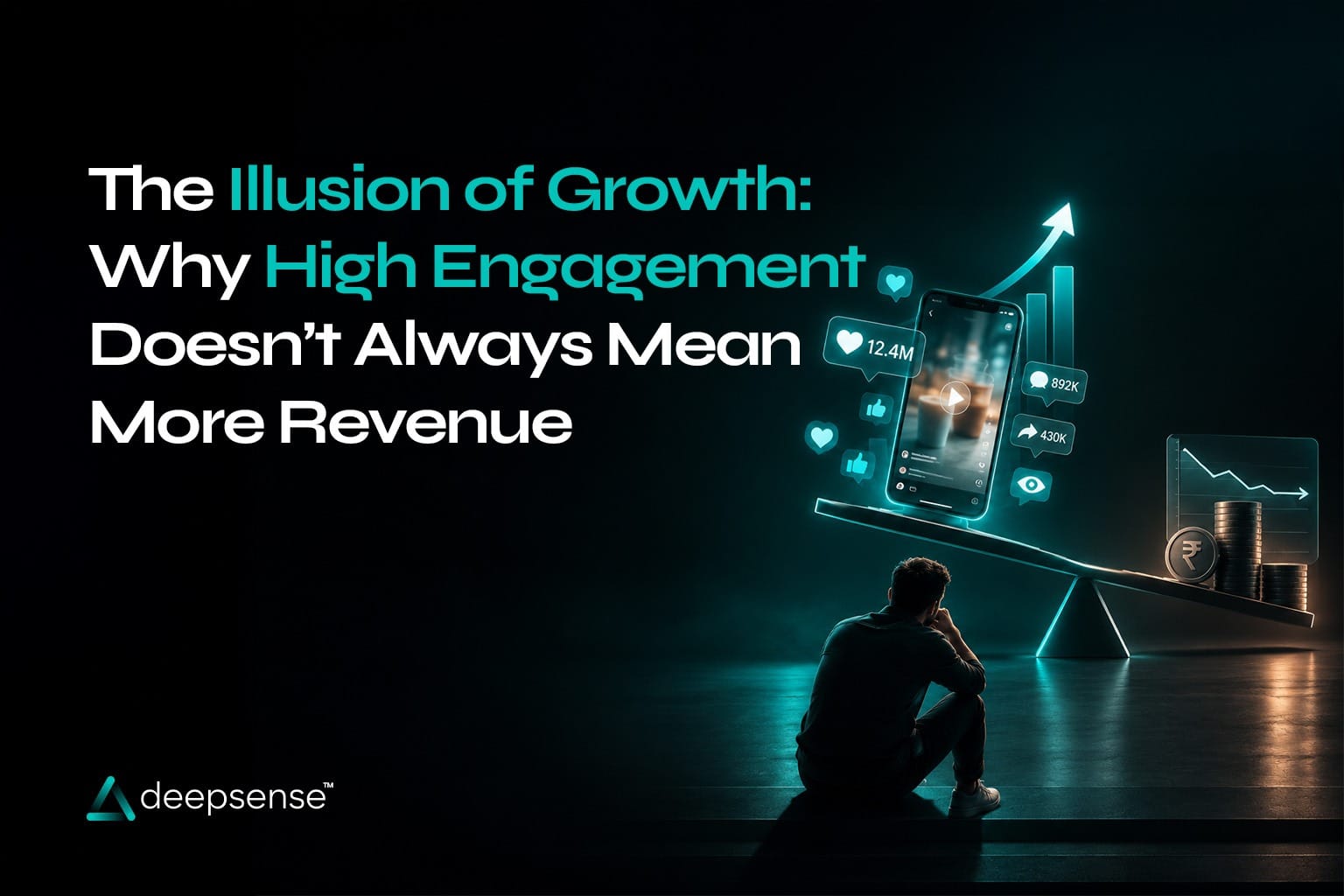
A post gets 50,000 likes.
A Reel crosses 1 million views.
Comments pour in.
Shares keep increasing.
On paper, everything looks successful.
Yet when the month ends, sales remain the same.
Leads haven’t increased.
Revenue barely moves.
Sound familiar?
This is one of the biggest traps in modern marketing.
Many businesses mistake attention for growth.
They assume that if engagement is rising, business performance must be improving too.
But in reality, high engagement and high revenue are not always connected.
This is the illusion created by marketing vanity metrics.
And understanding the difference can help businesses focus on what actually drives growth.
The Problem With Modern Marketing Metrics
Today’s platforms make it incredibly easy to track:
- likes,
- comments,
- shares,
- followers,
- impressions,
- views.
These numbers are visible, exciting, and easy to celebrate.
But not all metrics are equally valuable.
Some metrics make us feel successful.
Others actually indicate success.
The challenge is knowing the difference.
What Are Marketing Vanity Metrics?
Marketing vanity metrics are numbers that look impressive but don’t necessarily contribute to business outcomes.
Examples include:
- total followers,
- post likes,
- video views,
- impressions,
- reach.
These metrics can be useful indicators.
But they become dangerous when businesses treat them as proof of growth.
Because visibility alone does not generate revenue.
Why High Engagement Feels Like Success
Engagement creates a psychological reward.
When a post performs well, marketers feel validated.
Businesses feel seen.
Teams feel productive.
This isn’t inherently bad.
Engagement often indicates:
- audience interest,
- content relevance,
- brand awareness.
The problem begins when engagement becomes the primary goal.
Engagement vs Revenue: Understanding the Difference
Let’s simplify the distinction.
Engagement
Measures:
- attention,
- interaction,
- audience activity.
Examples:
- likes,
- comments,
- shares,
- saves.
Revenue
Measures:
- purchases,
- leads,
- customer acquisition,
- business growth.
This is the core challenge of engagement vs revenue.
Engagement tells you people noticed.
Revenue tells you people acted.
Why High Engagement Doesn’t Guarantee Sales
Many viral posts fail to generate meaningful business results.
Why?
Because attention and buying intent are different things.
Someone may:
- like a post,
- laugh at a meme,
- watch a Reel,
without having any intention of becoming a customer.
Engagement often reflects interest.
Revenue reflects commitment.
The Viral Content Trap
Many brands chase viral content because it creates impressive numbers.
A viral post can generate:
- massive reach,
- huge engagement,
- rapid follower growth.
But if that audience:
- isn’t qualified,
- isn’t interested in the offer,
- isn’t part of the target market,
the business impact may be minimal.
This is why viral success can sometimes create a false sense of growth.
The Difference Between Audience and Customers
Not every viewer is a potential buyer.
Not every follower is a future customer.
And not every engaged user contributes to revenue.
Businesses often forget this distinction.
Growing an audience is valuable.
But audience growth and customer growth are not the same thing.
Why Businesses Become Obsessed With Vanity Metrics
Vanity metrics are attractive because they’re:
- immediate,
- visible,
- easy to track,
- emotionally rewarding.
Revenue growth, on the other hand, is often:
- slower,
- more complex,
- influenced by multiple factors.
As a result, businesses naturally pay more attention to engagement.
Unfortunately, what gets measured often becomes what gets optimized.
What Real Marketing Performance Looks Like
Strong marketing should support business objectives.
This means looking beyond likes and views.
Important marketing performance metrics include:
- lead generation,
- conversion rates,
- customer acquisition cost,
- sales revenue,
- customer lifetime value,
- retention rates.
These metrics reveal whether marketing is creating business impact.
A Post With 500 Likes Can Outperform a Post With 50,000
Imagine two posts.
Post A
- 50,000 views
- 5,000 likes
- 500 comments
Generated:
- 0 leads
- 0 inquiries
Post B
- 2,000 views
- 100 likes
Generated:
- 20 qualified leads
- 5 sales conversations
Which post was more successful?
For the business, Post B likely created more value.
This demonstrates why engagement alone can be misleading.
The Role of Content ROI
Every piece of content should have a purpose.
That’s where content ROI becomes important.
Content ROI measures:
- business value created,
- leads generated,
- revenue influenced,
- customer relationships strengthened.
The goal isn’t simply to publish content.
The goal is to create outcomes.
Why Awareness Still Matters
This doesn’t mean engagement is useless.
Awareness is an essential part of growth.
People typically move through stages:
Awareness
“I know this brand.”
Interest
“I find this useful.”
Trust
“I believe this brand can help.”
Action
“I’ll become a customer.”
Engagement often plays a role in the early stages.
The problem arises when businesses stop measuring after awareness.
Marketing Analytics Should Follow the Customer Journey
Effective marketing analytics look at the entire journey.
Questions to ask include:
- How many people saw the content?
- How many engaged?
- How many clicked?
- How many became leads?
- How many became customers?
Looking at only one stage creates an incomplete picture.
Signs You’re Focusing Too Much on Vanity Metrics
You may be prioritizing vanity metrics if:
- every success report starts with views,
- likes matter more than leads,
- follower growth is the primary KPI,
- content strategy revolves around trends,
- revenue data is rarely discussed.
These are common warning signs.
What Metrics Matter More for Business Growth?
For sustainable business growth marketing, focus on metrics such as:
Lead Quality
Are you attracting the right audience?
Conversion Rate
How many visitors become customers?
Customer Acquisition Cost
How efficiently are you generating business?
Customer Lifetime Value
How much long-term value does each customer create?
Revenue Attribution
Which content actually influences sales?
These metrics provide deeper business insights.
Why Some Brands Grow Without Huge Engagement
Many successful businesses don’t dominate social media.
Their posts may receive modest engagement.
But their content consistently:
- educates,
- builds trust,
- qualifies prospects,
- supports purchasing decisions.
As a result, they generate strong business outcomes.
Growth often happens quietly before it becomes visible.
The Future of Marketing Measurement in 2026
As content volume increases and AI-generated content becomes common, vanity metrics will become even easier to inflate.
This means businesses will increasingly focus on:
- customer intent,
- conversion quality,
- revenue contribution,
- retention,
- long-term value.
The smartest marketers are already shifting their attention toward these indicators.
A Better Question to Ask
Instead of asking:
“How much engagement did this post get?”
Ask:
- Did it generate leads?
- Did it influence trust?
- Did it support conversions?
- Did it contribute to revenue?
Those questions reveal true performance.
Final Takeaway
High engagement can feel like growth.
But sometimes it’s only activity.
The real purpose of marketing is not simply to attract attention.
It’s to drive business outcomes.
That’s why businesses must look beyond marketing vanity metrics and focus on what truly matters:
qualified leads
customer acquisition
conversion rates
revenue growth
long-term customer value
Because likes don’t pay salaries.
Views don’t generate profit.
And followers don’t automatically become customers.
Revenue is what turns marketing activity into business growth.
FAQs
1. What are marketing vanity metrics?
Marketing vanity metrics are numbers such as likes, views, impressions, and follower counts that look impressive but do not always contribute directly to business growth or revenue.
2. What is the difference between engagement and revenue?
Engagement measures audience interaction, while revenue measures actual business outcomes such as sales, leads, and customer acquisition.
3. Why doesn’t high social media engagement always increase sales?
Many users engage with content for entertainment or information without intending to purchase. Engagement indicates interest, not necessarily buying intent.
4. Which marketing performance metrics matter most?
Important marketing performance metrics include lead generation, conversion rates, customer acquisition cost, customer lifetime value, and revenue attribution.
5. How can businesses improve content ROI?
Businesses can improve content ROI by creating content that addresses customer needs, builds trust, supports decision-making, and encourages meaningful actions.
6. Why are vanity metrics dangerous for marketers?
Vanity metrics can create a false sense of success, causing businesses to focus on visibility and engagement rather than measurable business outcomes like leads and revenue.