
Every day, people scroll through:
- hundreds of Instagram posts,
- countless Reels,
- LinkedIn updates,
- YouTube Shorts,
- Facebook feeds,
- and endless ads.
Most of that content gets ignored.
Not because it’s bad.
Not because the product is poor.
Not because the creator lacks expertise.
It fails because it never wins the first battle:
Attention.
In today’s digital world, you don’t have minutes to convince someone.
You barely have seconds.
That’s why understanding content hooks has become one of the most important skills in modern marketing.
Because if people don’t stop scrolling, nothing else matters.
Your:
- message,
- offer,
- story,
- value proposition,
never gets seen.
The Harsh Reality of Content Marketing
Many businesses spend hours creating content.
They focus on:
- graphics,
- captions,
- editing,
- hashtags,
- publishing schedules.
Then they wonder:
“Why is nobody engaging?”
The answer often lies in the opening few seconds.
Most users decide almost instantly whether content deserves their attention.
If the opening fails,
the rest of the content becomes irrelevant.
This is one of the biggest reasons why content fails online.
The Attention Economy Is More Competitive Than Ever
In 2026, you’re not competing only against other brands.
You’re competing against:
- influencers,
- creators,
- entertainment,
- news,
- memes,
- AI-generated content,
- personal messages.
Every scroll is a competition for attention.
This is why attention marketing has become a critical business skill.
The brands that win attention earn the opportunity to communicate.
The brands that don’t get skipped.
Why the First 3 Seconds Matter So Much
The human brain is designed to filter information quickly.
When people scroll, they subconsciously ask:
- Is this relevant to me?
- Is this interesting?
- Is this worth my time?
- Should I stop?
These questions are often answered in seconds.
If the answer is “no,”
the scroll continues.
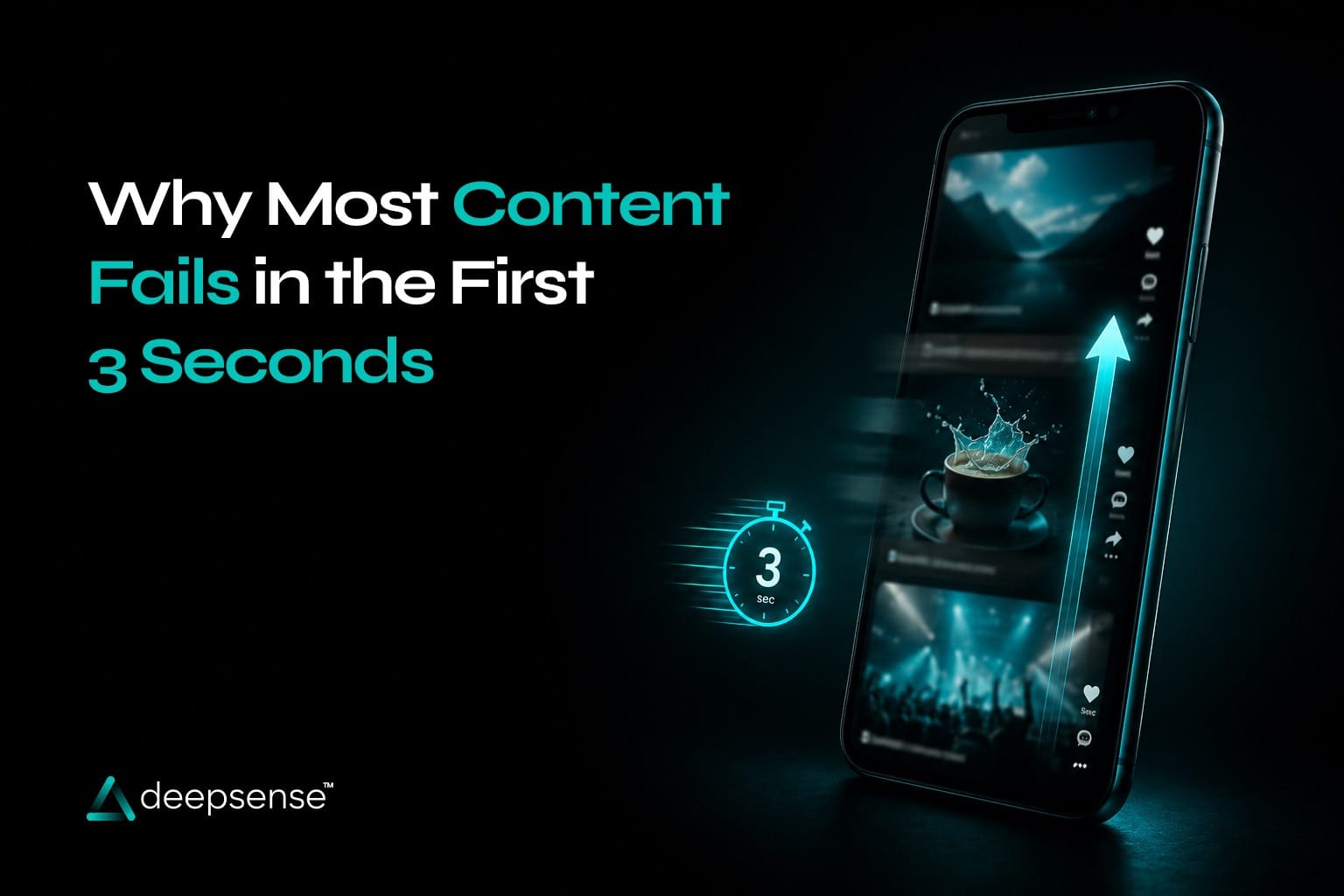
That’s why the first three seconds determine whether your content lives or dies.
The Biggest Reason Content Fails
Most content starts too slowly.
Examples:
“We are excited to announce…”
“Welcome to our latest post…”
“Here’s some information about…”
“Our company offers…”
These openings focus on the brand.
But audiences care about themselves first.
People stop for:
- curiosity,
- relevance,
- emotion,
- surprise,
- problems,
- opportunities.
Not introductions.
What Are Content Hooks?
Content hooks are the opening elements designed to stop scrolling and create curiosity.
A hook gives people a reason to pay attention.
It creates a mental interruption.
The goal is simple:
Make the audience pause.
Because a pause creates an opportunity.
And opportunity creates engagement.
Why Scroll-Stopping Content Works
The best scroll stopping content triggers one or more psychological responses:
Curiosity
“Most businesses make this mistake without realizing it.”
Surprise
“Your biggest marketing problem isn’t your marketing.”
Relatability
“Ever feel like your content gets ignored no matter how often you post?”
Fear of Missing Out
“What your competitors understand about branding that most businesses don’t.”
Emotional Recognition
“If you’re exhausted from creating content that nobody engages with, you’re not alone.”
These triggers create immediate interest.
The Psychology of Audience Attention
Modern audiences are overwhelmed.
Research and platform behavior consistently show that people process content incredibly quickly.
This shrinking audience attention span means brands must communicate value almost instantly.
People don’t decide whether content is good.
They decide whether it’s worth investigating.
That’s an important difference.
Common Reasons Content Fails in the First 3 Seconds
Let’s look at the most common mistakes.
1. Weak Openings
The hook is boring, generic, or predictable.
When audiences have seen similar openings hundreds of times, they ignore them automatically.
2. No Clear Benefit
People don’t immediately understand:
“Why should I care?”
If relevance isn’t obvious, attention disappears.
3. Talking About the Brand Too Early
Customers care about:
- their problems,
- their goals,
- their frustrations.
Starting with your company often reduces engagement.
4. Lack of Curiosity
If the audience already knows exactly what comes next, there’s no reason to continue.
Curiosity creates momentum.
5. Generic Visuals
Even great copy struggles when paired with:
- stock imagery,
- predictable layouts,
- repetitive design.
Visuals often act as the first hook.
The Anatomy of High-Performing Social Media Hooks
Strong social media hooks usually include at least one of these elements:
Problem-Based Hooks
“Why your content gets views but no engagement.”
Contrarian Hooks
“Posting more content isn’t the solution.”
Curiosity Hooks
“Most businesses discover this mistake too late.”
Mistake Hooks
“Three branding mistakes silently hurting your growth.”
Outcome Hooks
“How brands increase engagement without increasing ad spend.”
These structures immediately communicate value.
How to Grab Attention Online Without Clickbait
Many marketers confuse hooks with clickbait.
They’re not the same thing.
Clickbait:
- exaggerates,
- misleads,
- overpromises.
Strong hooks:
- create curiosity honestly,
- highlight relevance,
- earn attention ethically.
The goal is not to trick audiences.
The goal is to help them recognize value faster.
This is a crucial part of how to grab attention online effectively.
The Best Content Hooks Focus on the Audience
Notice a pattern among successful content?
It starts with:
- audience challenges,
- audience goals,
- audience frustrations,
- audience aspirations.
Not brand announcements.
People engage more when they immediately recognize themselves in the message.
Why Great Content Still Fails Sometimes
Here’s an important truth:
Great content can fail if the hook fails.
You might have:
- excellent insights,
- valuable information,
- expert knowledge.
But if nobody reaches the main content, the quality doesn’t matter.
The hook determines whether your message gets a chance.
A Simple Formula for Better Hooks
Try this structure:
Problem + Curiosity
Example:
“Your content isn’t failing because of the algorithm. Here’s what’s actually happening.”
Mistake + Consequence
Example:
“Most brands make this content mistake and lose engagement without realizing it.”
Outcome + Intrigue
Example:
“How small brands generate engagement without posting every day.”
Simple, direct, and curiosity-driven.
Why Content Hooks Matter More in 2026
The volume of content online continues to grow.
AI tools have made content creation easier than ever.
This means audiences now have more choices competing for attention.
As content supply increases:
attention becomes more valuable.
And attention starts with the hook.
Businesses that master content marketing strategy will increasingly focus on:
- attention capture,
- relevance,
- psychological triggers,
- audience-first messaging.
The Future of Attention Marketing
The next generation of successful content won’t simply be:
- longer,
- prettier,
- more frequent.
It will be:
- more relevant,
- more audience-focused,
- more emotionally compelling.
Because attention is no longer earned through volume.
It’s earned through connection.
And connection begins in the first few seconds.
Final Takeaway
Most content doesn’t fail because the information is bad.
It fails because people never stay long enough to see it.
In today’s crowded digital landscape:
Attention comes before engagement.
Engagement comes before trust.
Trust comes before conversion.
And attention begins with the hook.
That’s why mastering content hooks is one of the most valuable skills in modern marketing.
Because in a world where everyone is scrolling, the brands that grow aren’t necessarily the ones creating the most content.
They’re the ones creating content people actually stop for.
FAQs
1. What are content hooks?
Content hooks are opening lines, visuals, or statements designed to capture attention and encourage people to continue consuming content.
2. Why does content fail in the first 3 seconds?
Content often fails because it lacks a strong hook, clear relevance, curiosity, emotional appeal, or audience-focused messaging.
3. What makes scroll-stopping content effective?
Scroll-stopping content uses curiosity, relatability, emotion, surprise, or value-driven messaging to interrupt scrolling behavior.
4. How can brands improve social media hooks?
Brands can improve hooks by focusing on audience problems, creating curiosity, highlighting outcomes, and avoiding generic introductions.
5. Why is attention marketing important in 2026?
As content competition increases, attention becomes harder to earn. Strong hooks help brands capture attention before users scroll away.
6. How do you grab attention online without using clickbait?
Use honest curiosity, clear audience relevance, emotional triggers, and compelling outcomes rather than exaggerated or misleading claims.