
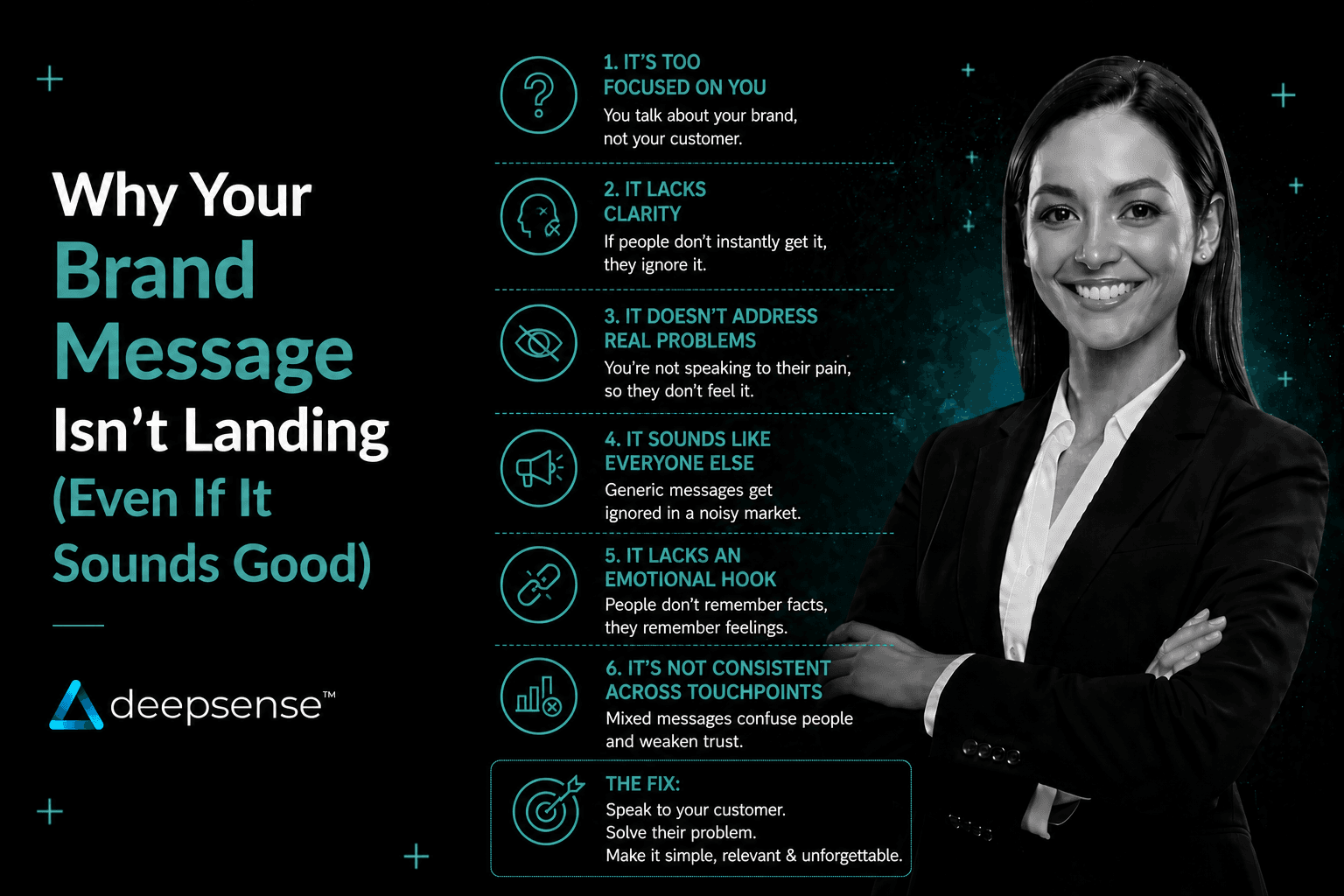
Many brands think their messaging problem is about creativity.
So they:
- redesign taglines,
- rewrite captions,
- change website copy,
- create “better” campaigns.
Yet customers still:
- scroll past,
- ignore ads,
- forget the brand,
- or fail to connect emotionally.
Why?
Because good-sounding messaging is not always effective messaging.
That’s the real reason why brand messaging fails.
In today’s digital world, customers are not responding to:
- polished words,
- clever lines,
- or generic inspiration.
They respond to:
relevance
clarity
emotional alignment
positioning
This blog breaks down why your message may sound good internally but still fail externally.
The Biggest Misunderstanding in Branding
Businesses often ask:
“Does this message sound good?”
But the real question should be:
“Does this message instantly connect with the customer?”
Because branding is not self-expression.
It is customer interpretation.
This gap between what brands say and what customers feel is where most ineffective brand messaging begins.
Why Customers Ignore Marketing Messages Today
Modern consumers see:
- hundreds of ads,
- thousands of captions,
- endless brand promises every day.
Which means the brain filters aggressively.
People ignore messages that feel:
- generic,
- unclear,
- repetitive,
- self-centered,
- emotionally flat.
This is the psychology behind why customers ignore marketing messages.
Your message is not competing against competitors only.
It is competing against:
attention fatigue.
1. Your Messaging Sounds Good But Says Nothing Specific
This is one of the biggest brand messaging mistakes.
Examples:
- “We deliver excellence”
- “Your trusted partner”
- “Quality you deserve”
- “Innovation meets creativity”
These sound professional.
But they are vague.
Customers immediately think:
“What does that actually mean for me?”
Strong messaging communicates:
- a clear problem,
- a specific outcome,
- a distinct value.
Weak messaging sounds polished but forgettable.
2. You’re Talking About Yourself Instead of the Customer
Many brands speak like this:
- “We are passionate about…”
- “Our mission is…”
- “We believe in…”
Customers care less about your internal story initially.
They care about:
- their frustration,
- their desire,
- their problem,
- their outcome.
This is a critical issue in brand communication strategy.
The customer should feel:
“This brand understands me.”
Not:
“This brand keeps talking about itself.”
3. Your Positioning Is Unclear
This is where messaging vs positioning becomes important.
Messaging = what you say
Positioning = how customers categorize you mentally
If your positioning is unclear:
your messaging becomes weak automatically.
Customers should instantly understand:
- what you do,
- who you help,
- why you are different,
- why they should care.
Without that clarity:
even beautiful messaging fails.
4. Your Brand Sounds Like Everyone Else
Many industries repeat the same language:
- premium quality,
- customer-first,
- innovative solutions,
- trusted service.
When every brand says the same thing:
none of them become memorable.
Modern audiences respond to:
- distinctiveness,
- specificity,
- personality,
- clarity.
This is why many brands struggle with customer perception in marketing.
Because customers cannot emotionally separate one brand from another.
5. Your Messaging Has No Emotional Trigger
People remember emotions more than information.
If your message only informs but never makes people:
- feel understood,
- feel excited,
- feel relieved,
- feel aspirational,
then it becomes forgettable.
Emotion creates memory.
And memory creates brand recall.
6. You Are Trying to Sound Smart Instead of Clear
Complex messaging creates distance.
Customers do not reward brands for sounding sophisticated.
They reward brands for being understandable.
This means:
- simpler words,
- clearer outcomes,
- direct communication.
Clarity beats cleverness in almost every market.
7. Your Visuals and Messaging Don’t Match
Sometimes the words are fine.
But the brand presentation feels disconnected.
Examples:
- premium messaging + cheap visuals,
- emotional copy + corporate design,
- modern tone + outdated website.
This inconsistency weakens trust.
And trust heavily affects message perception.
8. You’re Solving the Wrong Problem
Many brands communicate what they want to sell.
Not what customers actually care about.
Example:
Brand says:
“Advanced skincare formula”
Customer wants:
“How quickly will this improve my skin?”
This disconnect creates weak resonance.
A strong brand communication strategy starts with customer psychology, not company preference.
The Real Reason Brand Messaging Fails
Most messaging fails because it is:
- internally impressive,
- externally unclear.
Businesses hear the message repeatedly,
so they assume customers understand it too.
But audiences see your content for:
2–3 seconds.
If your value is not instantly understood,
attention disappears.
How to Improve Brand Messaging
Now let’s fix it.
1. Start with Customer Pain Points
Instead of:
“We provide advanced marketing solutions”
Try:
“Struggling to turn traffic into sales?”
The second version creates immediate relevance.
This is foundational to how to improve brand messaging.
2. Focus on Outcomes, Not Features
Customers buy results.
Not descriptions.
Instead of:
“AI-powered analytics dashboard”
Say:
“See exactly what’s wasting your marketing budget.”
3. Make Your Positioning Crystal Clear
Customers should instantly understand:
- what category you belong to,
- what problem you solve,
- why you are different.
Positioning sharpens messaging automatically.
4. Use Human Language
Avoid:
- jargon,
- buzzwords,
- corporate phrasing.
Write like real conversation.
Simple messaging feels more trustworthy.
5. Add Emotional Relevance
Good messaging doesn’t just explain.
It makes people feel:
- confident,
- safe,
- excited,
- understood.
Emotion increases memorability.
6. Test Messaging Based on Response Not Opinion
Do not judge messaging internally.
Judge it by:
- engagement,
- saves,
- clicks,
- conversions,
- replies,
- retention.
Customers decide whether messaging works.
Not brainstorming rooms.
A Simple Messaging Test Every Brand Should Do
Ask:
“If a customer sees our message for 5 seconds, will they instantly understand:
- what we do,
- who it is for,
- why it matters?”
If not:
the message is too weak.
Real Insight: Great Messaging Feels Obvious
The strongest brand messaging usually feels:
- simple,
- clear,
- emotionally accurate.
Not overly clever.
Because effective messaging creates recognition.
The audience should feel:
“Exactly. That’s my problem.”
That emotional alignment is what drives attention, trust, and conversion.
Final Takeaway
Most brands do not have a creativity problem.
They have a clarity problem.
Because messaging that sounds good internally can still fail externally if:
- positioning is weak,
- customer understanding is low,
- emotional relevance is missing,
- clarity is absent.
In modern marketing:
the best message is not the smartest one.
It is the one customers instantly understand and emotionally connect with.
That is what makes messaging land.
FAQs
1. Why does brand messaging fail?
Brand messaging fails when it lacks clarity, emotional relevance, strong positioning, or customer-focused communication.
2. Why do customers ignore marketing messages?
Customers ignore messages that feel generic, unclear, repetitive, or not directly relevant to their needs or emotions.
3. What is the difference between messaging and positioning?
Messaging is what a brand communicates, while positioning is how customers mentally perceive and categorize the brand.
4. How can brands improve their messaging?
Brands can improve messaging by focusing on customer pain points, simplifying communication, clarifying positioning, and emphasizing outcomes over features.
5. What are common brand messaging mistakes?
Using vague language, sounding too corporate, focusing too much on the brand instead of the customer, and lacking emotional connection are common mistakes.