
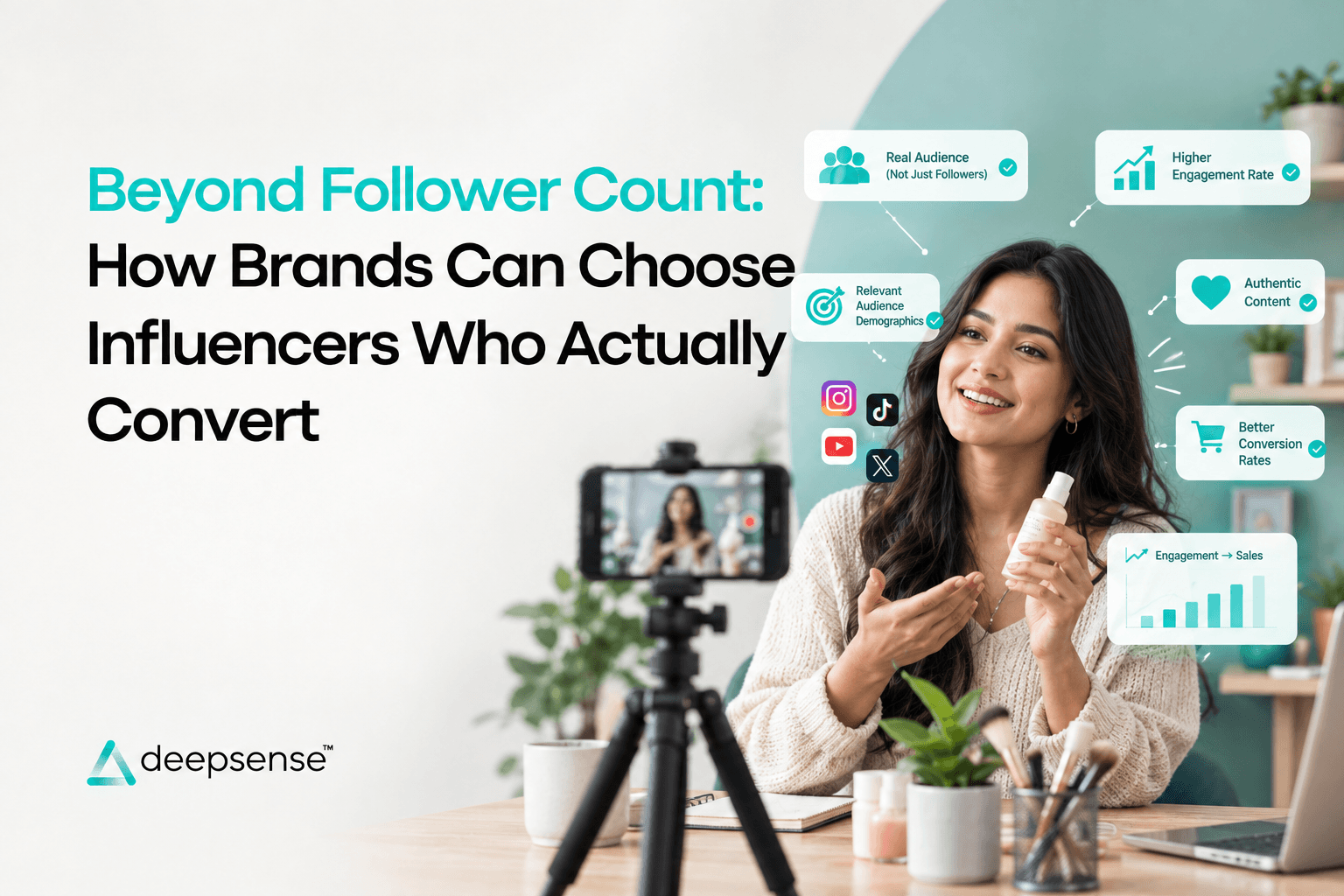
A creator with one million followers may generate thousands of views but very few sales. Meanwhile, a niche creator with just 15,000 followers could bring in highly relevant customers, meaningful enquiries, and stronger conversions. So, how should brands decide which influencer is worth investing in?
Influencer marketing has evolved beyond choosing creators based on popularity. Today, brands need to evaluate audience relevance, trust, content quality, purchase intent, and measurable business outcomes. The goal is not simply to get more people talking about a product. It is to reach the right people and give them a compelling reason to take action.
Understanding how to choose influencers requires a shift from vanity metrics to performance-driven selection. Here is how brands can build a smarter influencer selection strategy that supports awareness, engagement, leads, and sales.
Why Should Brands Look Beyond an Influencer’s Follower Count?
Follower count indicates the potential size of a creator’s audience, but it does not reveal how many followers are relevant to a brand, trust the creator, or are likely to buy.
Consider a skincare brand choosing between two creators. One has 500,000 followers, with a broad audience and inconsistent engagement. Another has 30,000 followers who regularly seek skincare recommendations and discuss product experiences. The second creator may offer a more relevant route to conversions, even with a smaller reach.
Brands should evaluate influencers based on four core factors:
- Audience relevance: Do their followers match the brand’s target customers?
- Credibility: Does the creator have a trusted voice in the relevant category?
- Content quality: Can they communicate product benefits naturally and convincingly?
- Performance: Can their content generate measurable actions, such as website visits, enquiries, sign-ups, or purchases?
Follower count still matters when estimating potential reach. However, it should be one input in the decision, not the final selection criterion.
How Can Brands Find the Right Influencers for Their Goals?
Before searching for creators, brands should define what success looks like. An influencer campaign designed to introduce a new product requires a different selection approach from one designed to generate sales or qualified leads.
Start by matching the campaign objective to the creator’s strengths.
| Campaign objective | What to prioritise |
|---|---|
| Brand awareness | Relevant reach, audience overlap, content visibility |
| Engagement and community building | Meaningful comments, shares, saves, conversations |
| Website traffic | Link clicks, story clicks, trackable visits |
| Lead generation | Audience intent, clear calls to action, lead quality |
| Sales and conversions | Purchase intent, product credibility, tracked sales |
| Product education | Subject expertise, demonstration skills, content depth |
For example, a B2B software company may benefit more from a respected industry educator who explains a business problem than from a lifestyle creator with a much larger audience.
Similarly, a fashion brand launching a new collection might prioritise creators whose styling content inspires product discovery and whose audiences regularly interact with shopping recommendations.
The first step in how to find the right influencers is therefore to define the intended audience and action before creating a shortlist.
Which Influencer Type Is Right for Your Brand?
Influencers are commonly grouped by audience size, but each category offers different advantages. The best choice depends on the product, campaign budget, target audience, and expected outcome.
Should Brands Choose Micro-Influencers for Better Conversions?
Micro-influencer marketing can be valuable when a brand needs niche relevance, personal recommendations, or access to a specific community. These creators often focus on a particular subject, such as fitness, skincare, parenting, technology, or regional food.
Their advantage is not that every micro-influencer automatically converts better. Results depend on audience quality, credibility, content, offer, and campaign execution.
Best suited for: Niche products, local campaigns, specialised categories, product trials, and targeted customer acquisition.
Are Macro-Influencers Better for Brand Awareness?
Macro-influencers can help brands reach larger audiences and build visibility quickly. They may be useful for product launches, major seasonal campaigns, and brands that need broad exposure.
However, high reach does not guarantee high purchase intent. Brands should check audience relevance and previous campaign performance before investing.
Best suited for: Large-scale awareness, launches, mass-market products, and campaigns requiring substantial reach.
When Should Brands Consider Nano-Influencers?
Nano-influencers usually have smaller, highly focused communities. They may be effective for local discovery, community recommendations, and campaigns where personal relevance matters.
Brands should still evaluate whether the creator can produce reliable content, reach the intended customers, and meet campaign requirements.
Best suited for: Community-led campaigns, local businesses, product seeding, and niche audience engagement.
Is a Specialist Creator Better Than a General Lifestyle Influencer?
Sometimes. A specialist creator may have fewer followers but stronger credibility in a category that requires explanation or informed recommendations.
For instance, a fitness equipment brand might work with a qualified fitness educator who demonstrates correct product use. A financial technology brand may prefer a creator who can explain its product clearly and responsibly rather than someone selected purely for entertainment value.
The strongest influencer selection strategy considers expertise and audience relevance alongside reach.
How Can Brands Evaluate an Influencer’s Audience Demographics?
An influencer may appear to be a perfect fit based on their content, but their audience may not match the brand’s target market.
Before finalising a partnership, review available audience insights, including:
- Location: Are followers based in the markets where the brand operates?
- Age group: Does the audience fall within the intended customer segment?
- Interests: Do followers engage with topics related to the product or service?
- Language: Can the creator communicate effectively with the target audience?
- Audience authenticity: Are engagement patterns and audience growth credible?
- Audience overlap: Would the creator bring a new audience or largely duplicate the reach of existing partners?
For example, an Indian D2C brand may need creators whose audiences are concentrated in India, while a global SaaS company may prioritise professionals in specific international markets.
Brands should request relevant insights from creators or use appropriate analytics tools where available. Public profile information alone may not provide enough evidence to assess audience demographics accurately.
The key question is not simply, “Who follows this influencer?” It is, “How closely does this audience match the people we want to reach?”
Is an Influencer’s Engagement Rate Enough to Predict Sales?
No. Influencer engagement rate can help assess how actively an audience interacts with content, but it does not directly measure purchase intent or conversion potential.
A creator may receive thousands of likes because their content is entertaining. Another may generate fewer likes but attract detailed questions about product features, pricing, availability, or usage.
Both engagement patterns provide useful information, but they indicate different audience behaviours.
When assessing engagement, brands should consider:
- Comments that demonstrate genuine interest rather than generic reactions.
- Shares and saves that suggest content has practical or personal value.
- Questions about product suitability, features, price, or purchasing.
- Consistency across recent posts instead of relying on one viral result.
- Engagement relative to the creator’s usual reach and audience size.
- Signs of suspicious activity, repetitive comments, or sudden unexplained growth.
Brands should also understand how engagement rate is calculated. Some reports use followers as the denominator, while others use reach or impressions. These measures are not directly interchangeable.
A high engagement rate is a useful signal, not proof that an influencer will drive sales. It should be evaluated alongside audience relevance, content quality, and actual campaign results.
What Should Brands Check Before Approving an Influencer?
A strong creator shortlist should be supported by evidence, not just a polished profile or an attractive media kit.
Use the following checklist before committing campaign budget.
1. Review Previous Brand Collaborations
Look at the creator’s sponsored content. Does it feel natural? Do they explain the product clearly? Are the comments meaningful? Where results are available, ask about clicks, leads, sales, and other outcomes from comparable campaigns.
Past performance is useful context, but it is not a guarantee of future results.
2. Assess Content Quality and Brand Fit
Check whether the creator’s tone, values, visual style, and communication approach fit the brand. Consider whether they can explain the product accurately without making unsupported claims.
A creator who produces entertaining content may not necessarily be the best person to explain a complex B2B service.
3. Check Authenticity and Reputation
Review recent posts, audience interactions, growth patterns, and previous partnerships. Look for potentially conflicting brand deals, misleading claims, or content that could create reputational risks.
For health, finance, and other sensitive categories, additional compliance and claims checks may be necessary.
4. Confirm Deliverables and Usage Rights
Before approval, clarify the number and format of posts, publishing dates, revision terms, disclosure requirements, exclusivity, and reporting expectations.
If the brand plans to reuse creator content in paid advertisements, confirm the necessary usage rights and permissions separately.
5. Agree on Measurable Outcomes
Set expectations before the campaign starts. Depending on the objective, these may include reach, engagement, qualified website visits, leads, conversions, revenue, or cost per acquisition.
Without agreed metrics and tracking, it becomes difficult to distinguish a successful partnership from one that simply generated attention.
How Can Brands Measure Influencer Campaign ROI?
Influencer campaign ROI should be evaluated against the campaign’s actual objective and total cost. Sales are important, but awareness and consideration campaigns may require different success measures.
For conversion-focused campaigns, brands should establish tracking before publishing.
Useful influencer performance metrics include:
- Reach and impressions: How many people saw the content, and how often?
- Engagement rate: How actively did the audience interact with it?
- Link clicks and landing-page visits: Did the content attract relevant traffic?
- Conversion rate: What proportion of tracked visitors completed the desired action?
- Cost per lead: How much did the campaign spend to generate a lead?
- Customer acquisition cost: What was the cost of acquiring a customer through the campaign?
- Revenue attributed to the campaign: How much trackable revenue did it generate?
- Return on investment (ROI): Did the financial return justify the total investment?
Brands can use unique UTM-tagged links, creator-specific discount codes, dedicated landing pages, affiliate links, and platform reporting to improve measurement. For longer B2B sales cycles, CRM tracking can help connect influencer-generated enquiries to later opportunities and closed deals.
How Do You Calculate Influencer Conversion Rate?
A simple way to calculate conversion rate is to divide the number of conversions by the number of relevant tracked visits, then multiply by 100.
For example, if an influencer campaign generates 800 tracked landing-page visits and 32 purchases, the conversion rate is:
Conversion rate = (32 ÷ 800) × 100 = 4%
This means 4% of the tracked visits resulted in purchases. It does not necessarily mean the influencer caused every purchase, because attribution methods and other marketing touchpoints can affect the result.
How Do You Calculate Influencer Campaign ROI?
A common formula is:
ROI = [(Attributed revenue − total campaign cost) ÷ total campaign cost] × 100
Suppose a campaign generates ₹1,50,000 in attributed revenue and costs ₹50,000 in total.
ROI = [(₹1,50,000 − ₹50,000) ÷ ₹50,000] × 100 = 200%
This is a revenue-based illustration, not a profit calculation. For a more realistic profitability assessment, brands should account for product costs, fulfilment, discounts, agency fees, creator fees, production expenses, and other relevant costs. Revenue attribution should also be interpreted carefully.
Should Brands Choose One Influencer or Work With Multiple Creators?
There is no universal answer. A single creator can offer a consistent message and a simpler campaign structure, while a group of creators can help brands reach different audience segments and test different content approaches.
A multi-creator campaign may include:
- A specialist creator who explains the product in depth.
- A micro-influencer who reaches a relevant niche community.
- A larger creator who introduces the brand to a wider audience.
- Customer creators who share genuine product experiences, where appropriate.
Rather than spreading the budget equally across every creator, brands can test a small group, compare performance, and invest further in the partnerships that deliver the strongest results.
However, avoid judging creators solely on last-click sales. Some may contribute to discovery or consideration without receiving direct conversion credit. A sensible measurement approach combines direct-response tracking with broader campaign objectives.
What Are the Most Common Influencer Selection Mistakes Brands Should Avoid?
Even a well-funded influencer campaign can underperform if the selection process is weak. Watch out for these common mistakes:
- Choosing creators purely because they have large followings.
- Assuming high engagement automatically means high purchase intent.
- Ignoring audience location, demographics, or category relevance.
- Approving creators without checking previous sponsored content.
- Failing to define campaign objectives before negotiations.
- Running campaigns without unique links, codes, or conversion tracking.
- Evaluating results before allowing enough time for the buying cycle.
- Focusing only on immediate sales while ignoring the campaign’s intended role.
- Overlooking content rights, disclosure requirements, and brand-safety checks.
The solution is a repeatable evaluation process. Score creators against consistent criteria, document why each one was shortlisted, and compare their results against the same campaign objectives wherever possible.
How Can Brands Build a Repeatable Influencer Selection Strategy?
A practical influencer marketing strategy should make creator selection consistent, measurable, and easier to improve over time.
Step 1: Define the business goal. Decide whether the campaign is intended to increase awareness, generate leads, drive purchases, or support another measurable outcome.
Step 2: Describe the target audience. Identify relevant demographics, interests, location, customer needs, and purchase barriers.
Step 3: Discover suitable creators. Search by category, audience relevance, content format, expertise, and community fit rather than relying only on follower rankings.
Step 4: Evaluate and shortlist. Compare audience insights, engagement quality, content consistency, previous collaborations, and available performance data.
Step 5: Set expectations and tracking. Agree on deliverables, fees, usage rights, campaign dates, reporting, and the metrics that will determine success.
Step 6: Test, measure, and optimise. Compare results across creators, identify what influenced performance, and use those insights to improve future partnerships.
This approach transforms influencer selection from a subjective decision into a repeatable marketing process.
Frequently Asked Questions
How many followers should an influencer have to drive sales?
There is no minimum follower count that guarantees sales. Audience relevance, credibility, product fit, content quality, and conversion performance are more useful selection criteria than a fixed number of followers.
Are micro-influencers better than macro-influencers?
Neither category is automatically better. Micro-influencers may offer niche relevance, while macro-influencers can provide broader reach. The right choice depends on the campaign objective, audience, budget, and measured results.
What is a good influencer engagement rate?
There is no single engagement-rate benchmark that applies to every platform, creator size, and industry. Compare creators using the same calculation method, recent performance, content format, and audience context.
How can brands track sales from influencer marketing?
Brands can use unique UTM links, discount codes, affiliate links, dedicated landing pages, and analytics or CRM data. These methods improve attribution, although they may not capture every influence on a customer’s decision.
Should brands prioritise reach or conversions?
Prioritise the metric that matches the campaign objective. Reach is useful for awareness, while qualified visits, leads, purchases, and acquisition costs are more relevant for performance-focused campaigns. A broader campaign may need a combination of measures.
Final Thoughts: Choose Influencers for the Value They Create
The most effective influencer partnerships begin with a clear understanding of the audience and the outcome the brand wants to achieve. Follower count, engagement rate, and content quality can help identify promising creators, but none should be treated as a guarantee of success.
By evaluating audience relevance, credibility, campaign fit, and measurable performance, brands can make more informed decisions about where to invest their influencer marketing budgets.
The goal is not to find the most popular influencer. It is to find the creator who can connect the brand with the right audience and help move that audience towards meaningful action.