
For years, marketing followed a familiar cycle:
Plan a campaign → Launch it → Run ads → Measure results → Stop → Start again.
But customer behaviour has changed.
People don’t interact with brands only when a campaign is live. They discover products through search, social media, recommendations, creators, reviews, AI tools, websites, email, and multiple digital touchpoints throughout the year.
This is why more brands are moving towards always-on marketing.
Instead of treating marketing as a series of disconnected campaigns, brands are building continuous systems that keep them visible, relevant, and connected with their audiences.
So, what exactly is always-on marketing? Why are brands adopting it? And does it mean running campaigns 24/7?
What Is Always-On Marketing?
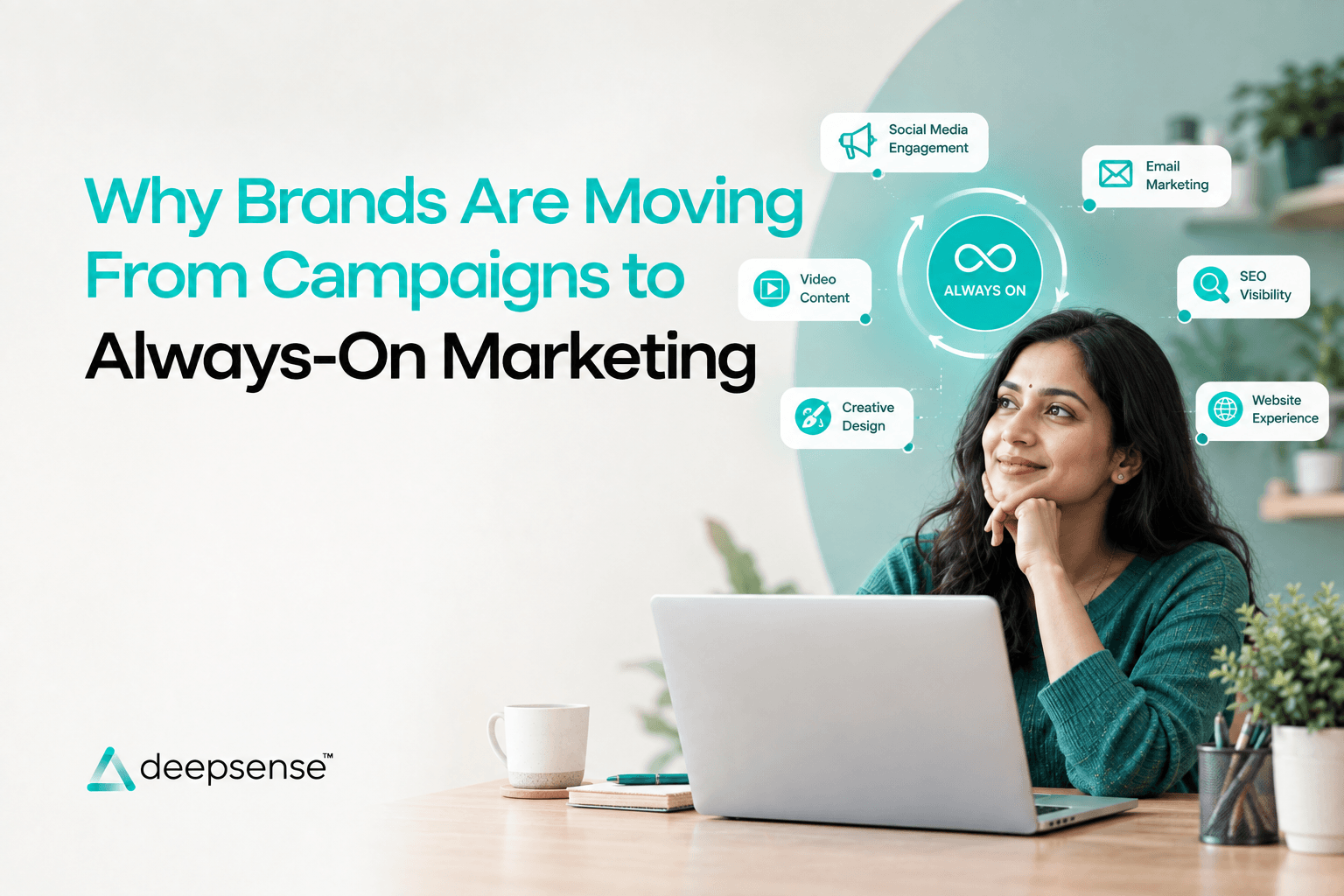
Always-on marketing is an approach where a brand maintains a consistent marketing presence throughout the year instead of communicating only during major campaigns.
It can include:
- Search marketing
- Social media content
- SEO
- Email marketing
- Paid advertising
- Retargeting
- Content marketing
- Community engagement
- Influencer activity
- Website optimisation
- Customer communication
The important difference is that these activities are connected to a broader strategy rather than operating as isolated campaigns.
For example, a brand may run a major festive campaign for two weeks.
But its always-on approach could continue before, during, and after that campaign through educational content, search visibility, social content, retargeting, email, and customer engagement.
The campaign becomes one moment within a larger marketing system.
Why Are Brands Moving Away From Campaign-Only Marketing?
Campaigns can create attention.
But attention is temporary.
A customer may see an advertisement today, forget about the brand tomorrow, and search for the product six weeks later.
If the brand disappears between campaigns, another competitor may occupy that space.
This is one reason businesses are investing in continuous marketing.
The objective is not necessarily to communicate the same message every day.
It is to maintain a relevant presence throughout the customer’s decision-making journey.
Does Always-On Marketing Mean Running Ads All the Time?
No.
This is one of the biggest misconceptions about an always-on marketing strategy.
Always-on does not mean:
“Spend money on advertising every single day.”
It means:
“Maintain a continuous connection with your audience.”
Some activities may run continuously, while others can be activated based on business priorities.
For example:
Always active:
- SEO
- Website optimisation
- Organic social content
- Email database building
- Brand content
Always available, but budget-controlled:
- Search ads
- Retargeting
- Lead-generation campaigns
Activated when relevant:
- Festival campaigns
- Product launches
- Seasonal offers
- Events
- Limited-time promotions
This creates a more flexible marketing ecosystem.
What Is the Difference Between Campaign Marketing and Always-On Marketing?
The difference is primarily in how marketing is structured.
| Campaign-Based Marketing | Always-On Marketing |
| Built around specific campaigns | Built around continuous presence |
| Often has fixed start and end dates | Runs continuously or in recurring cycles |
| Focuses heavily on campaign messages | Combines multiple customer needs |
| Attention peaks during launches | Maintains ongoing visibility |
| Can create gaps between campaigns | Reduces communication gaps |
| Often measures campaign performance | Tracks performance across the customer journey |
Neither approach eliminates the other.
In fact, effective always-on marketing campaigns often sit alongside major campaign moments.
The difference is that the brand doesn’t disappear once the campaign ends.
How Does Always-On Marketing Improve Customer Engagement?
Customers rarely make decisions in a single interaction.
Someone might:
See a Reel → Search Google → Visit the website → Read a blog → Compare competitors → See a retargeting ad → Read reviews → Subscribe to email → Purchase later.
Every interaction contributes to the decision.
This is why a strong customer engagement strategy needs to work across multiple touchpoints.
Always-on marketing allows brands to remain part of that journey.
Instead of asking:
“How do we get attention during this campaign?”
brands can ask:
“How do we remain useful and relevant throughout the customer journey?”
Why Is Consistency Becoming More Important Than Campaign Frequency?
Running more campaigns doesn’t automatically create stronger brand awareness.
A brand might launch ten campaigns in a year but still feel inconsistent if every campaign has a different message, visual identity, or positioning.
An effective always-on brand strategy creates continuity.
The audience repeatedly encounters:
- Similar brand positioning
- Consistent visual identity
- Recognisable messaging
- Recurring content themes
- Relevant educational content
- Consistent brand values
Over time, this can help build familiarity.
The goal isn’t to make every piece of content identical.
It is to make every interaction feel like it belongs to the same brand.
How Does SEO Fit Into Always-On Marketing?
SEO is naturally suited to an always-on approach.
Unlike a campaign that may run for a few weeks, useful search content can continue attracting relevant users over a much longer period.
A brand can continuously work on:
- New search topics
- Existing content optimisation
- Technical SEO
- Internal linking
- Product pages
- Local search
- Answer-focused content
- Authority building
For example, an industrial company could publish content answering customer questions throughout the year rather than relying only on a product launch campaign.
This creates a growing library of information that can support future customer journeys.
Why Is Content Becoming a Continuous Marketing Asset?
A campaign usually has a limited lifespan.
Content can have a much longer one.
A useful blog post, video, case study, comparison page, or guide can continue supporting marketing after the original publishing date.
This changes how brands should think about content.
Instead of asking:
“What should we post this week?”
an always-on approach asks:
“What information will our customers continuously need?”
That shift can transform content from a posting activity into a strategic business asset.
How Does Always-On Digital Marketing Support Different Customer Stages?
Not everyone visiting a brand’s website is ready to buy.
One person may be discovering a problem.
Another may be researching solutions.
Another may be comparing vendors.
Someone else may already be ready to purchase.
An always-on digital marketing approach can create content and touchpoints for each stage.
Awareness
Help customers understand the problem.
Consideration
Help them explore possible solutions.
Evaluation
Provide comparisons, proof, case studies, demonstrations, and detailed information.
Conversion
Make it easy to enquire, purchase, book, or contact the business.
Retention
Continue communicating after the sale.
This creates a connected customer journey rather than a collection of disconnected campaigns.
What Role Does Real-Time Marketing Play?
Continuous marketing doesn’t mean everything has to be planned months in advance.
Brands also need the ability to respond to what’s happening now.
This is where real-time marketing becomes valuable.
Brands can respond to:
- Trending conversations
- Cultural moments
- Breaking developments
- Customer conversations
- Industry news
- Unexpected events
- Emerging consumer behaviour
However, reacting quickly doesn’t mean reacting to everything.
Real-time content works best when the moment is genuinely relevant to the brand and its audience.
The strongest approach combines:
Planned always-on content + timely real-time opportunities.
Can Always-On Marketing Reduce Dependence on Big Campaigns?
It can reduce the pressure placed on individual campaigns.
When a brand relies entirely on a major campaign, every launch carries significant expectations.
If the campaign underperforms, there may be little activity supporting the brand afterwards.
An always-on system creates a broader foundation.
The brand can continue generating:
- Organic traffic
- Search visibility
- Audience engagement
- Retargeting opportunities
- Email interactions
- Website conversions
- Brand familiarity
Major campaigns can then create additional spikes of attention instead of carrying the entire marketing strategy.
What Does an Always-On Marketing Strategy Look Like in Practice?
Imagine a skincare brand.
Instead of only advertising during a festive sale, its yearly strategy could include:
SEO:
Content around skincare concerns and product education.
Social media:
Regular educational, entertaining, and product-focused content.
Email:
Product recommendations, education, launches, and retention communication.
Paid media:
Search, prospecting, and retargeting based on business objectives.
Influencers:
Ongoing creator partnerships and product demonstrations.
Campaigns:
Seasonal launches, festive offers, and new-product campaigns.
Website:
Continuous optimisation of product pages and conversion journeys.
The campaigns still exist.
But they operate within a larger continuous marketing system.
Is Always-On Marketing More Expensive?
Not necessarily.
The cost depends on the channels, audience, industry, objectives, and execution model.
In some cases, always-on marketing can actually make marketing resources more efficient because brands can continuously optimise existing assets rather than starting from zero for every campaign.
For example, a successful blog can be:
Published → Optimised for SEO → Converted into a Reel → Used in an email → Shared on LinkedIn → Referenced in a sales conversation.
One content asset can support multiple channels.
The key is not simply doing more marketing.
It is creating a system where marketing activities support one another.
How Should Brands Build an Always-On Marketing Strategy?
A practical always-on marketing strategy can start with five steps.
1. Identify the Customer Journey
Understand what customers need before, during, and after purchase.
2. Build Content Around Customer Questions
Create useful content for awareness, consideration, evaluation, and retention.
3. Choose the Right Continuous Channels
Focus on channels that match the audience rather than trying to maintain every platform.
4. Add Campaign Moments
Use product launches, festivals, events, promotions, and seasonal opportunities to create spikes of attention.
5. Continuously Measure and Optimise
Look beyond campaign-level metrics.
Track indicators such as:
- Organic visibility
- Website engagement
- Lead quality
- Conversion rate
- Customer acquisition cost
- Returning visitors
- Email engagement
- Brand search demand
- Revenue contribution
The strategy should evolve based on what the data reveals.
What Will Marketing Campaigns Look Like in 2026?
The role of campaigns is changing rather than disappearing.
In the past, a campaign could be treated as the centre of the marketing strategy.
Increasingly, campaigns can become amplifiers within a broader ecosystem.
For example:
Always-on foundation → Campaign launch → Increased attention → Retargeting → Content → Conversion → Retention → New customer journey
This creates a loop rather than a straight line.
That is an important shift in marketing campaigns 2026.
Is Always-On Marketing the Same as Posting Every Day?
No.
This approach should never become an excuse for creating content simply to fill a calendar.
A brand can post every day and still have no meaningful strategy.
The better question is:
“Are we consistently providing something valuable to the audience?”
Sometimes that means publishing content.
Sometimes it means improving a landing page.
Sometimes it means answering a customer question.
Sometimes it means optimising an old article.
Sometimes it means running a targeted ad.
Continuous marketing is about continuous relevance, not continuous noise.
What Should Brands Do Differently in 2026?
Brands should stop viewing marketing as a collection of isolated moments.
Instead, think of marketing as a system:
Build visibility → Create engagement → Educate → Convert → Retain → Learn → Optimise → Repeat
Major campaigns can still create excitement.
But the brand should have something working before the campaign begins and something continuing after it ends.
That is the real value of an always-on marketing approach.
Final Takeaway: Are Campaigns Becoming Part of a Bigger Marketing System?
Campaigns aren’t disappearing.
Their role is evolving.
Instead of depending entirely on occasional bursts of communication, brands can combine campaigns with continuous content, SEO, social media, paid media, email, website optimisation, and customer engagement.
The future isn’t necessarily campaigns vs always-on marketing.
It is:
Always-on foundation + Campaign moments + Continuous optimisation.
Brands that adopt this approach can build marketing systems designed not just to generate short-term attention, but to remain relevant throughout the customer’s journey.
Because in a digital world, customers don’t stop discovering, comparing, researching, or interacting just because a campaign has ended.
Why should the brand disappear?
FAQs
What is always-on marketing?
Always-on marketing is a continuous approach to maintaining brand visibility, customer engagement, and marketing activity throughout the year rather than relying only on short-term campaigns.
How is always-on marketing different from traditional campaigns?
Traditional campaigns usually have defined start and end dates. Always-on marketing maintains an ongoing presence while using campaigns as specific moments within a larger strategy.
Does always-on marketing mean running ads continuously?
No. It can include SEO, content, organic social media, email, website optimisation, customer engagement, and selectively activated paid campaigns.
Why is always-on marketing important in 2026?
Customers interact with brands across multiple digital touchpoints throughout the year. Continuous marketing helps brands remain visible and relevant across those customer journeys.
What channels work well for always-on marketing?
SEO, content marketing, social media, email marketing, paid search, retargeting, websites, and customer communication can all contribute to an always-on strategy.
Can small businesses use always-on marketing?
Yes. Small businesses don’t need to be active on every channel. They can choose a few channels that align with their audience and maintain consistent, useful activity.
How do you measure always-on marketing?
Measurement can include organic traffic, search visibility, engagement, leads, conversion rates, customer acquisition costs, returning visitors, email performance, and revenue contribution.
Does always-on marketing replace campaigns?
No. Campaigns can remain important for launches, seasonal promotions, events, and major brand moments. Always-on marketing provides the continuous foundation around them.
What is the biggest mistake with always-on marketing?
Treating it as a requirement to constantly publish content. The objective is continuous relevance and customer value not simply continuous activity.