
For years, SEO revolved around keywords. Find what people search for, optimise your pages, build backlinks, and improve rankings.
But search is becoming more complex.
Search engines need to understand not just the words on a page, but also the people, businesses, products, services, and concepts those words refer to. AI-powered search experiences are making this broader understanding increasingly important.
For example, when someone searches for a digital marketing agency, they may want more than a list of websites containing that phrase. They may want to understand what each agency specialises in, which industries it serves, what expertise it demonstrates, and whether it can be trusted.
This is where Entity SEO becomes important.
In 2027, brands should look beyond individual keywords and build a consistent, credible digital presence that helps search engines and users understand who they are, what they do, and why they matter.
So, what is Entity SEO? How does entity-based search work? And how can businesses build brand authority beyond traditional keyword optimisation?
What Is Entity SEO and Why Does It Matter in 2027?
Entity SEO is the practice of helping search engines understand a brand, person, product, service, or concept as a distinct, identifiable entity and understand its relationships with other entities.
An entity is something that can be identified and distinguished from other things.
For example, a company is more than its brand name. It may have a website, founders, employees, services, locations, products, published content, and industry relationships.
When these details are accurate and consistently represented across credible sources, it becomes easier for people and search systems to understand the company.
Traditional keyword-focused SEO asks:
- Which keywords should this page target?
- What search intent does it satisfy?
- How can it rank for relevant queries?
Entity-based SEO also asks:
- What is this brand known for?
- Which topics is it genuinely qualified to discuss?
- What products and services does it provide?
- Which people and organisations are associated with it?
- What credible evidence supports its expertise?
Entity SEO does not replace keyword research. Instead, it adds a broader layer of meaning, context, and identity to an SEO strategy.
How Is Entity-Based SEO Different From Traditional Keyword SEO?
Keyword SEO and entity-based SEO solve related but different problems.
| Traditional Keyword SEO | Entity-Based SEO |
|---|---|
| Focuses on search terms and page relevance | Focuses on identifiable subjects and their relationships |
| Optimises pages for specific queries | Builds a consistent understanding of the brand and its expertise |
| Targets keyword rankings | Supports relevance, recognition, and contextual understanding |
| Often organises content by keyword | Connects content around topics, entities, and user needs |
| Measures rankings, traffic, and conversions | Also examines brand mentions, source consistency, and entity recognition |
Consider a company that offers SEO, UI/UX design, web development, video production, and email marketing.
A keyword-only approach might create separate pages targeting each service.
An entity-based approach would also establish a clear picture of the company as a digital solutions provider, connect each service to relevant expertise, showcase real projects, and ensure its business information remains consistent.
The result is a more coherent digital identity.
The key distinction: keywords help connect content with search queries, while entity optimisation helps establish what that content and the brand behind it actually represent.
How Does Google Understand Entities?
Search engines use multiple signals to understand content and the relationships between subjects. These may include page text, internal links, structured data, references across the web, and other contextual information.
Google’s Knowledge Graph is one system used to organise information about entities and their relationships.
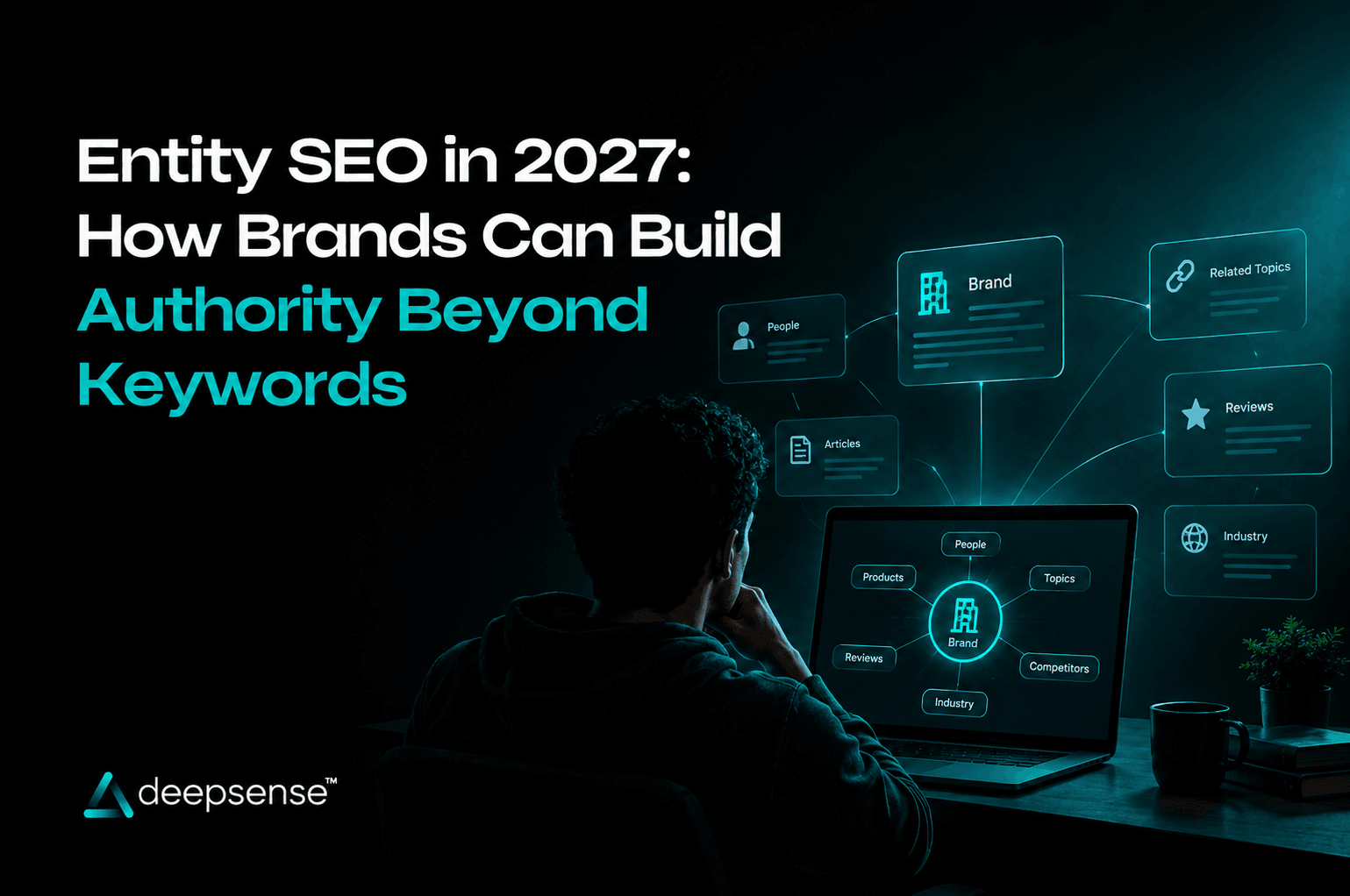
For example, a recognised business entity might be associated with:
- Its official website
- Its founders or leadership
- Its products and services
- Its industry
- Its location
- Related organisations
- Credible publications mentioning the business
These relationships help provide context beyond a single keyword or webpage.
However, brands should understand one important distinction: adding structured data or publishing an About page does not automatically guarantee inclusion in Google’s Knowledge Graph or a Knowledge Panel.
Entity recognition depends on multiple signals, and the exact systems and thresholds are not fully public.
The practical goal is to make the brand’s identity clear, accurate, and consistently supported by credible information.
Why Is Entity SEO Becoming More Relevant for AI Search?
People increasingly use conversational search experiences to ask detailed questions rather than entering only short keywords.
For example, instead of searching for “SEO agency,” someone might ask:
“Which digital marketing agencies can help a B2B company improve organic visibility and generate qualified leads?”
Answering this question requires more context than matching a phrase. The system needs to assess the question, identify relevant businesses and services, and determine which sources may help answer it.
This is one reason entity-based SEO and AI search optimization are often discussed together.
A strong brand presence can help establish:
- What the company does
- Which problems it solves
- Which industries it understands
- What expertise it demonstrates
- What evidence supports its claims
- How its services relate to customer needs
However, entity SEO alone does not guarantee that an AI system will mention or recommend a brand. AI search visibility depends on the particular system, query, available sources, and other factors.
Brands should therefore build entity clarity as part of a broader strategy that includes useful content, technical SEO, reputation, and genuine expertise.
What Is the Role of the Google Knowledge Graph in Entity SEO?
The Google Knowledge Graph helps Google organise information about people, places, organisations, and other real-world entities and the relationships between them.
For brands, this makes accurate and consistent identity information particularly important.
Imagine two businesses with similar names. If their websites, profiles, descriptions, and other public information are inconsistent or incomplete, distinguishing them can be more difficult.
A business can improve clarity by maintaining:
- A clear and consistent official business name
- An accurate About Us page
- Reliable company details
- A clearly defined list of services
- Authoritative leadership or team information
- Relevant official social profiles
- Appropriate structured data
- Consistent information across legitimate business directories
These steps help communicate identity, but they do not guarantee a Knowledge Panel.
A Knowledge Panel is a search feature, not a badge that businesses can claim simply by implementing schema markup.
How Can Brands Build Authority Beyond Keywords?
Building authority requires more than publishing dozens of articles around a target keyword.
A stronger approach connects a brand’s identity, expertise, content, evidence, and reputation.
1. Establish a Clear Brand Identity
Start by defining exactly who the business is and what it offers.
Your website should clearly communicate:
- What the business does
- Who it serves
- Which problems it solves
- What makes its approach distinctive
- Where its expertise lies
Avoid vague positioning that makes the business appear to offer everything to everyone.
For example, a digital agency that clearly explains its capabilities across SEO, design, development, video, and performance marketing gives visitors a more useful understanding of its services than a generic claim such as “We deliver innovative digital solutions.”
2. Build Topic Clusters Around Genuine Expertise
Create connected content around the topics your brand is qualified to discuss.
For an SEO agency, this might include technical SEO, content strategy, search intent, structured data, digital analytics, and AI search optimisation.
Each article should serve a distinct user need while linking naturally to relevant supporting resources and service pages.
This approach strengthens topical organisation and helps readers explore related information without treating every article as an isolated keyword target.
3. Demonstrate Expertise With Evidence
Claims become more credible when supported by real evidence.
Brands can demonstrate expertise through:
- Detailed case studies
- Original research
- Practical demonstrations
- Expert commentary
- Documented project outcomes
- Author biographies
- Customer testimonials
- Relevant industry contributions
For example, an agency claiming expertise in technical SEO can explain the problem it identified, the changes implemented, the limitations involved, and the measured results.
That is more useful than repeating “We are SEO experts” across multiple pages.
Google’s published guidance similarly emphasises helpful, reliable, people-first content and clear evidence of who created it and why readers should trust it.
4. Strengthen Credible External Recognition
Your own website explains who you are. Independent sources can provide additional context about your reputation.
Relevant opportunities may include:
- Industry publications
- Legitimate business directories
- Partner websites
- Conference speaker profiles
- Professional interviews
- Industry association listings
- Genuine customer reviews
- Original research cited by others
The objective is not to accumulate as many mentions as possible. It is to build an accurate and credible reputation in places relevant to your business.
Avoid fake reviews, manufactured mentions, and low-quality link schemes.
How Does Structured Data Support Entity SEO?
Structured data is a standardised way of describing information on a webpage so that search engines can interpret it more clearly.
It can help identify details such as an organisation’s name, website, logo, contact information, and relationships to official profiles.
For appropriate pages, useful schema types may include:
OrganizationPersonWebSiteArticleService, using the relevant Schema.org vocabulary where appropriateBreadcrumbList
For example, an organisation’s structured data might identify its official name, website URL, logo, and official social profiles.
The sameAs property can link an entity to other pages that identify the same entity, provided those references are accurate.
A few important rules apply:
- Markup must accurately reflect the visible page content and real-world information.
- Use relevant properties rather than adding every available field.
- Validate implementation and monitor errors.
- Avoid creating duplicate or conflicting descriptions of the same entity.
- Do not expect schema markup alone to improve rankings or guarantee enhanced search features.
Google explains that structured data can provide explicit clues about page meaning and may enable eligible rich results, but displaying those features is not guaranteed.
What Is the Difference Between Entity SEO and Semantic SEO?
Entity SEO and semantic SEO are closely related, but they are not identical.
Semantic SEO focuses on meaning, context, relationships between concepts, and satisfying the intent behind a search.
Entity SEO focuses more specifically on identifying entities and clarifying their attributes and relationships.
For example, a page about “technical SEO” might cover crawling, indexing, JavaScript rendering, canonicalisation, and structured data. That is a semantic approach because it explains related concepts and how they connect.
Entity optimisation would also help establish which organisation published the content, who authored it, what the company specialises in, and how the article relates to the organisation’s wider expertise.
Together, these approaches help create content that is both contextually useful and clearly attributable.
How Should Brands Build an Entity SEO Strategy for 2027?
An effective entity SEO strategy should begin with an audit rather than immediately adding schema or publishing more content.
Step 1: Audit Your Brand’s Digital Identity
Review your website, business profiles, social accounts, directories, and other important public references.
Check whether your business name, description, website, leadership details, and services are accurate and consistent.
Identify duplicate profiles, outdated information, and conflicting descriptions.
Step 2: Define Your Core Entities
List the important entities associated with your business.
Depending on the organisation, these could include:
- The company itself
- Founders and leadership
- Main services
- Products
- Specialist teams
- Key industry categories
- Original research or proprietary offerings
Only include entities that genuinely exist and are relevant.
Step 3: Map Your Content to These Entities
Review existing pages and determine what each page establishes about your business and its expertise.
Connect related blog posts to relevant service pages, team profiles, case studies, and supporting resources through meaningful internal links.
Avoid forcing every page to mention the same list of keywords or services.
Step 4: Implement Relevant Structured Data
Add accurate structured data to the pages where it makes sense.
Use an appropriate Organization schema for the business, Person schema for relevant individuals, and other types according to the actual content.
Keep entity identifiers consistent where appropriate, and use official profile links only when they truly refer to the same entity.
Step 5: Build External Credibility
Seek genuine opportunities to demonstrate expertise beyond your website.
Publish original insights, contribute to relevant industry discussions, build legitimate partnerships, and make it easy for others to reference your work accurately.
Step 6: Monitor Recognition and Performance
Review your organic search performance, branded queries, referring domains, relevant brand mentions, and available AI referral or citation data.
Treat these metrics as complementary indicators rather than proof of entity recognition on their own.
Repeat the audit periodically as your brand, services, and online presence evolve.
How Can You Measure the Success of Entity-Based SEO?
Entity SEO does not have one universal score.
A practical measurement framework should combine traditional SEO outcomes with indicators of brand clarity and recognition.
| Area | What to Measure |
|---|---|
| Organic visibility | Relevant non-branded and branded impressions, clicks, and rankings |
| Brand discovery | Branded search trends and relevant search queries |
| Website structure | Internal linking, crawlability, and indexation |
| Structured data | Valid markup and relevant Search Console enhancements |
| External credibility | Relevant mentions, referring domains, and quality of references |
| Business outcomes | Qualified leads, conversions, and assisted conversions |
| AI search visibility | Relevant mentions or citations in selected AI search experiences, where measurable |
Not every metric directly measures entity understanding. For example, a rise in branded searches may reflect stronger awareness, but it does not prove that Google has added the company to the Knowledge Graph.
Use multiple indicators, compare them over time, and connect improvements to business outcomes where possible.
What Entity SEO Mistakes Should Brands Avoid?
Entity optimisation can become counterproductive when brands focus on signals instead of accuracy and usefulness.
Watch out for these common mistakes:
Adding schema without fixing inconsistent information. Structured data cannot compensate for conflicting or inaccurate business details.
Creating content just to appear authoritative. A large volume of repetitive articles does not automatically establish expertise.
Overusing keywords and entity names. Repeating a brand, person, or topic unnaturally can make content harder to read.
Creating fake external recognition. Manufactured reviews and misleading profiles can damage trust.
Expecting an instant Knowledge Panel. Search engines make their own decisions about entity recognition and search presentation.
Ignoring traditional SEO fundamentals. Crawlability, useful content, relevant internal links, accessibility, and sound technical implementation remain important.
The strongest entity SEO work is built on clarity, evidence, and genuine expertise—not shortcuts.
What Does the Future of Entity SEO Look Like in 2027?
The future of entity SEO is likely to involve a closer relationship between technical clarity, useful content, digital reputation, and search experiences that interpret complex questions.
Brands should prepare by building a digital presence that consistently answers five questions:
- Who are you?
- What do you do?
- Who do you help?
- What expertise can you demonstrate?
- Why should people trust your information?
This matters whether someone discovers the business through a traditional search result, an industry publication, a social platform, or an AI-assisted search experience.
But the objective should not be to optimise exclusively for one search platform or to chase every emerging AI feature.
It should be to create an accurate, useful, well-connected, and credible representation of the business across the web.
That is a more durable foundation than relying on individual keyword rankings alone.
Final Takeaway: Can Entity SEO Help Brands Build Authority Beyond Keywords?
Yes, entity SEO provides a useful framework for making a brand’s identity, expertise, and relationships clearer across its digital presence.
But authority is not created by schema markup alone, and no single tactic guarantees rankings, Knowledge Graph inclusion, or AI citations.
Brands need to combine clear positioning, helpful content, accurate structured data, meaningful internal links, credible external recognition, and measurable SEO performance.
As search continues to evolve, the stronger question is not simply:
“Which keywords should our brand rank for?”
It is:
“When people and search systems encounter our brand, can they clearly understand who we are, what we know, and why our expertise matters?”
That is the foundation of a sustainable entity SEO strategy for 2027.
FAQs
What is Entity SEO?
Entity SEO is the practice of helping search engines identify and understand a brand, person, product, or concept and its relationships with other entities.
Is Entity SEO more important than keywords?
Entity SEO does not replace keyword optimisation. Keywords help connect pages with search queries, while entity optimisation adds context about the subjects, organisations, and expertise represented by those pages.
How does Entity SEO help with AI search optimization?
Clear brand information, useful content, and credible supporting sources can help AI search systems interpret a business and its expertise. However, entity optimisation does not guarantee that a brand will be cited or recommended by AI systems.
What is the Google Knowledge Graph?
The Google Knowledge Graph is a system that organises information about real-world entities and their relationships to help Google understand information and answer relevant queries.
Does structured data improve Entity SEO?
Structured data can provide explicit information about a page and the entities it describes. It should be accurate and relevant, but it does not independently guarantee higher rankings, Knowledge Panel inclusion, or rich results.
How can a small business implement an Entity SEO strategy?
Start with a clear About page, accurate business information, consistent official profiles, useful content around genuine expertise, appropriate structured data, and relevant internal links. Build external recognition through legitimate industry participation and customer relationships.
What is the difference between Entity SEO and semantic SEO?
Semantic SEO focuses on meaning, context, and relationships between concepts. Entity SEO focuses more specifically on identifying subjects and clarifying their attributes and relationships. The two approaches work well together.
How long does Entity SEO take to show results?
There is no fixed timeline. Changes to structured data or website clarity may be implemented relatively quickly, but building recognition and credibility can take considerably longer. Monitor search performance and business outcomes instead of relying on a guaranteed timeframe.