
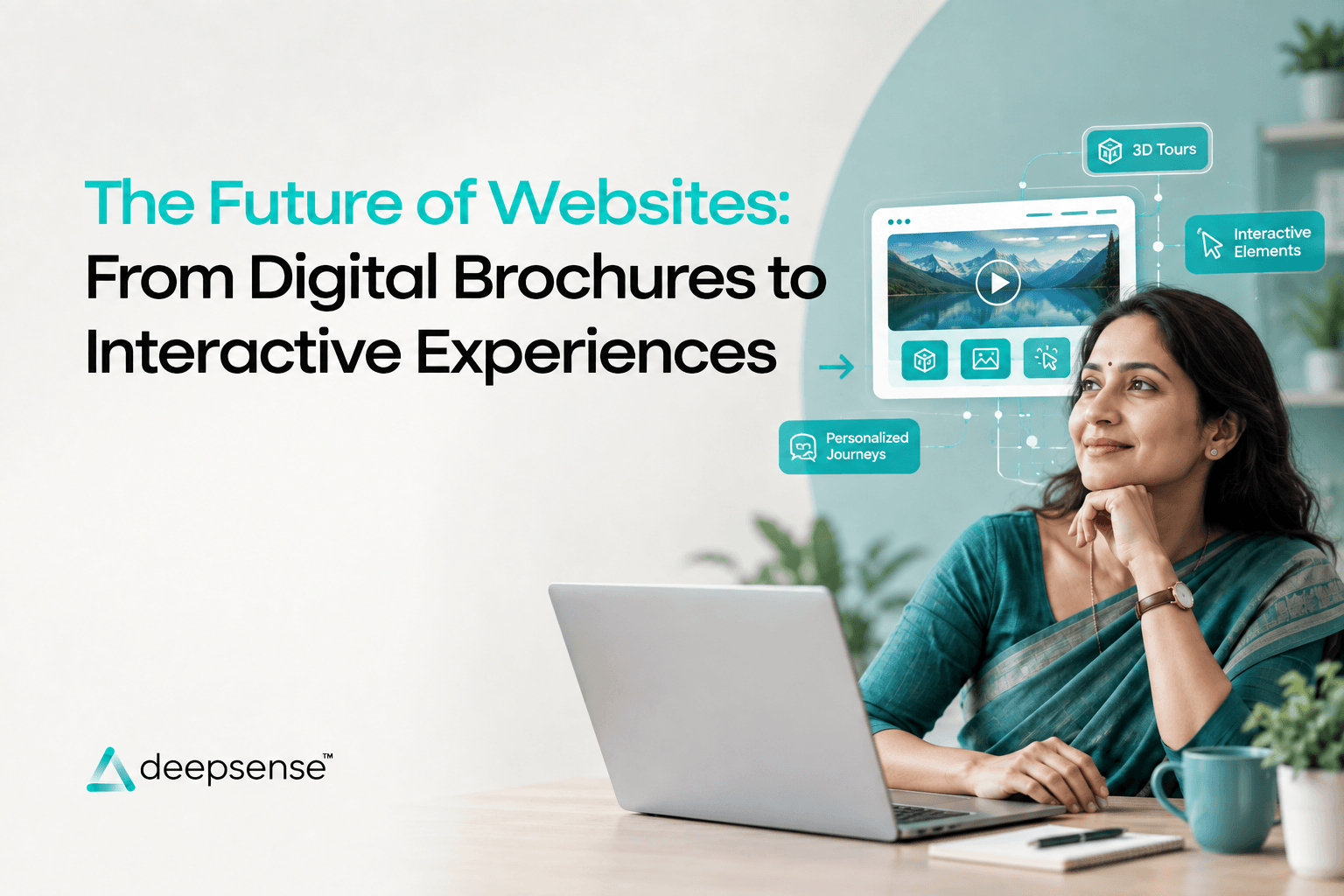
For years, a business website was treated like a digital brochure: a homepage, an About Us page, a list of services, a few images, and a contact form.
But that model is changing.
Today, people expect websites to do more than provide information. They expect websites to respond, guide, personalise, demonstrate, and create experiences.
This shift is shaping the future of websites.
Modern brands are moving towards interactive websites, immersive interfaces, personalised content, AI-powered experiences, and smarter website user experiences that make visitors active participants rather than passive readers.
So, what will websites look like in the coming years? And how should businesses prepare for this change?
Why Are Websites Moving Beyond Digital Brochures?
A traditional website mainly answers one question:
“Who are you and what do you offer?”
Modern websites need to answer much more:
- Why should I choose you?
- Which product or service is right for me?
- Can I see how this works?
- Can I interact with the experience?
- Can I get an answer immediately?
- What should I do next?
This is why the future of web design is increasingly focused on interaction and usefulness rather than simply visual presentation.
A website should not just display information. It should help users experience it.
What Is an Interactive Website?
An interactive website allows visitors to actively engage with content instead of simply scrolling through static pages.
Interaction can include:
- Product configurators
- Calculators
- Quizzes
- Interactive animations
- Dynamic product demonstrations
- Personalised recommendations
- Interactive maps
- Before-and-after sliders
- Scroll-based storytelling
- AI-powered assistants
- Dynamic dashboards
For example, instead of a furniture company showing 20 images of a sofa, an interactive website could allow users to change colours, fabrics, configurations, and room settings.
That creates an interactive web experience rather than a standard product page.
Why Is Website User Experience Becoming More Important?
A beautiful website is not necessarily a useful website.
Visitors need to understand where they are, what they can do, and where they should go next.
This makes website user experience one of the most important considerations in modern website design.
A strong experience should make it easy for users to:
Discover → Understand → Explore → Decide → Act
If a website looks impressive but makes users work hard to find information, the design is not solving the real problem.
The future is therefore not simply about making websites more visually complex.
It is about making them more intuitive and useful.
What Are the Biggest Website Trends in 2026?
The website trends 2026 are moving towards experiences that combine design, technology, content, and personalisation.
Some important directions include:
1. AI-Powered Website Experiences
AI can help websites deliver more personalised and responsive experiences.
For example, AI can support:
- Conversational search
- Product recommendations
- Content personalisation
- Customer support
- Automated assistance
- Smarter website navigation
Instead of every visitor seeing exactly the same journey, websites can increasingly adapt based on user needs and behaviour.
2. Interactive Product Experiences
Brands are finding new ways to allow customers to experience products before making a decision.
For example:
Car brands: configure vehicles and explore features.
Interior brands: visualise products in different environments.
SaaS companies: interact with product demonstrations.
E-commerce brands: customise products before purchasing.
This makes the website part of the product discovery process.
3. Motion and Micro-Interactions
Small animations can provide useful feedback and make interfaces feel more responsive.
Examples include:
- Animated buttons
- Hover interactions
- Progress indicators
- Smooth transitions
- Scroll animations
- Interactive cards
However, motion should support usability rather than distract from it.
Good interactive website design makes interactions feel purposeful.
4. Personalised Experiences
Why should every visitor experience the same website?
A returning customer may need different information from a first-time visitor.
Future websites can increasingly adapt content, recommendations, offers, and navigation according to context.
This could make websites feel less like static pages and more like digital assistants.
5. Immersive Storytelling
Some brands are using animation, video, 3D elements, and interactive storytelling to communicate complex ideas.
Instead of saying:
“Our technology is advanced.”
A website can demonstrate how the technology works.
That difference can turn a claim into an experience.
Will AI Change the Way Websites Are Designed?
Yes, but AI is unlikely to make traditional web design irrelevant.
Instead, AI is changing how websites are planned, built, personalised, and maintained.
AI can help teams with:
- User research analysis
- Content creation
- Design exploration
- Prototyping
- Personalisation
- Chat interfaces
- Search experiences
- Code generation
- Testing and optimisation
This means designers and developers can spend more time solving experience problems rather than repeating manual tasks.
The real opportunity is not simply AI-generated websites.
It is using AI to create better digital experiences.
Are Interactive Websites Better Than Simple Websites?
Not necessarily.
The goal should not be to make every website interactive.
A simple website can sometimes provide a better experience than an overloaded interactive one.
For example, a local service business may simply need:
- Clear services
- Location information
- Reviews
- Contact details
- Booking options
Adding unnecessary animations and interactions could make the experience slower and harder to use.
The right question is:
“What interaction helps the user?”
Not:
“What interaction can we add?”
That distinction will become increasingly important in the future of websites.
How Will Modern Website Design Change?
Modern website design is moving from page-focused thinking to experience-focused thinking.
Traditional approach:
Homepage → About → Services → Contact
Experience-led approach:
User need → Discovery → Interaction → Personalisation → Action
This means designers need to think about the complete customer journey rather than designing individual pages in isolation.
The website becomes a connected experience rather than a collection of URLs.
What Role Will 3D and Immersive Experiences Play?
3D can be particularly valuable for brands selling products that are difficult to understand through static images.
For example:
- Architecture
- Real estate
- Automotive
- Manufacturing
- Furniture
- Interior design
- Consumer products
- Industrial equipment
A visitor could rotate a product, explore its components, change configurations, or understand how it works.
For these industries, immersive experiences can communicate information that paragraphs of text cannot.
Will Websites Become More Like Apps?
In some ways, yes.
Websites are increasingly incorporating app-like experiences such as:
- Personalised dashboards
- Real-time updates
- Interactive tools
- Notifications
- Saved preferences
- Account-based experiences
- Dynamic interfaces
However, websites still have an important advantage: accessibility through a browser without necessarily requiring a separate app installation.
This makes the web an increasingly flexible platform for digital experiences.
What Does This Mean for B2B Websites?
The shift is especially interesting for B2B brands.
Many B2B websites still rely heavily on product descriptions, company information, downloadable PDFs, and enquiry forms.
But B2B buyers increasingly research independently before speaking with sales teams.
A modern B2B website could offer:
- Interactive product selectors
- ROI calculators
- Industry-specific recommendations
- Product configurators
- Interactive case studies
- Technical explainers
- Comparison tools
- AI-powered Q&A
- Self-service resource centres
Instead of simply saying “Contact our sales team,” the website can help prospects understand whether the solution is relevant first.
That can make the website a more valuable part of the sales journey.
How Will SEO Change as Websites Become More Interactive?
Interactive experiences still need to be discoverable.
A visually impressive website cannot generate organic visibility if search engines and users cannot understand its content.
Therefore, the future of websites will require a balance between:
Experience + Accessibility + Searchability
Important foundations will continue to include:
- Clear information architecture
- Crawlable content
- Strong internal linking
- Descriptive headings
- Structured data where appropriate
- Fast performance
- Mobile usability
- Accessible content
- Helpful, original information
Interactive elements should enhance the content rather than hide important information from users and search engines.
Can Interactive Experiences Improve Conversions?
They can, when they remove uncertainty or make decision-making easier.
Consider a visitor looking for industrial equipment.
A traditional page might provide specifications and a contact form.
An interactive experience could let the visitor:
Choose application → Select requirements → Compare options → See recommended product → Request a quote
The website is now helping the user make a decision.
That is where engaging website experiences can become commercially valuable.
The objective is not interaction for entertainment.
It is interaction that moves the user closer to an informed action.
What Should Businesses Do to Prepare for the Future of Websites?
Businesses do not need to completely rebuild their websites overnight.
Instead, they can start by identifying where the current experience creates friction.
Ask:
- Where do visitors leave?
- Which information is difficult to find?
- What questions does the sales team answer repeatedly?
- Which products are difficult to understand?
- Where do customers hesitate before enquiring?
- What could be demonstrated instead of explained?
- Which parts of the customer journey could be personalised?
These answers can reveal opportunities for interactive experiences.
A calculator may solve one problem.
A product configurator may solve another.
An AI assistant may solve another.
The future does not require one giant interactive website. It requires better digital experience design.
What Will the Future of Websites Actually Look Like?
The future is unlikely to be one specific visual style.
Instead, websites will increasingly become a combination of:
Content + Design + Data + AI + Interaction + Personalisation
The website of the future may understand what visitors are looking for, help them navigate information, demonstrate products, answer questions, and guide them towards relevant actions.
In other words, websites are moving from:
“Here is information about our business.”
to:
“Here is an experience that helps you solve your problem.”
That is the bigger shift behind the future of websites.
What Should Brands Focus on When Building Their Next Website?
Before investing in complicated technology, brands should focus on the fundamentals.
A future-ready website should be:
Useful
It should answer real customer questions.
Easy to navigate
Visitors should not have to search endlessly for important information.
Fast
Interactive experiences should not come at the expense of performance.
Accessible
The experience should work for as many users as possible.
Search-friendly
Important content should remain discoverable.
Interactive where necessary
Interaction should solve a problem, not simply decorate the interface.
Scalable
The website should be able to evolve as the business grows.
The strongest website development trends are not about adding every new technology.
They are about choosing technology that creates measurable value.
Final Takeaway: Are Websites Becoming Experiences Instead of Brochures?
Yes the role of a website is expanding.
A website is no longer just a place where customers verify that a company exists.
It can become a product discovery platform, sales tool, educational resource, brand experience, support channel, and conversion engine.
The future of websites will therefore belong to brands that think beyond pages and start thinking in terms of experiences.
The question is no longer:
“Does our business have a website?”
It is:
“What can someone actually experience, understand, and accomplish on our website?”
That is where the next generation of web design is heading.
FAQs
What is the future of websites?
The future of websites is moving towards interactive, personalised, AI-assisted, and experience-focused digital platforms rather than static information pages.
What are interactive websites?
Interactive websites allow users to actively engage with content through tools, animations, calculators, configurators, quizzes, personalisation, and other interactive elements.
What are the major website trends in 2026?
Key trends include AI-powered experiences, interactive product demonstrations, personalisation, immersive storytelling, conversational interfaces, motion design, and experience-led website development.
Will AI replace web designers?
AI can automate and assist with many parts of website creation, but human designers remain important for understanding users, developing creative direction, solving experience problems, and making strategic design decisions.
Are interactive websites good for SEO?
They can be, provided important content remains accessible, crawlable, fast, mobile-friendly, and supported by strong information architecture and technical SEO.
Should every business build an interactive website?
No. The right level of interactivity depends on the business, audience, customer journey, and purpose of the website. Interaction should solve a genuine user problem rather than exist simply because it is a trend.
What is the difference between modern website design and traditional website design?
Traditional websites often focus on presenting company information through static pages. Modern website design increasingly focuses on user journeys, interaction, personalisation, usability, and measurable outcomes.
What is the future of web design?
The future of web design is likely to combine human-centred design with AI, data, interactive interfaces, immersive media, and personalised digital experiences.