
For years, FAQ schema was one of the easiest SEO wins.
Add structured FAQ markup, and your page could gain:
- extra SERP visibility,
- expandable question sections,
- better click-through rates,
- and stronger search presence.
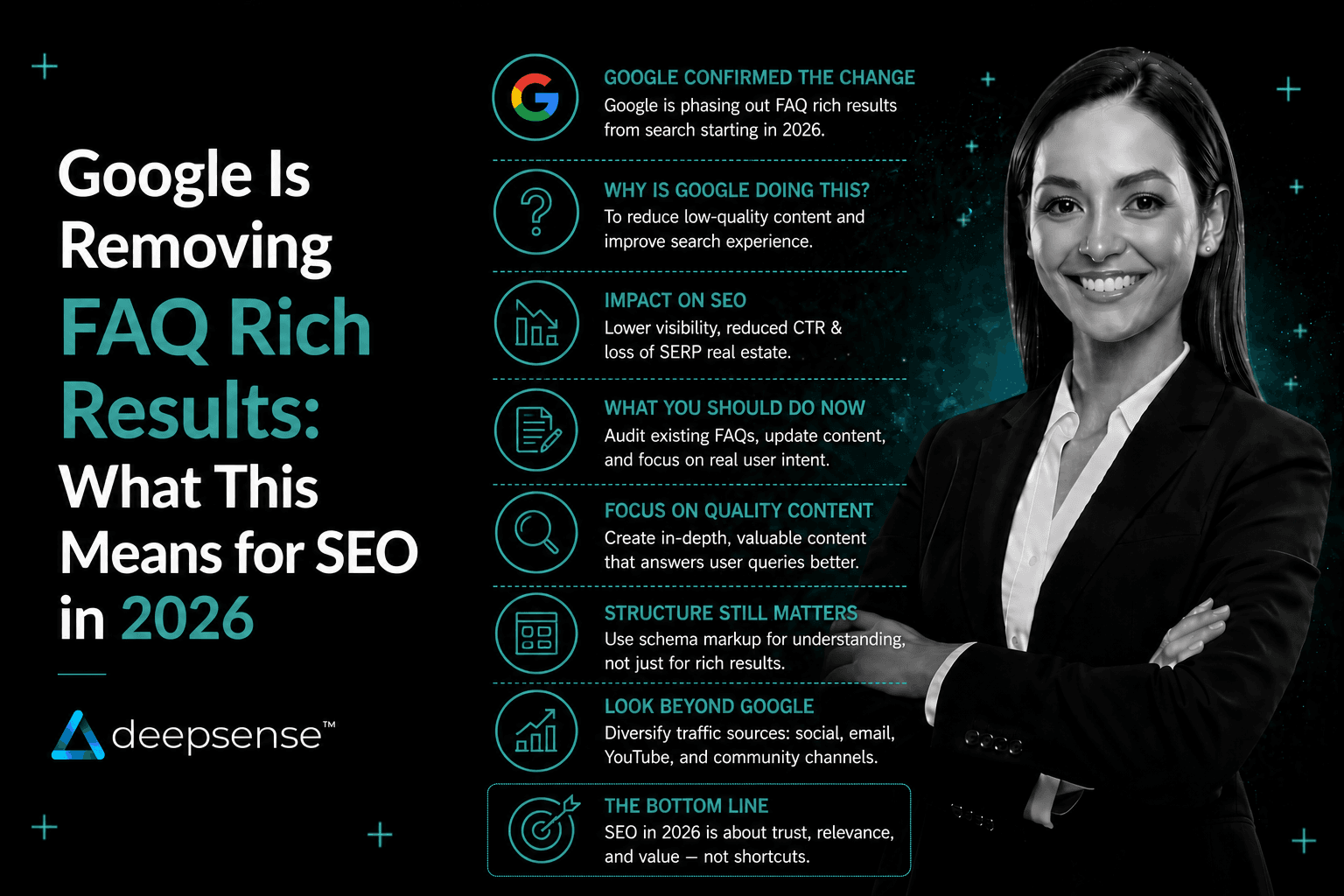
But now, Google is dramatically reducing FAQ rich results visibility.
And this shift is changing how SEO works in 2026.
The reality is:
SEO is moving away from “search appearance tricks” and toward deeper content quality, AI readability, and answer-engine optimization.
That’s why the conversation around Google removing FAQ rich results matters much more than people realize.
This isn’t just a schema update.
It’s a signal about where search is heading next.
What Exactly Is Changing?
Google has already significantly reduced the visibility of FAQ rich results across standard search listings.
Earlier:
many websites could display expandable FAQ sections directly in SERPs.
Now:
Google shows FAQ rich results only in highly limited situations and mainly for authoritative or government-oriented content types.
This major Google FAQ schema update means most websites will no longer get the same visual SERP enhancement they once relied on.
So while FAQ schema itself is not completely “dead,” its SEO value has changed dramatically.
Why Google Is Reducing FAQ Rich Results
Google’s goal is becoming increasingly clear:
cleaner search results
less SERP clutter
more trustworthy answers
stronger AI-generated experiences
Over time, FAQ rich results became heavily overused.
Many websites added:
- repetitive FAQs,
- keyword-stuffed questions,
- low-value schema,
- irrelevant structured content.
As a result:
Google reduced visibility to improve search quality.
This is one of the biggest structured data SEO changes in recent years.
Does FAQ Schema Still Matter in 2026?
Yes but differently.
This is where many marketers misunderstand the update.
FAQ schema still helps:
- search engines understand context,
- improve content structure,
- organize entity relationships,
- support AI readability,
- assist answer extraction.
But the benefit is no longer primarily:
“getting fancy dropdown SERP results.”
Instead, FAQ content now supports:
- GEO,
- AEO,
- AI search understanding,
- semantic clarity.
That’s why FAQ schema SEO 2026 is evolving rather than disappearing.
The Bigger Shift: SEO Is Moving Toward AI Search
This update reflects a larger industry transformation.
Search is no longer only:
“10 blue links.”
Users now get answers from:
- Google AI Overviews,
- ChatGPT,
- Gemini,
- Perplexity,
- voice assistants,
- AI-generated summaries.
This means search engines care more about:
- answer clarity,
- contextual structure,
- topical authority,
- semantic understanding.
This is the rise of:
AI search SEO strategy
And FAQ content still plays a role in that ecosystem.
What SEO Professionals Need to Understand Now
The old mindset was:
“Add FAQ schema to increase SERP space.”
The new mindset should be:
“Structure content so AI systems understand and extract answers easily.”
That is a massive strategic difference.
FAQ Rich Results Removed: What Businesses Are Losing
Let’s be realistic.
The reduction of FAQ rich snippets does remove some advantages.
1. Reduced Visual Dominance in SERPs
Earlier:
FAQ dropdowns occupied more screen space.
That increased:
- visibility,
- CTR,
- perceived authority.
Now many listings appear smaller again.
2. Lower CTR for Some Pages
Pages that relied heavily on FAQ rich snippets may see:
- reduced clicks,
- lower engagement,
- less SERP differentiation.
Especially for informational content.
3. Less “Easy Win” SEO Tactics
SEO is becoming harder to game with markup-only strategies.
Google increasingly rewards:
- depth,
- quality,
- expertise,
- usefulness.
Why This Update Is Actually Important for Better SEO
Ironically, this change may improve SEO quality overall.
Because now businesses must focus on:
- genuine authority,
- useful content,
- trust,
- better user experience.
Instead of relying on:
schema manipulation alone.
This aligns strongly with:
- EEAT,
- GEO,
- AEO,
- AI content evaluation systems.
The Future of SEO 2026: What Matters More Now
As FAQ rich results reduce, these areas become more important.
1. Topical Authority
Google increasingly prefers sites that deeply cover subjects.
Meaning:
- topic clusters,
- semantic relevance,
- interconnected content,
matter more than isolated schema tricks.
This is central to the future of SEO 2026.
2. AI Readability
AI systems prefer content that is:
- clearly structured,
- answer-focused,
- concise yet detailed,
- logically organized.
Well-written FAQ sections still help with this.
3. GEO (Generative Engine Optimization)
SEO is evolving into optimization for:
- AI-generated answers,
- conversational search,
- citation systems.
This means:
clear Q&A formatting still matters.
Even if rich snippets shrink.
4. EEAT Signals
Google continues prioritizing:
- Experience,
- Expertise,
- Authoritativeness,
- Trustworthiness.
That means:
real insights outperform template-based FAQ stuffing.
5. User Intent Satisfaction
Google increasingly measures:
- whether content solves the query,
- whether users stay,
- whether answers feel complete.
Search satisfaction matters more than markup quantity.
Should You Still Use FAQ Schema?
Yes strategically.
Do NOT:
spam unnecessary questions
add keyword-heavy filler FAQs
use FAQs unrelated to user intent
Instead:
add genuinely useful questions
structure answers clearly
support conversational search
improve AI extraction potential
This is the smarter approach to schema markup changes in 2026.
What Smart SEO Teams Are Doing Now
Leading SEO teams are shifting from:
“How do we get bigger SERP snippets?”
to:
“How do we become the source AI engines trust and summarize?”
That changes content strategy entirely.
Now they focus more on:
- entity optimization,
- conversational structure,
- semantic relevance,
- topical authority,
- AI answer extraction,
- content trust signals.
The Real SEO Lesson Behind This Update
Google’s reduction of FAQ rich results sends a larger message:
superficial SEO advantages are becoming less valuable.
Search engines now prioritize:
- usefulness,
- clarity,
- trust,
- contextual understanding.
Which means modern SEO success comes less from technical loopholes…
and more from becoming genuinely valuable.
Final Takeaway
Yes, Google removing FAQ rich results changes traditional SEO visibility strategies.
But it does not mean FAQ content is useless.
Instead, it signals a deeper transition:
from SERP manipulation
to AI-ready information architecture.
In 2026, the brands that win search visibility will not simply be the ones using more schema.
They will be the ones creating:
structured knowledge
trustworthy content
AI-readable answers
genuine topical authority
Because the future of SEO is no longer just about ranking pages.
It is about becoming the answer itself.
FAQs
1. Is Google removing FAQ rich results completely?
No. Google has significantly reduced FAQ rich results visibility for most websites, but FAQ schema still exists and may appear in limited cases.
2. Does FAQ schema still help SEO in 2026?
Yes. FAQ schema still helps with content structure, AI readability, semantic understanding, and answer engine optimization even if rich snippets appear less frequently.
3. Why did Google reduce FAQ rich results?
Google reduced FAQ rich results to decrease SERP clutter, improve search quality, and limit low-value or spammy schema usage.
4. What replaces FAQ rich results in future SEO strategy?
Future SEO focuses more on AI search optimization, topical authority, EEAT, conversational content, and structured answer-focused writing.
5. Should websites continue using FAQ schema?
Yes, but strategically. Businesses should use relevant, user-focused FAQs that genuinely improve content clarity and search understanding.