
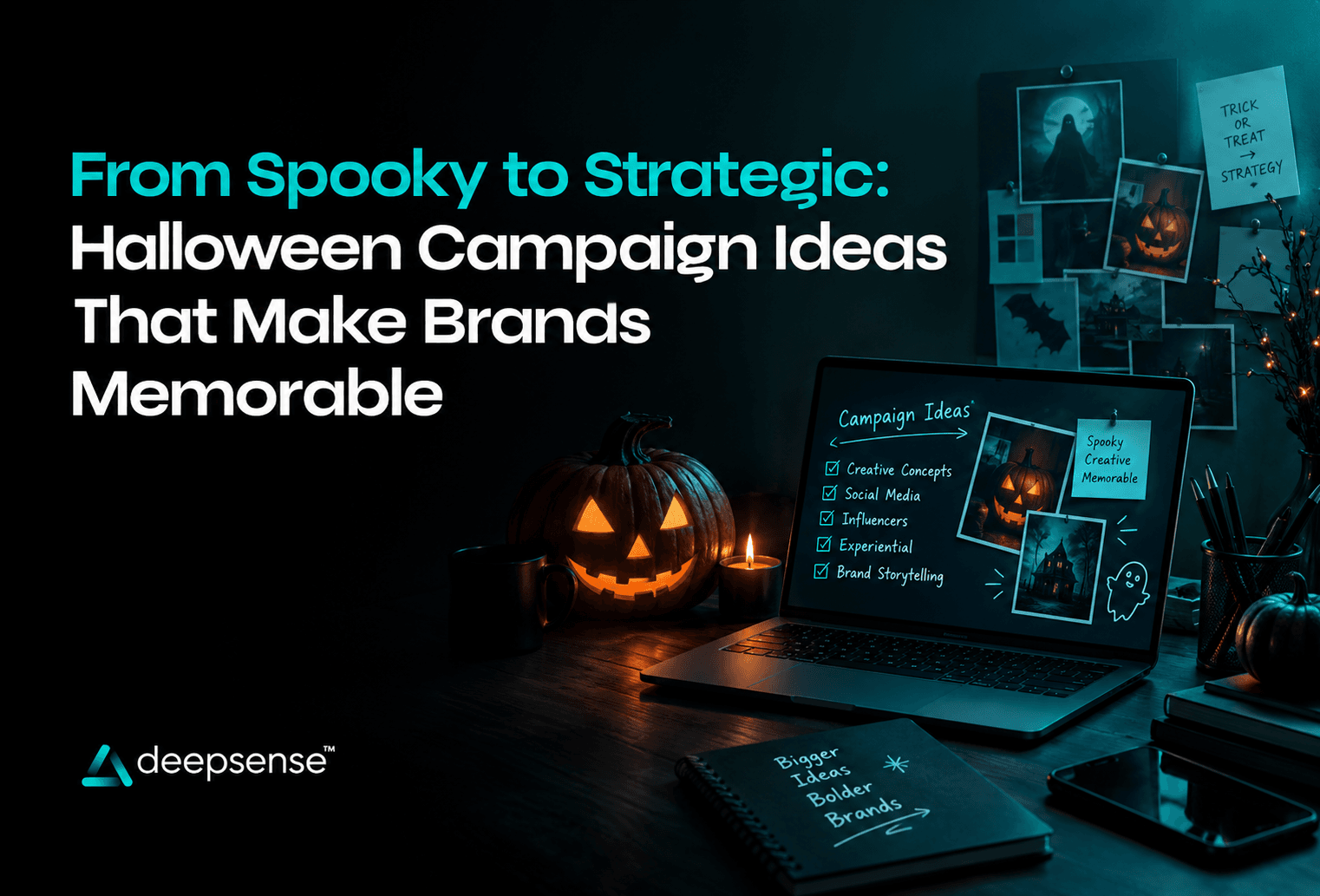
Every Halloween, social media fills with pumpkins, ghosts, skeletons, spooky fonts, and orange-and-black creatives. Brands join the celebration, publish a festive greeting, and move on.
But here’s the problem: when every brand looks spooky, how does anyone remember yours?
The opportunity lies in turning Halloween into more than a seasonal design theme. It can become a creative platform for storytelling, customer participation, product discovery, brand positioning, and lead generation.
The most effective Halloween marketing ideas don’t simply make people stop scrolling. They give people a reason to remember the brand after the spooky season ends.
From interactive campaigns and unexpected product transformations to suspense-driven Reels and playful brand experiences, here are 25 creative concepts designed to make Halloween marketing more strategic.
Why Should Brands Think Beyond Traditional Halloween Posts?
A generic Halloween greeting can help a brand participate in a seasonal moment, but it may not communicate anything distinctive about the business.
A stronger campaign connects three things:
- The Halloween hook: What makes someone curious?
- The brand connection: Why does this idea make sense for your business?
- The marketing objective: What should the audience do, feel, remember, or discover?
For example, a cybersecurity company could turn common online threats into Halloween monsters. A skincare brand could reveal the hidden ingredients behind a product. A digital agency could create a horror story about a website that attracts traffic but generates zero leads.
Each concept uses Halloween creatively while reinforcing the brand’s expertise.
That is the difference between seasonal decoration and strategic marketing.
25 Creative Halloween Marketing Ideas That Go Beyond Pumpkins
1. What If Your Brand’s Biggest Problem Became the Halloween Villain?
Campaign concept: Meet Your Brand’s Nightmare.
Turn the biggest problem your product or service solves into a Halloween villain.
Examples:
- Digital marketing agency: The Traffic Vampire, draining budgets without generating leads.
- Cybersecurity company: The Data Phantom, stealing sensitive information.
- Productivity software: The Deadline Monster, consuming every working hour.
- Skincare brand: The Mystery Ingredient, hiding behind confusing product labels.
- Financial services brand: The Fee Goblin, quietly eating into savings.
Creative execution: Introduce the villain in a suspenseful Reel, reveal its destructive behaviour, and show how the brand helps defeat it.
Hook: “Some nightmares don’t disappear when you wake up.”
Strategic goal: Brand positioning and product education.
2. Can You Turn Your Product Into Something Nobody Expects?
Campaign concept: The Product Transformation.
Take an ordinary product and transform it into something unexpectedly spooky.
Imagine a regular perfume bottle becoming a mysterious potion, a coffee cup developing a monster’s shadow, or a software dashboard turning into a haunted control room.
The transformation can be created using practical effects, editing, animation, or AI-assisted visuals.
Creative execution: Begin with an ordinary product shot, build suspense through quick cuts, and reveal the transformed product in the final frame.
Hook: “Something strange happened to our bestseller.”
Strategic goal: Product awareness, video engagement, and creative differentiation.
The twist should make the product more memorable not hide what the brand actually sells.
3. What If Your Website Became a Haunted House?
Campaign concept: Enter If You Dare.
Turn your website into a Halloween discovery experience.
Visitors might encounter hidden messages, spooky cursor effects, secret product pages, or clues scattered across selected pages.
For a digital agency, the experience could even include a playful “haunted website audit” that reveals fictional website mistakes before offering a real checklist.
Creative execution: Promote the experience through a Reel and invite visitors to find a hidden clue or unlock a special resource.
Hook: “There are three hidden secrets on our website. Can you find them?”
Strategic goal: Website traffic, exploration, and lead generation.
Keep the experience fast, accessible, mobile-friendly, and easy to exit. The objective is to create curiosity, not make the website genuinely difficult to use.
4. Can Your Audience Guess the Halloween Reveal?
Campaign concept: The Mystery Drop.
Build anticipation around a product, offer, collaboration, or announcement without revealing everything immediately.
For three days, publish a series of visual clues.
- Day 1: A mysterious silhouette.
- Day 2: A close-up of one recognisable feature.
- Day 3: A final clue with a countdown.
- Reveal day: The product, collaboration, or offer is unveiled.
Creative execution: Reels, Stories, email teasers, and a final reveal post.
Hook: “Something is coming out of the shadows.”
Strategic goal: Anticipation, repeat engagement, and product discovery.
This works best when the reveal is genuinely worth waiting for. Mystery without a meaningful payoff can quickly frustrate an audience.
5. What Are the 10 Scariest Things in Your Industry?
Campaign concept: The Industry Horror List.
Create a carousel that exposes the everyday problems customers fear most.
For a digital marketing agency:
- Traffic without conversions.
- Ads without qualified leads.
- Rankings that never translate into enquiries.
- A website nobody can navigate.
- Content nobody remembers.
- Reports full of vanity metrics.
- Inconsistent brand messaging.
- Broken conversion tracking.
- Marketing budgets without clear priorities.
- A strategy that never gets reviewed.
Creative execution: Use horror-poster visuals, dramatic typography, and one problem per slide.
Hook: “Forget ghosts. These are the real marketing nightmares.”
Strategic goal: Thought leadership, saves, shares, and qualified enquiries.
This is one of the strongest Halloween post ideas for brands that want to demonstrate expertise rather than simply entertain.
6. Can You Create a Reel That Looks Like a Horror Movie Trailer?
Campaign concept: The Nightmare Before the Purchase.
Use the structure of a horror trailer to dramatise a relatable customer problem.
For example, a B2B software company could show an employee battling endless spreadsheets. A logistics brand could portray a shipment disappearing into a maze of delays. A marketing agency could depict a business owner refreshing an analytics dashboard with no leads in sight.
Structure the Reel like this:
Normal day → Strange warning → Problem escalates → Dramatic reveal → Brand solution.
Hook: “This October, one business discovered the terrifying truth about its marketing.”
Strategic goal: Brand awareness, video completion, and problem-solution storytelling.
The creative trick is to make the audience recognise the problem before revealing the solution.
7. What If Your Brand Offered a “Trick or Treat” Choice?
Campaign concept: Choose Your Treat.
Let customers choose between two options through Instagram Stories, a landing page, or a campaign email.
For example:
- Trick: Guess which product is right for you.
- Treat: Get a personalised recommendation.
Or:
- Trick: Take the five-question marketing challenge.
- Treat: Receive a practical checklist based on your score.
E-commerce brands could offer a surprise reward after customers complete a simple interaction.
Hook: “Choose wisely. Your treat depends on it.”
Strategic goal: Engagement, preference collection, and product discovery.
If the campaign collects customer information, explain how it will be used and obtain appropriate consent.
8. Can Your Brand Turn Customer Reviews Into Spooky Stories?
Campaign concept: The Reviews That Haunt Us—in a Good Way.
Turn genuine customer reviews into a creative Halloween series.
For example, a customer saying, “I couldn’t stop using this product,” could inspire a playful spooky visual about a product that keeps coming back.
A B2B brand might dramatise a customer describing how a frustrating process disappeared after adopting its solution.
Creative execution: Review snippets, animated text, customer video, or short-form storytelling.
Hook: “These reviews are haunting us. And we’re not complaining.”
Strategic goal: Social proof, credibility, and conversion support.
Use authentic reviews, preserve their meaning, and obtain permission when required. Do not invent testimonials or imply that a fictional story is a real customer experience.
9. What If Your Audience Could Create the Campaign?
Campaign concept: Your Halloween Alter Ego.
Invite people to share a Halloween-themed version of themselves, their work personality, or their favourite product.
Examples:
- Designers: The Pixel Perfectionist.
- Marketers: The Deadline Witch.
- Developers: The Bug Hunter.
- Entrepreneurs: The Midnight Founder.
- Students: The Assignment Ghost.
Participants can share a template, create their own version, or tag the brand.
Hook: “Who are you after 6 PM on Halloween?”
Strategic goal: User-generated content, community participation, and organic reach.
Make participation easy and offer clear instructions about reposting content.
10. Can You Make Your Brand the Solution to a Digital Nightmare?
Campaign concept: Exorcise the Problem.
For service-based brands, use Halloween as a metaphor for removing a persistent problem.
Examples:
- SEO agency: Exorcise invisible search rankings.
- Web development company: Banish slow-loading pages.
- Email marketing team: Escape the spam folder.
- Design studio: Defeat forgettable brand identities.
- Analytics team: Remove the ghost of unreliable data.
Creative execution: A before-and-after Reel showing the problem haunting a business and the solution restoring order.
Hook: “Your business doesn’t need another ghost. It needs a better strategy.”
Strategic goal: Lead generation and service differentiation.
This concept is particularly useful for creative Halloween advertising because the seasonal metaphor naturally explains the service’s value.
11. What If Your Product Had a Secret Halloween Identity?
Campaign concept: The Alter Ego Reveal.
Give an existing product a temporary Halloween personality.
A perfume could become a midnight potion. A productivity app could become a time-saving spell. A fashion collection could transform into a mysterious character wardrobe.
For a B2B brand, a familiar product could be presented as the “silent hero” that solves problems behind the scenes.
Creative execution: Introduce the normal product, tease its hidden personality, and reveal its Halloween alter ego.
Hook: “You know our product. But have you met its darker side?”
Strategic goal: Product recall, storytelling, and creative differentiation.
The Halloween identity should strengthen the product’s existing positioning rather than confuse customers about what it does.
12. Can You Turn a Boring Industry Topic Into a Spooky Quiz?
Campaign concept: Which Marketing Monster Are You?
Create a quiz that gives users a playful result based on their answers.
For a marketing agency, results could include:
- The Traffic Vampire
- The Content Ghost
- The Conversion Goblin
- The Strategy Wizard
- The Analytics Detective
Each result could link to a useful article, checklist, service page, or recommended next step.
Creative execution: Instagram Stories, an interactive landing page, or a short quiz Reel.
Hook: “Discover the marketing monster hiding inside your business.”
Strategic goal: Engagement, audience insight, and qualified lead generation.
Keep the quiz short and make the result genuinely useful. A personalised recommendation is a better payoff than a random label.
13. What If Your Brand Told a Story in Five Seconds?
Campaign concept: The Five-Second Fright.
Create a micro-story that delivers a surprising twist almost immediately.
Examples:
- A person closes a laptop, but the website notification keeps appearing.
- A coffee cup casts the shadow of a monster.
- A product box opens by itself to reveal a new collection.
- A dashboard shows zero leads, then reveals one overlooked conversion problem.
Creative execution: A five-to-ten-second Reel with a strong opening frame, one unexpected visual, and a branded reveal.
Hook: “Watch until the end. The last second changes everything.”
Strategic goal: Attention, completion, and brand recall.
Don’t rely on a misleading hook. The final reveal should reward the viewer for watching.
14. Can You Create a Halloween Campaign Around “Things That Should Scare Every Business”?
Campaign concept: Business Horror Stories.
Build a campaign around common operational and marketing risks.
Examples:
- No backup for critical business data.
- No visibility into lead sources.
- An outdated website.
- No follow-up after an enquiry.
- Customer feedback that goes unanswered.
- An email list that has not been cleaned.
- A business that depends entirely on one acquisition channel.
Each post should explain why the problem matters and provide a simple action to address it.
Hook: “The scariest thing about business? Not knowing what is going wrong.”
Strategic goal: Thought leadership, educational engagement, and service awareness.
This approach turns Halloween content into useful professional content for LinkedIn as well as Instagram.
15. What If Your Brand Created a Digital Haunted Treasure Hunt?
Campaign concept: Find the Hidden Treat.
Place a series of clues across your digital channels.
For example:
- A Reel reveals the first clue.
- A blog post contains the second.
- An Instagram Story provides the third.
- A landing page unlocks the final reward.
The reward could be a downloadable guide, a product sample, a discount, or entry into a legitimate giveaway.
Hook: “Four clues. Three platforms. One hidden treat.”
Strategic goal: Cross-channel engagement, website visits, and content discovery.
Keep the journey short enough to complete and ensure the reward is clearly explained.
16. Can You Make a Festive Offer Feel Like a Secret Discovery?
Campaign concept: The Secret Treat Vault.
Instead of publishing a standard discount banner, create a limited-time offer revealed through an interactive experience.
For example, visitors could answer a question, discover a hidden code, or complete a small challenge to reveal a relevant offer.
For B2B brands, the “treat” could be a free consultation, a downloadable resource, or a complimentary assessment rather than a discount.
Creative execution: Landing page, email campaign, Story countdown, and reveal post.
Hook: “The treat isn’t on the menu. You’ll have to find it.”
Strategic goal: Click-throughs, enquiries, and conversions.
Use genuine deadlines and transparent offer terms. Manufactured scarcity can damage trust.
17. What If Your Brand Made the Audience Laugh Instead of Scream?
Campaign concept: The Not-So-Scary Side of Business.
Use relatable humour instead of traditional horror.
Examples:
- A marketer sees “Can we make it viral?” in a client message.
- A designer receives “Just one tiny change” for the fifteenth time.
- A founder opens the monthly expenses report.
- A sales team discovers an enquiry with no contact details.
- A developer hears, “It worked on my laptop.”
Creative execution: POV Reels, office sketches, memes, and relatable carousels.
Hook: “Some workplace horror stories are based on real events.”
Strategic goal: Shares, community engagement, and brand personality.
Keep the humour friendly and avoid making customers or colleagues the target of humiliating jokes.
18. Can You Turn Your Brand’s Values Into a Halloween Story?
Campaign concept: The Monster We Refuse to Become.
Use a Halloween character to represent behaviour your brand actively rejects.
Examples:
- A sustainability brand defeats waste.
- A cybersecurity brand confronts carelessness.
- An education brand challenges misinformation.
- A customer-first business defeats indifference.
- A responsible marketing agency challenges misleading claims.
The story should show the brand’s values through actions rather than simply stating them.
Hook: “Every brand has a line it refuses to cross.”
Strategic goal: Brand positioning, trust, and emotional connection.
This works especially well for businesses that want a distinctive message without relying on product discounts.
19. What If Your Email Campaign Arrived From a Haunted Inbox?
Campaign concept: Open If You Dare.
Give your Halloween email marketing a playful narrative.
Possible subject lines:
- “Something spooky is waiting inside.”
- “Your Halloween treat has arrived.”
- “The offer that disappears at midnight.”
- “A little mystery for your inbox.”
The email could reveal a seasonal collection, share a useful guide, announce a special offer, or invite customers to an interactive experience.
Creative execution: Themed subject line, suspenseful hero image, short copy, and one clear call to action.
Strategic goal: Email engagement, website traffic, and conversions.
Segment the audience where possible, use accurate subject lines, and avoid sending repeated messages simply to manufacture urgency.
20. Can Your Brand Turn a Product Demonstration Into a Halloween Experiment?
Campaign concept: The Spooky Lab.
Create a playful experiment that demonstrates a genuine product benefit.
Examples:
- A cleaning product tackles a staged mess.
- A design tool transforms a dull visual into a polished creative.
- A software product turns a chaotic workflow into an organised dashboard.
- A camera captures a dramatic low-light scene.
- A beauty product completes a Halloween-inspired look.
Creative execution: Start with a mysterious setup, show the experiment, and reveal the result.
Hook: “We tested it under the strangest conditions.”
Strategic goal: Product education, consideration, and trust.
Any performance claims should be accurate and supported by the demonstration. Halloween is a creative wrapper, not a reason to exaggerate results.
21. What If Your Audience Could Vote on the Ending?
Campaign concept: You Decide the Nightmare.
Create a multi-part Story or Reel series where the audience chooses what happens next.
For example, a fictional character enters a haunted office and must choose between two doors. Each choice leads to a different episode, product discovery, or educational reveal.
A service brand could use the same format to let audiences choose which business problem gets solved first.
Creative execution: Polls, branching story options, follow-up Reels, and a final reveal.
Hook: “You chose the door. Now live with the consequences.”
Strategic goal: Repeat engagement, audience participation, and content retention.
Plan the possible endings in advance so that every option leads to a coherent experience.
22. Can You Build a Halloween Campaign Around Customer Transformations?
Campaign concept: From Frightful to Fantastic.
Show how a customer moved from a challenging situation to a better outcome.
Examples:
- A business improves its website conversion journey.
- A customer discovers a product that fits their needs.
- A team replaces manual work with automation.
- A learner gains confidence in a new skill.
- A brand refreshes an outdated identity.
Creative execution: Before-and-after visuals, customer interviews, case studies, or short transformation Reels.
Hook: “The before was scary. The after tells a different story.”
Strategic goal: Social proof, consideration, and enquiries.
Use real examples with permission and explain the context behind the transformation. The story should be credible, not a fabricated overnight success.
23. What If Your Brand Created a Halloween Countdown With a Purpose?
Campaign concept: Seven Days of Spooky Surprises.
Publish one themed piece of content each day leading up to Halloween.
For example:
- Day 1: A mystery teaser.
- Day 2: A behind-the-scenes reveal.
- Day 3: An audience poll.
- Day 4: A useful tip.
- Day 5: A customer story.
- Day 6: A secret treat.
- Day 7: The main campaign reveal.
Each post should contribute to one overarching story rather than feeling like seven unrelated uploads.
Hook: “Seven days. Seven surprises. One spooky finale.”
Strategic goal: Repeat engagement, campaign consistency, and audience anticipation.
Use a realistic publishing schedule and make sure each instalment offers something valuable.
24. Can Your Brand Create a Halloween Campaign That Leads Into November?
Campaign concept: The Nightmare Doesn’t End on October 31.
Use Halloween to address a problem that remains relevant after the festival.
For example:
- A marketing agency moves from a Halloween campaign into a year-end marketing checklist.
- A retailer uses seasonal engagement to introduce its upcoming festive collection.
- A software company offers a workflow review before year-end planning.
- A B2B business turns campaign engagement into an educational email series.
Creative execution: Halloween content leads to a useful resource, followed by relevant November communication.
Hook: “The ghosts may disappear. Your business challenges won’t.”
Strategic goal: Lead nurturing, retention, and long-term campaign value.
This is particularly useful because the audience relationship does not have to end when the seasonal creative comes down.
25. What If Your Brand’s Halloween Campaign Became an Annual Tradition?
Campaign concept: The Annual Brand Nightmare Awards.
Create a repeatable campaign that audiences can recognise every Halloween.
Possible award categories:
- The Most Mysterious Marketing Metric
- The Scariest Website Experience
- The Biggest Productivity Monster
- The Most Unexpected Customer Question
- The Best Transformation of the Year
For a consumer brand, the awards could celebrate customer creativity, favourite products, or the funniest community submissions.
Creative execution: Audience nominations, voting, shortlists, and a final awards Reel.
Hook: “It’s that time of year again. The nightmares are back.”
Strategic goal: Brand recall, repeat participation, and community building.
An annual format gives the campaign the potential to become a recognisable brand property rather than a one-time Halloween post.
Which Halloween Campaign Ideas Work Best for Different Business Goals?
The right concept depends on what the brand needs to achieve. A campaign designed for shares may not generate qualified leads, and a conversion-focused campaign may not maximise reach.
| Business objective | Campaign ideas to prioritise |
| Brand awareness | Product transformation, horror trailer, five-second fright |
| Social engagement | Audience voting, alter-ego challenge, mystery reveal |
| Website traffic | Haunted website, treasure hunt, secret treat vault |
| Lead generation | Industry horror list, marketing quiz, business nightmare audit |
| Product discovery | Secret identity, spooky experiment, mystery drop |
| Customer trust | Customer reviews, transformation stories, brand values |
| Email engagement | Haunted inbox, secret treat, countdown series |
| Long-term brand recall | Annual nightmare awards, recurring villain, brand story series |
For the strongest result, select one main concept and adapt it across multiple channels. Avoid launching ten disconnected Halloween ideas just because the calendar provides an opportunity.
How Can Brands Turn These Halloween Marketing Ideas Into a Real Campaign?
A creative idea becomes more powerful when it has a clear execution plan.
Step 1: Choose One Campaign Concept
Pick an idea that connects naturally with your product, service, audience, or brand positioning.
Step 2: Define the Objective
Decide whether the priority is awareness, engagement, traffic, leads, sales, or retention.
Step 3: Develop the Creative Hook
Create a memorable headline, visual twist, or narrative that communicates the idea quickly.
Step 4: Plan the Customer Journey
Determine what happens after someone watches the Reel or sees the post. Will they visit a landing page, answer a quiz, download a resource, or make a purchase?
Step 5: Adapt the Idea Across Channels
A single campaign can become:
- A teaser Reel
- An Instagram carousel
- An interactive Story
- A landing page
- An email
- A paid advertisement
- A LinkedIn post
- A follow-up educational resource
Each format should suit its platform rather than simply repeat the same creative everywhere.
Step 6: Measure What Matters
Track the metrics that match the objective:
- Reach and impressions for awareness
- Shares, saves, and meaningful comments for engagement
- Click-through rate and landing-page visits for traffic
- Qualified leads and conversion rate for lead generation
- Revenue and customer acquisition cost for sales campaigns
- Returning visitors and repeat engagement for retention
Do not judge a campaign solely by views. A smaller campaign that attracts relevant prospects may deliver more business value than a high-view post with little audience relevance.
What Are the Biggest Halloween Marketing Mistakes Brands Should Avoid?
Even a creative concept can fail if the execution is weak.
Using the same visual clichés as every competitor. Pumpkins and ghosts can support a campaign, but they should not be the entire idea.
Forcing a product connection. If the Halloween theme makes the product harder to understand, simplify the concept.
Chasing virality without a business objective. A popular Reel is not automatically a successful campaign.
Creating suspense without a payoff. Mystery should lead to something useful, entertaining, or worth discovering.
Ignoring the post-click experience. If the campaign promises an interactive experience, the destination should deliver it.
Using fear inappropriately. Avoid misleading threats, insensitive cultural references, and frightening claims that could harm trust.
Ending the campaign at the end of October. Use the engagement and insights gained to inform the next relevant customer interaction.
The goal is to create a campaign people enjoy while keeping the brand credible and recognisable.
Final Takeaway: How Can Brands Make Halloween Marketing Memorable in 2026?
The best Halloween campaigns don’t win simply because they look spooky. They win when they turn a familiar seasonal moment into a distinctive brand experience.
A villain can make a business problem easier to understand. A mystery can encourage product discovery. A quiz can reveal customer preferences. A transformation can demonstrate value. A recurring campaign can help audiences recognise the brand year after year.
That is the strategic opportunity behind Halloween marketing ideas in 2026.
Instead of asking, “What Halloween post should we publish?”, ask:
“What can we create this Halloween that our audience will remember, participate in, or associate with our brand long after October ends?”
Because the real marketing nightmare isn’t being scary.
It’s being forgettable.
FAQs
What are the best Halloween marketing ideas for brands in 2026?
Strong ideas include interactive quizzes, product transformations, mystery reveals, horror-themed storytelling, customer-generated content, industry problem carousels, and Halloween experiences connected to a clear marketing objective.
How can brands make Halloween social media ideas more engaging?
Give the audience something to do, discover, vote on, or share. Interactive Stories, challenges, mystery reveals, and relatable Reels can create more participation than a generic festive greeting.
What are some creative Halloween Reel ideas?
Brands can create horror-movie trailers, five-second visual twists, product transformations, workplace comedy, customer transformations, and short stories built around the problem their product solves.
How can B2B brands use Halloween marketing campaigns?
B2B brands can turn industry challenges into playful horror stories, create educational carousels, offer interactive assessments, showcase customer transformations, and use Halloween themes to promote useful resources.
How can Halloween campaigns generate leads?
Connect the creative idea to a relevant next step, such as a quiz, downloadable guide, product selector, consultation, or landing page. Measure qualified leads rather than relying on engagement alone.
Should brands use discounts for Halloween marketing?
Discounts can work for suitable products and audiences, but they are not essential. Interactive experiences, exclusive resources, product demonstrations, and customer stories can also create meaningful engagement.
When should brands launch Halloween marketing campaigns?
Timing depends on the audience, offer, and campaign complexity. Teasers and awareness content can begin before Halloween, while interactive experiences and final promotions can be scheduled closer to the date. Avoid launching so late that customers cannot participate or purchase in time.
How can brands measure Halloween marketing campaign performance?
Match the measurement to the goal. Use reach and impressions for awareness, shares and saves for engagement, clicks for traffic, qualified leads for acquisition, and conversions or revenue for sales.