
Every week, brands jump onto:
- viral audio,
- trending memes,
- hashtag moments,
- temporary internet hype.
For a few hours:
engagement spikes.
Then everything disappears.
No sustained growth.
No stronger brand recall.
No real customer loyalty.
This is the trap many businesses fall into today:
confusing attention with demand.
And that’s why brands need to stop chasing trends and start focusing on building brand demand.
Because trends create temporary visibility.
Demand creates long-term business growth.
The Problem with Trend-Driven Marketing
Trend marketing feels productive because it creates quick signals:
- views,
- likes,
- shares,
- impressions.
But most trends have one major weakness:
they belong to the internet, not to your brand.
Meaning:
people remember the trend…
not the company behind it.
This is the biggest flaw in trend marketing vs brand building.
Why Brands Become Addicted to Trends
Trends offer instant dopamine.
You post something trendy.
Engagement increases.
It feels like growth.
But often:
- conversions stay flat,
- brand recall stays weak,
- customer trust doesn’t improve.
So brands repeat the cycle:
another trend,
another meme,
another temporary spike.
Over time, marketing becomes reactive instead of strategic.
What Building Demand Actually Means
Demand means customers:
- think about you before they need you,
- trust you before comparison,
- remember you without reminders,
- actively search for your brand,
- recommend you naturally.
That is true customer demand marketing.
Demand is not built from one viral moment.
It is built from:
- consistency,
- positioning,
- trust,
- repeated value,
- emotional memory.
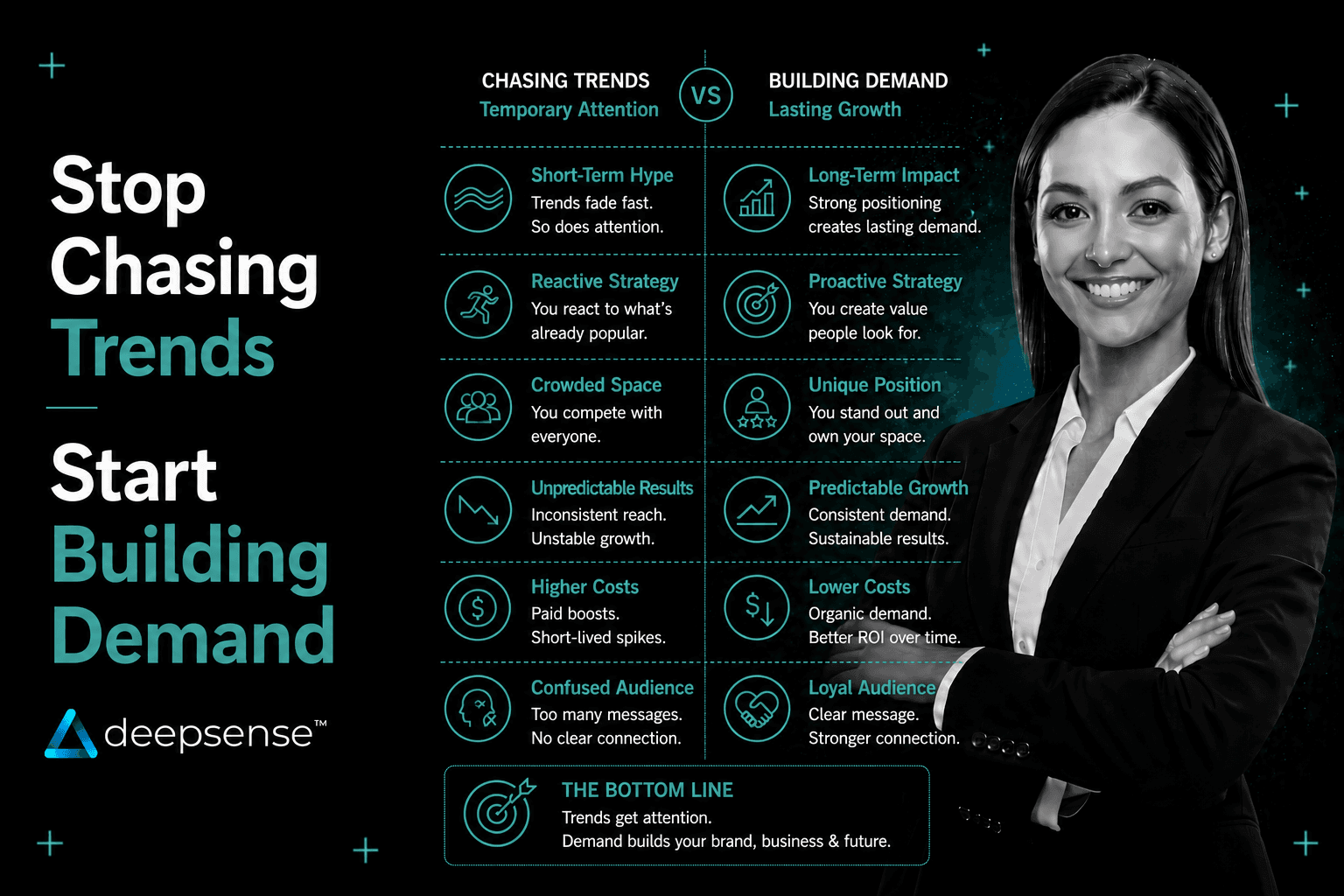
Trend Marketing vs Brand Building: The Core Difference
| Trend Marketing | Brand Demand Building |
|---|---|
| Short-term attention | Long-term recall |
| Temporary engagement | Sustainable trust |
| Viral spikes | Predictable growth |
| Chasing algorithms | Building customer memory |
| Reactive content | Strategic positioning |
One creates noise.
The other creates market presence.
Why Trend Marketing Fails Long-Term
Let’s break down why trend marketing fails when overused.
1. Trends Rarely Build Brand Identity
If your entire strategy depends on:
- trending templates,
- copied formats,
- viral audio,
your brand starts looking interchangeable.
Customers remember:
the content style
not:
your unique value.
2. Trend Audiences Often Don’t Convert
Trend-driven content attracts broad attention.
But broad attention is not always buyer intent.
You may get:
- views,
- likes,
- shares,
from people who never become customers.
This creates misleading growth signals.
3. Trends Expire Fast
A trend’s lifecycle is extremely short.
Which means:
you constantly need the next thing.
This creates marketing exhaustion.
Instead of compounding growth,
you restart visibility from zero repeatedly.
4. Trend Dependence Weakens Brand Positioning
Strong brands stand for something.
Trend-dependent brands adapt to everything.
Over time, customers stop understanding:
- what the brand actually represents,
- why it exists,
- what makes it different.
This weakens long-term perception.
The Psychology Behind Real Demand
Demand is built when customers repeatedly associate your brand with:
- trust,
- relevance,
- expertise,
- emotional connection,
- problem-solving.
This happens through consistency.
Not randomness.
The brands growing sustainably in 2026 are not necessarily the loudest.
They are the most memorable.
That is the foundation of brand growth strategy 2026.
What Sustainable Demand Generation Looks Like
A real demand generation strategy focuses on building:
- visibility,
- trust,
- recall,
- and conversion systems together.
Here’s how.
1. Create Problem-Aware Content
Instead of chasing trends daily:
create content around:
- customer pain points,
- buying hesitations,
- common mistakes,
- industry insights,
- emotional frustrations.
This creates relevance that lasts longer than trends.
2. Build Distinct Brand Positioning
Ask:
“What should people remember us for?”
Not:
“What trend should we copy today?”
Strong positioning creates:
- easier recall,
- lower customer resistance,
- better organic growth.
3. Invest in Search-Based Visibility
Trends disappear quickly.
Search intent compounds.
Brands building demand invest in:
- SEO blogs,
- YouTube search content,
- FAQ content,
- Google visibility,
- GEO/AEO optimization.
Because demand often begins when customers actively search for solutions.
4. Create Repeatable Content Pillars
Instead of random posting:
build recurring themes.
Examples:
- educational insights,
- customer psychology,
- product education,
- case studies,
- founder perspectives.
This creates familiarity.
Familiarity builds trust.
5. Build Community, Not Just Audience
Audiences consume.
Communities engage.
Brands that build demand:
- reply consistently,
- involve customers,
- encourage UGC,
- create emotional participation.
This deepens customer memory.
6. Prioritize Retention Alongside Reach
Many brands focus only on getting new people.
But demand compounds through:
- repeat buyers,
- referrals,
- loyalty,
- customer advocacy.
Retention reduces dependency on constant attention chasing.
Long-Term Business Growth Marketing Requires Patience
This is important.
Trend spikes are fast.
Demand generation is slower initially.
But over time:
- customer acquisition becomes cheaper,
- trust becomes stronger,
- organic growth increases,
- referrals improve,
- conversion resistance drops.
That’s the power of long term business growth marketing.
The Smartest Brands Use Trends Differently
This does not mean:
“Never use trends.”
It means:
use trends strategically.
Smart brands:
- adapt trends to their positioning,
- maintain consistent messaging,
- avoid losing identity,
- use trends as amplification not foundation.
Trends should support the brand.
Not replace it.
Signs You’re Chasing Trends Too Much
You may be trapped in trend dependency if:
- engagement fluctuates wildly,
- your audience doesn’t remember your core value,
- sales don’t match reach,
- content feels directionless,
- you constantly need new viral ideas.
This usually means:
attention exists,
but demand does not.
The Real Advantage of Building Demand
When demand is strong:
- customers search for you directly,
- ads become more efficient,
- conversions become easier,
- referrals increase naturally,
- competitors struggle to replace you.
Because demand creates preference.
And preference is one of the most valuable assets in marketing.
Final Takeaway
Trends can give you visibility.
But demand gives you stability.
One creates temporary spikes.
The other creates long-term growth.
That’s why brands in 2026 must stop obsessing over:
“What’s trending today?”
and start asking:
“What makes customers remember us tomorrow?”
Because the brands that survive long term are not the ones chasing attention endlessly.
They are the ones consistently building brand demand.
FAQs
1. What does building brand demand mean?
Building brand demand means creating long-term customer interest, trust, and preference so people actively seek out your brand over time.
2. What is the difference between trend marketing and brand building?
Trend marketing focuses on temporary attention, while brand building focuses on long-term trust, positioning, and customer recall.
3. Why does trend marketing fail for many businesses?
Trend marketing often creates short-term engagement without building meaningful customer loyalty, differentiation, or conversion systems.
4. How can businesses create sustainable marketing growth?
By focusing on consistent messaging, SEO, customer trust, demand generation, retention, and strategic brand positioning.
5. What is a demand generation strategy?
A demand generation strategy is a long-term marketing approach focused on creating awareness, trust, and customer interest that leads to sustainable business growth.