
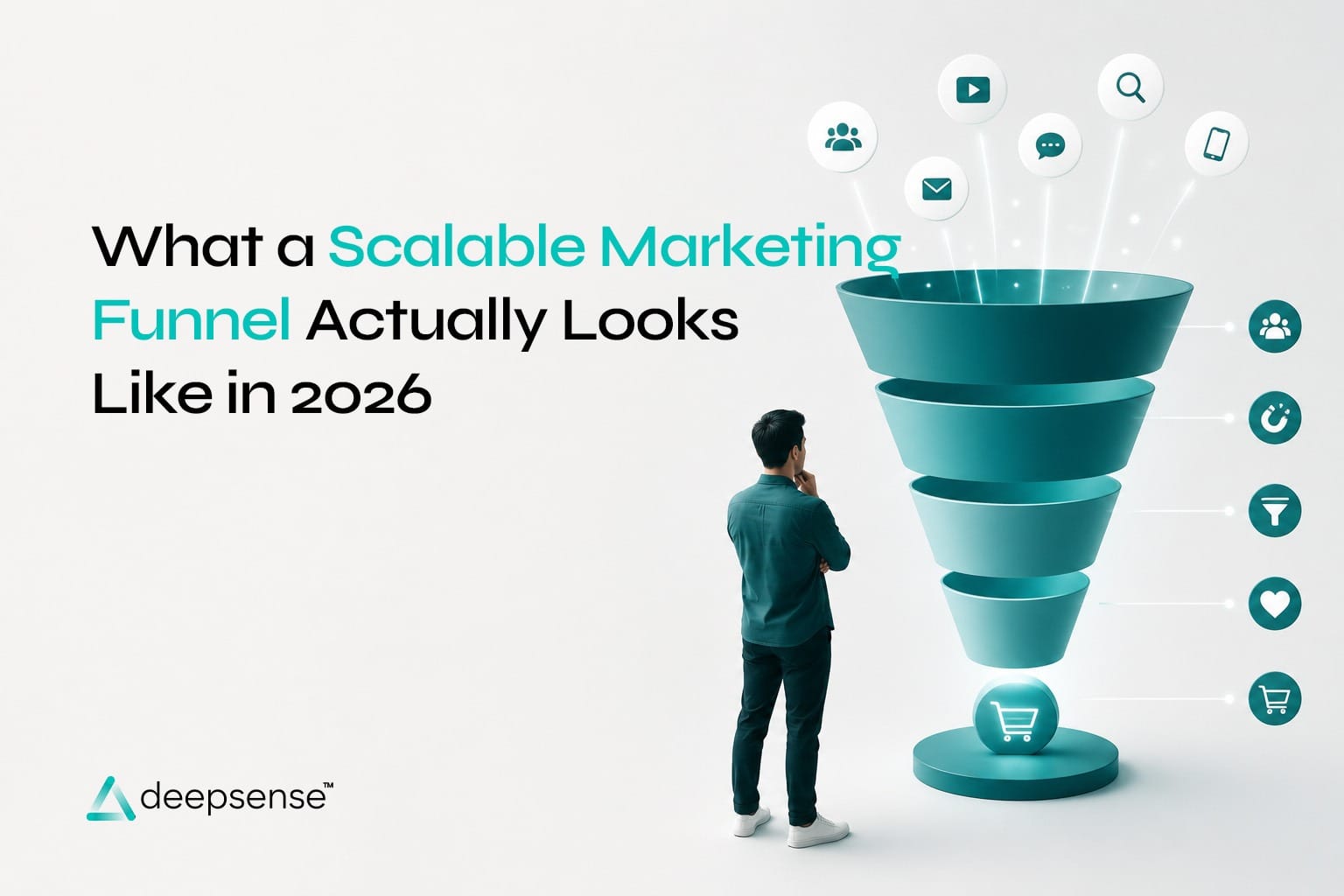
Most businesses think they have a funnel.
Ads running
Landing page live
Maybe a WhatsApp number
But that’s not a funnel.
That’s just disconnected activity.
A true scalable marketing funnel 2026 is:
Automated
Data-driven
Conversion-focused
Built to grow without breaking
This blog breaks down what a modern marketing funnel strategy actually looks like and how to build one that scales.
The Shift: Funnels Then vs Funnels in 2026
Old Funnel (Outdated):
- Linear (Awareness → Consideration → Purchase)
- One-size-fits-all
- Minimal personalization
New Funnel (2026):
- Multi-touchpoint
- Personalized journeys
- Automation-driven
- Built for retention + lifetime value
This is the evolution of the digital marketing funnel 2026.
The Core Principle of a Scalable Funnel
A scalable funnel doesn’t just generate leads
It converts, nurtures, and retains automatically
The goal is not just traffic.
The goal is:
Predictable revenue
The 5 Stages of a High-Converting Funnel Structure
1. Attention Layer (Traffic Generation)
Goal:
Attract the right audience.
Channels:
- Paid Ads (Meta, Google)
- SEO
- Social Media Content
- Influencer collaborations
Strategy:
- Hook-based creatives
- Problem-focused messaging
- Scroll-stopping content
This is the entry point of your lead generation funnel strategy.
2. Capture Layer (Lead Conversion)
Goal:
Turn visitors into leads.
Tools:
- Landing pages
- Lead magnets (guides, offers, discounts)
- Forms / WhatsApp opt-ins
Key Elements:
- Clear headline
- Strong value proposition
- One CTA
This is where most conversion funnel optimization begins.
3. Nurture Layer (Trust Building)
Goal:
Warm up cold leads.
Channels:
- Email sequences
- WhatsApp automation
- Retargeting ads
Content:
- Testimonials
- Case studies
- Educational content
This is where most why leads don’t convert problems get solved.
4. Conversion Layer (Sales Engine)
Goal:
Convert leads into paying customers.
Elements:
- Sales pages
- Offers (discounts, bundles, urgency)
- Checkout optimization
Strategy:
- Remove friction
- Add trust signals
- Simplify decision-making
This is the heart of a high converting funnel structure.
5. Retention Layer (Growth Multiplier)
Goal:
Turn customers into repeat buyers.
Channels:
- Email marketing
- Loyalty programs
- Upsell & cross-sell flows
Why It Matters:
Retention is cheaper than acquisition
This is often missing in most funnels.
The Automation Layer: What Makes Funnels Scalable
A true automated sales funnel runs without constant manual effort.
Key Automation Components:
1. Lead Capture Automation
- Instant response after form submission
- Auto WhatsApp/email confirmation
2. Follow-Up Sequences
- Drip emails
- Reminder messages
- Abandoned cart recovery
3. Behavioral Triggers
- If user clicks → send offer
- If user doesn’t buy → retarget
4. CRM Integration
- Track user journey
- Segment audience
- Personalize communication
This is where marketing automation strategy becomes powerful.
What Breaks Funnels (And Stops Scaling)
Even with traffic, funnels fail due to:
No Alignment Between Ads & Landing Page
- Mismatch messaging
- Confuses users
Weak Follow-Up System
- Leads go cold
- Missed conversions
No Data Tracking
- No idea what’s working
- No optimization
Overcomplicated Funnel
- Too many steps
- Drop-offs increase
Ignoring Retention
- No repeat purchases
- Growth becomes expensive
These are common customer journey funnel failures.
What Makes a Funnel Truly Scalable in 2026
1. Personalization at Scale
- Dynamic content
- Behavior-based messaging
2. Omnichannel Presence
Users interact across:
Your funnel must connect all touchpoints.
3. Data-Driven Optimization
Track:
- Conversion rate
- Drop-off points
- Cost per acquisition
4. Speed & Mobile Optimization
- Fast loading pages
- Mobile-first design
5. Continuous Testing
- A/B testing
- Creative experiments
- Funnel improvements
Example of a Simple Scalable Funnel
Here’s a practical structure:
- Instagram Ad →
- Landing Page →
- Lead Capture (Offer) →
- WhatsApp Automation →
- Retargeting Ads →
- Sales Page →
- Purchase →
- Email Retention Flow
This is a basic digital marketing funnel 2026 model that works across industries.
Final Takeaway
Most businesses don’t fail because of traffic.
They fail because:
Their funnel isn’t built to convert or scale
A real scalable marketing funnel 2026:
Attracts the right audience
Converts efficiently
Nurtures automatically
Retains customers
Because:
Traffic brings people
Funnels turn them into revenue
FAQs
1. What is a scalable marketing funnel in 2026?
A system that automates lead generation, nurturing, conversion, and retention to generate consistent revenue.
2. What makes a marketing funnel scalable?
Automation, data tracking, personalization, and optimized conversion stages.
3. How do I build a high converting funnel structure?
Focus on clear messaging, strong CTAs, optimized landing pages, and effective follow-up systems.
4. Why is automation important in funnels?
It reduces manual effort, improves response time, and increases conversion efficiency.
5. What are common mistakes in marketing funnels?
Poor targeting, weak landing pages, no follow-up, lack of tracking, and ignoring retention strategies