
I. The Pervasive Nature and Capabilities of AI
AI is deeply integrated into modern life through applications like smart assistants and personalized online experiences. Its core strengths lie in:
- Speed: AI performs complex calculations and analyses significantly faster than humans.
- Data Handling: It can process and make sense of massive datasets beyond human capacity.
- Pattern Recognition: AI excels at identifying intricate correlations and trends within data.
II. The Unique Aspects of Human Thinking
Human cognition possesses depth and non-computational qualities that differentiate it from AI. These include:
- Intuition: Humans have an innate ability to “just know” things without conscious reasoning, a capacity AI lacks as it relies on structured data and predefined rules.
- Emotions and Empathy: Emotions are central to human decision-making, values, and understanding context. While AI can mimic emotions, it cannot genuinely experience or comprehend them, which is crucial for ethical judgment.
- Consciousness: The subjective, internal experience of being conscious is a non-computable aspect of human thinking. Philosophers like Roger Penrose suggest non-computational processes in the human mind, arguing consciousness cannot be simulated by computers. AI systems are statistical engines that process but do not perceive or feel.
- True Creativity: Human creativity involves inspiration, combining unrelated ideas, and generating novel solutions driven by culture, motivation, and emotion. AI’s creativity is largely imitative, based on existing data.
- Common Sense and Contextual Understanding: Humans possess an intuitive understanding of the world, enabling them to grasp nuance, interpret idioms, detect sarcasm, and understand cultural references. AI struggles with these subtle aspects and implicit knowledge.
- Moral Judgment and Ethical Decision-Making: Humans can weigh values and make ethical trade-offs in ambiguous situations. AI can be programmed to flag ethical concerns but lacks genuine ethical reasoning or the ability to justify foundational ethical frameworks.
- Deep Reflection: Human thinking involves pondering, allowing ideas to “simmer” and integrate emotionally over time, cultivating wisdom. AI does not ponder in this human sense.
III. The AI-Human Crossover: Collaboration and Augmented Intelligence
There are overlaps where AI and human intelligence intersect, such as pattern recognition. Newer AI learning mechanisms are beginning to resemble human learning. The future outlook is not AI replacement but “augmented intelligence,” where AI acts as a tool to enhance human capabilities.
- AI handles the mundane: Automating repetitive, data-intensive tasks.
- Humans provide the depth: Focusing on creativity, critical thinking, emotional intelligence, and ethical consideration.
Examples of this collaboration include:
- Healthcare: AI predicts health risks and assists diagnostics; doctors provide empathetic, patient-centric care.
- Creative Industries: AI generates initial ideas; humans refine and imbue them with unique vision and emotion.
- Marketing: AI segments customers and suggests strategies; humans craft resonant campaigns using psychology and culture.
Effective collaboration requires clear roles, transparency in AI decision-making, continuous training, and human oversight.
IV. Controversies, Concerns, and AI Governance
The rise of AI presents challenges:
- Workforce Impact: While AI may automate some jobs, experts predict it will create new ones requiring different skills. Over-reliance on AI could diminish human critical thinking.
- Ethical Considerations:
- Algorithmic Bias: Biased training data leads to discriminatory AI outputs.
- Privacy and Security: AI systems collect vast personal data, raising privacy concerns.
- Transparency and Explainability: Users need to understand how AI makes decisions.
- Concentration of Power: Concerns exist about a few companies controlling foundational AI models.
- Algorithmic Bias: Biased training data leads to discriminatory AI outputs.
Organizations like UNESCO are establishing global standards and ethical principles for AI, emphasizing a human-rights-centered approach focusing on proportionality, safety, privacy, fairness, transparency, and human oversight.
V. The Future of Human Cognition in an AI World
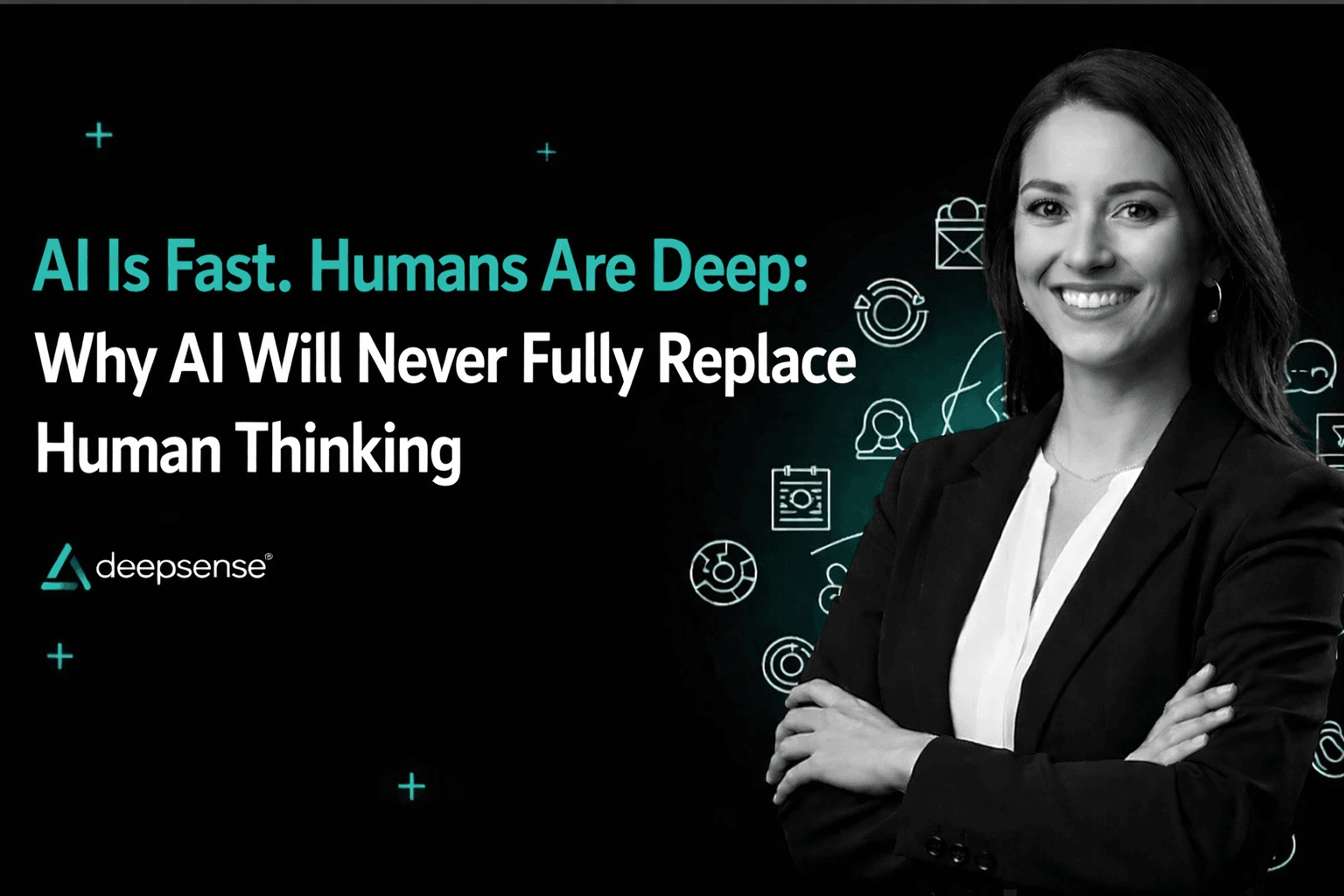
AI will transform “thinking labor” but will not replace human thinking in its entirety, particularly its deep, non-computational facets. Predictions of AI becoming a “superhuman coder” do not equate to becoming a “superhuman human.” The future is about collaboration, leveraging human strengths like creativity, empathy, critical thinking, and the ability to “be.” The most valuable asset remains the depth of humanity.
Frequently Asked Questions (FAQs)
Q1: What is the fundamental difference between AI and human thinking?
A1: AI excels at speed and data processing; human thinking possesses unique depth through intuition, emotion, consciousness, creativity, common sense, moral judgment, and reflection, which AI cannot genuinely replicate.
Q2: Can AI ever truly be creative?
A2: AI can generate imitative creative content by analyzing existing data. Human creativity involves true inspiration, abstract conceptualization, and innovation driven by unique factors.
Q3: Will AI replace all human jobs?
A3: AI will automate some tasks and displace some jobs but will also create new ones. The goal is augmented intelligence, where AI enhances human capabilities for complex, creative, and emotionally intelligent roles.
Q4: What are the biggest limitations of AI?
A4: Key limitations include the inability to possess genuine intuition, experience emotions or empathy, achieve true consciousness, exhibit common sense in ambiguous situations, make autonomous moral judgments, or engage in deep reflection.
Q5: How can humans and AI work together effectively?
A5: Effective collaboration (augmented intelligence) involves AI handling data-intensive tasks, allowing humans to apply their strengths in creativity, critical thinking, emotional intelligence, and ethical reasoning to interpret AI insights and make strategic decisions.
Q6: What is “augmented intelligence”?
A6: Augmented intelligence is a concept where AI acts as a tool to enhance human capabilities, automating routine tasks and freeing humans for higher-order cognitive functions.
Q7: How does AI learn, and what are the implications for bias?
A7: AI learns from the data it is fed. If this data contains biases, the AI’s outputs will also be biased, leading to discriminatory outcomes.
Q8: Why is transparency and explainability important in AI?
A8: Transparency and explainability are crucial for users to understand how AI arrives at its decisions, fostering trust and accountability.
Q9: What role do organizations like UNESCO play in AI development?
A9: Organizations like UNESCO establish global standards and ethical principles for AI, promoting a human-rights-centered approach to ensure responsible development and deployment.
Q10: What is the most valuable asset for humans in the age of AI?
A10: The depth of humanity, encompassing creativity, empathy, critical thinking, and the unique ability to simply “be,” is considered the most valuable asset.